Virginia Commonwealth University.
Am J Pol Sci. 2012;56(1):34-51. doi: 10.1111/j.1540-5907.2011.00568.x.
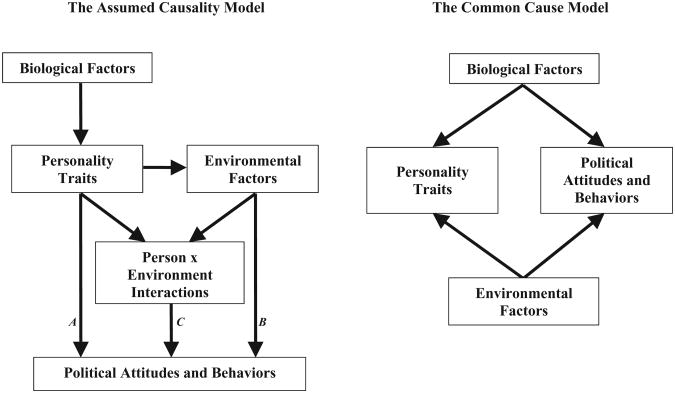
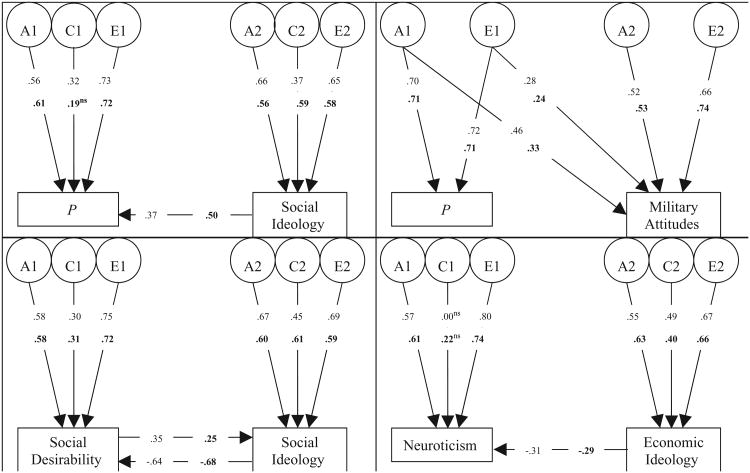
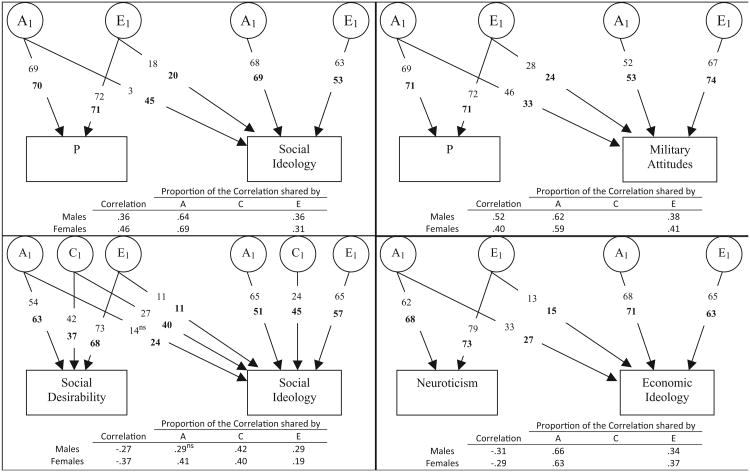
The assumption in the personality and politics literature is that a person's personality motivates them to develop certain political attitudes later in life. This assumption is founded on the simple correlation between the two constructs and the observation that personality traits are genetically influenced and develop in infancy, whereas political preferences develop later in life. Work in psychology, behavioral genetics, and recently political science, however, has demonstrated that political preferences also develop in childhood and are equally influenced by genetic factors. These findings cast doubt on the assumed causal relationship between personality and politics. Here we test the causal relationship between personality traits and political attitudes using a direction of causation structural model on a genetically informative sample. The results suggest that personality traits do not cause people to develop political attitudes; rather, the correlation between the two is a function of an innate common underlying genetic factor.
人格与政治文献中的假设是,一个人的人格促使他们在以后的生活中形成某些政治态度。这一假设基于这两个结构之间的简单相关性,以及人格特质受遗传影响并在婴儿期发展,而政治偏好则在以后的生活中发展的观察结果。然而,心理学、行为遗传学和最近政治学的研究表明,政治偏好也在儿童时期发展,并受到遗传因素的同等影响。这些发现使人对人格与政治之间假定的因果关系产生了怀疑。在这里,我们使用遗传信息丰富的样本中的因果关系结构模型来测试人格特质和政治态度之间的因果关系。结果表明,人格特质不会导致人们形成政治态度;相反,两者之间的相关性是一个内在共同遗传因素的函数。