Center for Health and Social Economics CHESS, National Institute for Health and Welfare, Helsinki, Finland.
Acta Orthop. 2012 Apr;83(2):190-6. doi: 10.3109/17453674.2012.672089. Epub 2012 Mar 8.
Factors associated with malpractice claims are poorly understood. Knowledge of these factors could help to improve patient safety. We investigated whether patient characteristics and hospital volume affect claims and compensations following total hip arthroplasty (THA) and knee arthroplasty (TKA) in a no-fault scheme.
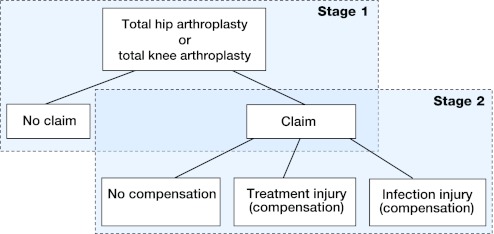
A retrospective registry-based study was done on 16,646 THAs and 17,535 TKAs performed in Finland from 1998 through 2003. First, the association between patient characteristics-e.g., age, sex, comorbidity, prosthesis type-and annual hospital volume with filing of a claim was analyzed by logistic regression. Then, multinomial logistic regression was applied to analyze the association between these same factors and receipt of compensation.
For THA and TKA, patients over 65 years of age were less likely to file a claim than patients under 65 (OR = 0.57, 95% CI: 0.46-0.72 and OR = 0.65, CI: 0.53-0.80, respectively), while patients with increased comorbidity were more likely to file a claim (OR = 1.17, CI: 1.04-1.31 and OR = 1.14, CI: 1.03-1.26, respectively). Following THA, male sex and cemented prosthesis reduced the odds of a claim (OR = 0.74, CI: 0.60-0.91 and OR = 0.77, CI: 0.60-0.99, respectively) and volume of between 200 and 300 operations increased the odds of a claim (OR = 1.29, CI: 1.01-1.64). Following TKA, a volume of over 300 operations reduced the probability of compensation for certain injury types (RRR = 0.24, CI: 0.08-0.72).
Centralization of TKA to hospitals with higher volume may reduce the rate of compensable patient injuries. Furthermore, more attention should be paid to equal opportunities for patients to file a claim and obtain compensation.
医疗事故索赔的相关因素尚未明确。了解这些因素有助于提高患者安全。本研究旨在探讨在无过错方案下,全髋关节置换术(THA)和膝关节置换术(TKA)后,患者特征和医院手术量是否会影响索赔和赔偿。
本研究是一项回顾性基于注册的研究,纳入了芬兰 1998 年至 2003 年间实施的 16646 例 THA 和 17535 例 TKA。首先,采用逻辑回归分析患者特征(如年龄、性别、合并症、假体类型)和年度医院手术量与索赔之间的关系。然后,采用多项逻辑回归分析这些相同因素与获得赔偿之间的关系。
与 65 岁以下患者相比,65 岁以上患者 THA(比值比[OR] = 0.57,95%置信区间[CI]:0.46-0.72 和 OR = 0.65,CI:0.53-0.80)和 TKA(OR = 0.57,95% CI:0.46-0.72 和 OR = 0.65,CI:0.53-0.80)的索赔可能性较低,而合并症较多的患者更有可能提出索赔(OR = 1.17,CI:1.04-1.31 和 OR = 1.14,CI:1.03-1.26)。THA 术后,男性和骨水泥假体降低了索赔的可能性(OR = 0.74,CI:0.60-0.91 和 OR = 0.77,CI:0.60-0.99),而手术量在 200 至 300 例之间增加了索赔的可能性(OR = 1.29,CI:1.01-1.64)。TKA 术后,手术量超过 300 例降低了某些损伤类型获得赔偿的概率(相对危险度降低[RRR] = 0.24,CI:0.08-0.72)。
将 TKA 集中于手术量大的医院可能会降低可赔偿患者损伤的发生率。此外,应更加关注患者提出索赔和获得赔偿的平等机会。