Department of Pathology, University of California-Los Angeles, Los Angeles, CA, USA.
Arterioscler Thromb Vasc Biol. 2012 May;32(5):1246-54. doi: 10.1161/ATVBAHA.111.241257. Epub 2012 Mar 8.
Atherosclerosis is a chronic inflammatory disease initiated by monocyte recruitment and retention in the vessel wall. An important mediator of monocyte endothelial interaction is the chemokine interleukin (IL)-8. The oxidation products of phospholipids, including oxidized 1-palmitoyl-2-arachidonyl-sn-glycerol-3-phosphocholine (Ox-PAPC), accumulate in atherosclerotic lesions and strongly induce IL-8 in human aortic endothelial cells (HAECs). The goal of this study was to identify the proximal events leading to induction of IL-8 by Ox-PAPC in vascular endothelial cells.
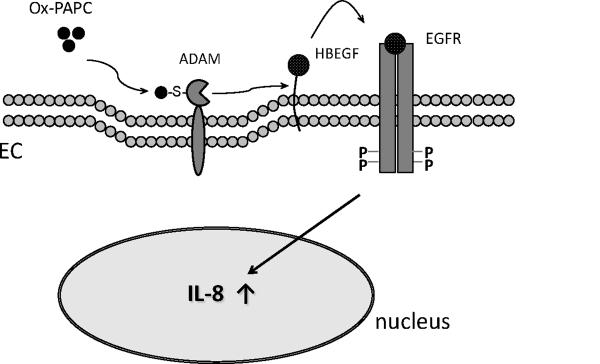
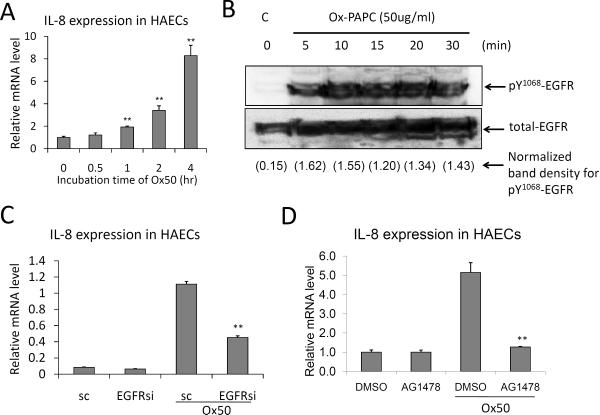
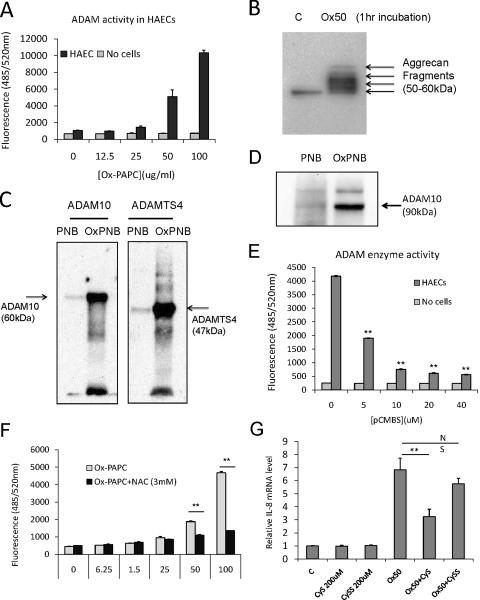
In a systems genetics analysis of HAECs isolated from 96 different human donors, we showed that heparin-binding EGF-like growth factor (HBEGF) transcript levels are strongly correlated to IL-8 induction by Ox-PAPC. The silencing and overexpression of HBEGF in HAECs confirmed the role of HBEGF in regulating IL-8 expression. HBEGF has been shown to be stored in an inactive form and activation is dependent on processing by a dysintegrin and metalloproteinases (ADAM) to a form that can activate the epidermal growth factor (EGF) receptor. Ox-PAPC was shown to rapidly induce HBEGF processing and EGF receptor activation in HAECs. Using siRNA we identified 3 ADAMs that regulate IL-8 induction and directly demonstrated that Ox-PAPC increases ADAM activity in the cells using a substrate cleavage assay. We provide evidence for one mechanism of Ox-PAPC activation of ADAM involving covalent binding of Ox-PAPC to cysteine on ADAM. Free thiol cysteine analogs showed inhibition of IL-8 induction by Ox-PAPC, and both a cysteine analog and a cell surface thiol blocker strongly inhibited ADAM activity induction by Ox-PAPC. Using microarray analyses, we determined that this ADAM pathway may regulate at least 30% of genes induced by Ox-PAPC in HAECs.
This study is the first report demonstrating a role for the ADAM-HBEGF-EGF receptor axis in Ox-PAPC induction of IL-8 in HAECs. These studies highlight a role for specific ADAMs as initiators of Ox-PAPC action and provide evidence for a role of covalent interaction of Ox-PAPC in activation of ADAMs.
动脉粥样硬化是一种由单核细胞募集和保留在血管壁中引发的慢性炎症性疾病。单核细胞内皮相互作用的一个重要介质是趋化因子白细胞介素(IL)-8。磷脂的氧化产物,包括氧化 1-棕榈酰-2-花生四烯酰基-sn-甘油-3-磷酸胆碱(Ox-PAPC),在动脉粥样硬化病变中积累,并强烈诱导人主动脉内皮细胞(HAECs)中的 IL-8。本研究的目的是确定导致 Ox-PAPC 在血管内皮细胞中诱导 IL-8 的近端事件。
在对从 96 个不同的人类供体分离的 HAECs 进行系统遗传学分析中,我们表明肝素结合表皮生长因子样生长因子(HBEGF)转录物水平与 Ox-PAPC 诱导的 IL-8 强烈相关。HBEGF 在 HAECs 中的沉默和过表达证实了 HBEGF 在调节 IL-8 表达中的作用。HBEGF 已被证明以无活性形式储存,并且激活依赖于整联蛋白和金属蛋白酶(ADAM)的加工,形成可以激活表皮生长因子(EGF)受体的形式。Ox-PAPC 被证明可以快速诱导 HAECs 中 HBEGF 的加工和 EGF 受体的激活。使用 siRNA,我们鉴定了 3 种调节 IL-8 诱导的 ADAMs,并直接证明 Ox-PAPC 通过底物切割测定增加了细胞中的 ADAM 活性。我们提供了 Ox-PAPC 激活 ADAM 的一种机制的证据,涉及 Ox-PAPC 与 ADAM 上的半胱氨酸的共价结合。游离巯基半胱氨酸类似物显示抑制 Ox-PAPC 诱导的 IL-8 诱导,并且半胱氨酸类似物和细胞表面巯基阻断剂强烈抑制 Ox-PAPC 诱导的 ADAM 活性诱导。使用微阵列分析,我们确定该 ADAM 途径可能调节 Ox-PAPC 在 HAECs 中诱导的至少 30%的基因。
本研究首次报道了 ADAM-HBEGF-EGF 受体轴在 Ox-PAPC 诱导 HAECs 中 IL-8 中的作用。这些研究强调了特定 ADAMs 作为 Ox-PAPC 作用起始物的作用,并提供了 Ox-PAPC 在激活 ADAMs 中发挥共价相互作用的证据。