Department of Nutritional Sciences, University of Arizona, Tucson, AZ, USA.
Obesity (Silver Spring). 2012 Jul;20(7):1419-25. doi: 10.1038/oby.2012.62. Epub 2012 Mar 8.
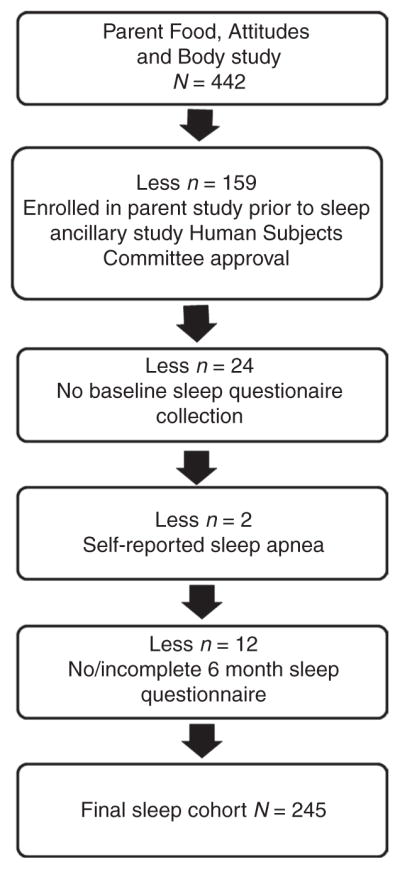
Evidence suggests that individuals who report fewer total hours of sleep are more likely to be overweight or obese. Few studies have prospectively evaluated weight-loss success in relation to reported sleep quality and quantity. This analysis sought to determine the association between sleep characteristics and weight loss in overweight or obese women enrolled in a randomized clinical trial of a weight-loss program. We hypothesized that in overweight/obese women, significant weight loss would be demonstrated more frequently in women who report a better Pittsburgh Sleep Quality Index (PSQI) Global Score or sleep >7 h/night as compared to women who report a worse PSQI score or sleep ≤7 h/night. Women of ages 45.5 ± 10.4 (mean ± SD) years and BMI of 33.9 ± 3.3 (n = 245) were randomized and completed PSQI at baseline and 6 months; 198 had weight change assessed through 24 months. At baseline, 52.7% reported PSQI scores above the clinical cutoff of 5. Better subjective sleep quality increased the likelihood of weight-loss success by 33% (relative risk (RR), 0.67; 95% confidence interval (CI), 0.52-0.86), as did sleeping >7 h/night. A worse Global Score at 6 months was associated with a 28% lower likelihood of continued successful weight loss at 18 months, but unassociated by 24 months. These results suggest that sleep quality and quantity may contribute to weight loss in intervention-based studies designed to promote weight control in overweight/obese adult women.
有证据表明,报告睡眠时间较少的个体更容易超重或肥胖。很少有前瞻性研究评估过睡眠质量和数量与减肥成功的关系。本分析旨在确定超重或肥胖女性的睡眠特征与减肥计划随机临床试验中减肥的相关性。我们假设,在超重/肥胖女性中,与报告 PSQI 评分较差或睡眠≤7 小时/晚的女性相比,报告 PSQI 全球评分较好或睡眠>7 小时/晚的女性减肥效果更为显著。年龄为 45.5 ± 10.4(平均值±标准差)岁,BMI 为 33.9 ± 3.3(n = 245)的女性被随机分组并在基线和 6 个月时完成 PSQI 评估;198 人通过 24 个月评估体重变化。基线时,52.7%的人 PSQI 评分超过 5 的临床临界值。更好的主观睡眠质量使减肥成功的可能性增加了 33%(相对风险 (RR),0.67;95%置信区间 (CI),0.52-0.86),睡眠时间>7 小时/晚也是如此。6 个月时的全球评分较差与 18 个月时持续成功减肥的可能性降低 28%相关,但到 24 个月时则没有相关性。这些结果表明,睡眠质量和数量可能有助于干预性研究中减肥,这些研究旨在促进超重/肥胖成年女性的体重控制。