Hasenkamp Wendy, Barsalou Lawrence W
Department of Psychology, Emory University Atlanta, GA, USA.
Front Hum Neurosci. 2012 Mar 1;6:38. doi: 10.3389/fnhum.2012.00038. eCollection 2012.
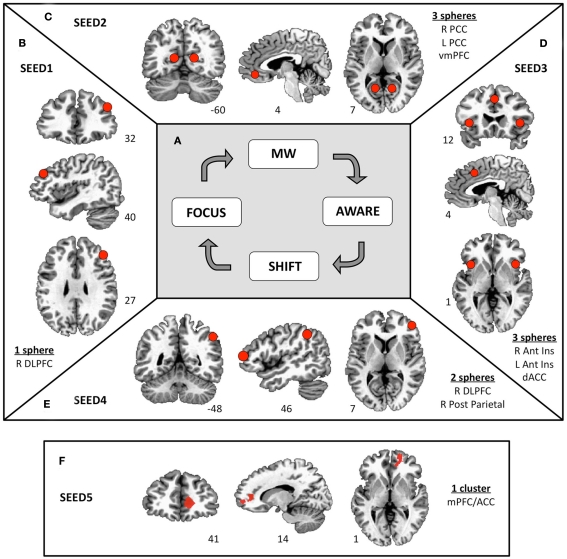
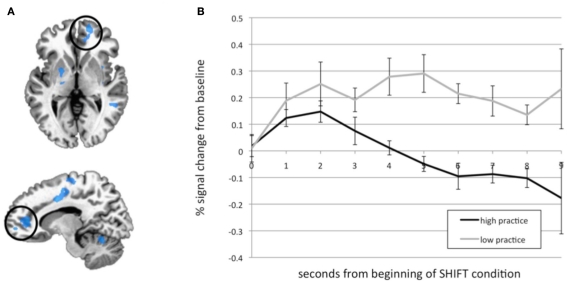
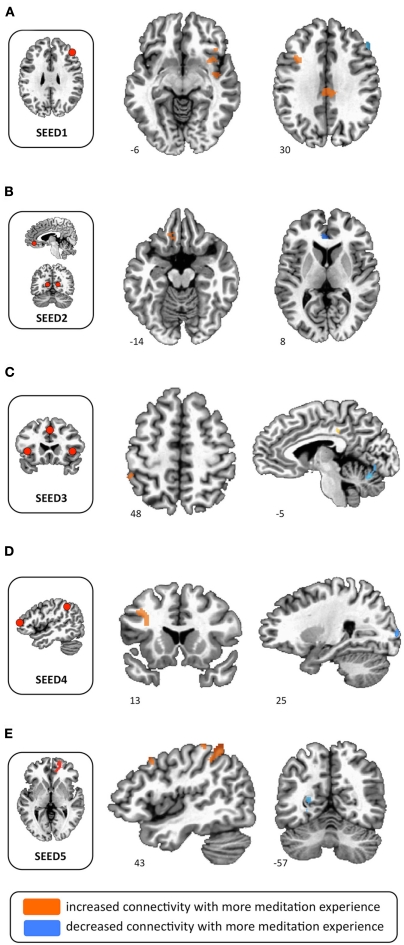
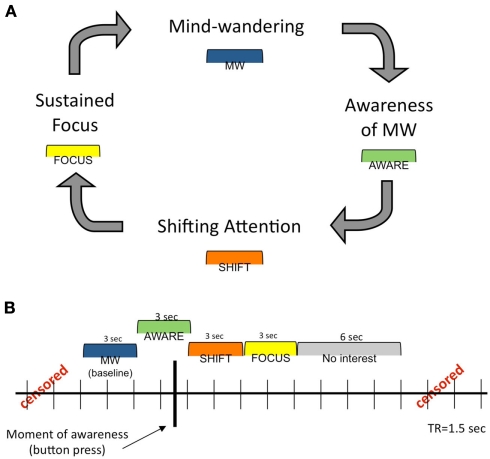
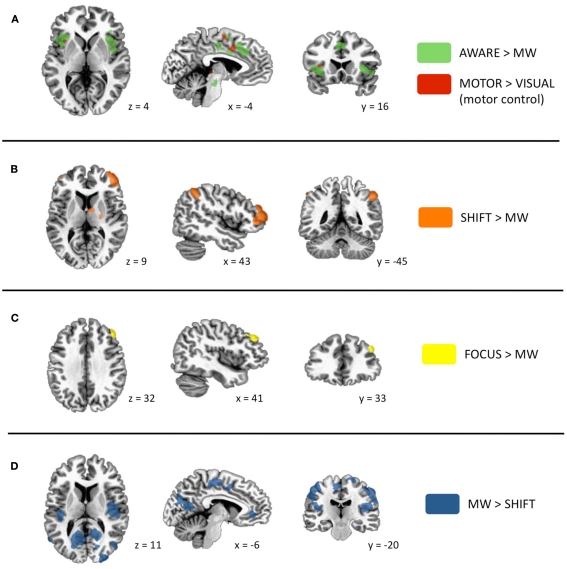
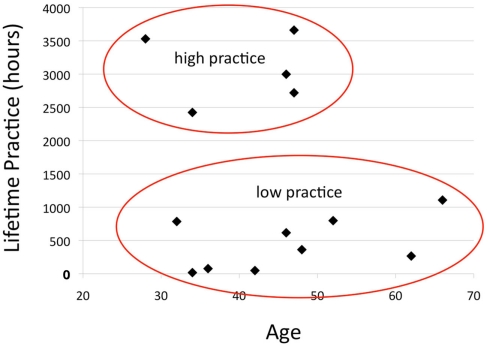
This study sought to examine the effect of meditation experience on brain networks underlying cognitive actions employed during contemplative practice. In a previous study, we proposed a basic model of naturalistic cognitive fluctuations that occur during the practice of focused attention meditation. This model specifies four intervals in a cognitive cycle: mind wandering (MW), awareness of MW, shifting of attention, and sustained attention. Using subjective input from experienced practitioners during meditation, we identified activity in salience network regions during awareness of MW and executive network regions during shifting and sustained attention. Brain regions associated with the default mode were active during MW. In the present study, we reasoned that repeated activation of attentional brain networks over years of practice may induce lasting functional connectivity changes within relevant circuits. To investigate this possibility, we created seeds representing the networks that were active during the four phases of the earlier study, and examined functional connectivity during the resting state in the same participants. Connectivity maps were then contrasted between participants with high vs. low meditation experience. Participants with more meditation experience exhibited increased connectivity within attentional networks, as well as between attentional regions and medial frontal regions. These neural relationships may be involved in the development of cognitive skills, such as maintaining attention and disengaging from distraction, that are often reported with meditation practice. Furthermore, because altered connectivity of brain regions in experienced meditators was observed in a non-meditative (resting) state, this may represent a transference of cognitive abilities "off the cushion" into daily life.
本研究旨在考察冥想体验对静思练习中所运用的认知行为背后的脑网络的影响。在之前的一项研究中,我们提出了一个在专注注意力冥想练习过程中出现的自然主义认知波动的基本模型。该模型在一个认知周期中指定了四个阶段:思绪游荡(MW)、对思绪游荡的觉察、注意力转移以及持续注意力。利用冥想期间有经验的练习者的主观反馈,我们确定了在对思绪游荡的觉察期间突显网络区域的活动,以及在注意力转移和持续注意力期间执行网络区域的活动。与默认模式相关的脑区在思绪游荡期间处于活跃状态。在本研究中,我们推断多年练习中注意力脑网络的反复激活可能会在相关回路中诱导持久的功能连接变化。为了探究这种可能性,我们创建了代表早期研究四个阶段中活跃网络的种子,并在相同参与者的静息状态下检查功能连接。然后对比了冥想经验丰富程度不同的参与者之间的连接图谱。冥想经验更丰富的参与者在注意力网络内部以及注意力区域与内侧额叶区域之间表现出更强的连接。这些神经关系可能参与了认知技能的发展,比如在冥想练习中经常被报告的保持注意力和从分心状态中脱离出来的能力。此外,由于在有经验的冥想者中观察到的脑区连接改变是在非冥想(静息)状态下出现的,这可能代表着认知能力从“坐垫上”转移到了日常生活中。