Department of Microbiology and Immunology, University of Melbourne, Melbourne, Victoria, Australia.
PLoS One. 2012;7(3):e32431. doi: 10.1371/journal.pone.0032431. Epub 2012 Mar 5.
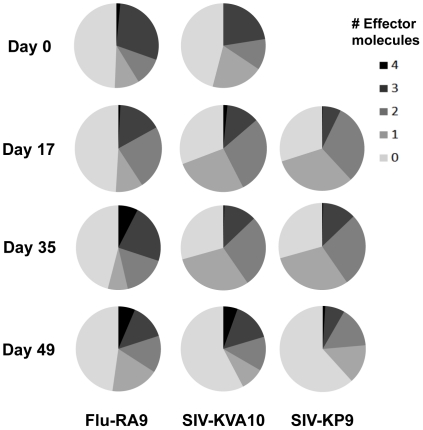
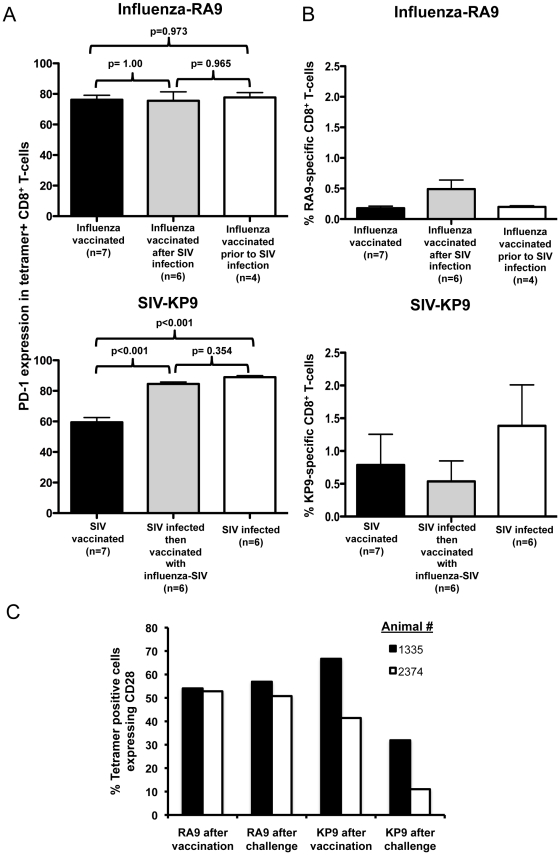
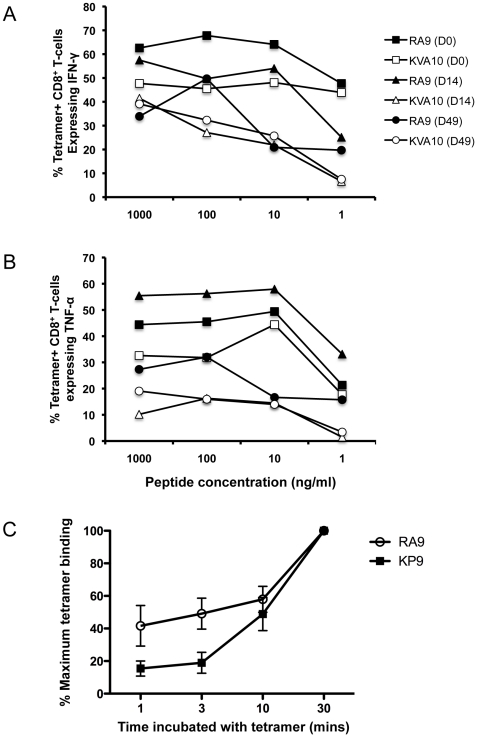
Macaques are a potentially useful non-human primate model to compare memory T-cell immunity to acute virus pathogens such as influenza virus and effector T-cell responses to chronic viral pathogens such as SIV. However, immunological reagents to study influenza CD8(+) T-cell responses in the macaque model are limited. We recently developed an influenza-SIV vaccination model of pigtail macaques (Macaca nemestrina) and used this to study both influenza-specific and SIV-specific CD8(+) T-cells in 39 pigtail macaques expressing the common Mane-A10(+) (Mane-A01084) MHC-I allele. To perform comparative studies between influenza and SIV responses a common influenza nucleoprotein-specific CD8(+) T-cell response was mapped to a minimal epitope (termed RA9), MHC-restricted to Mane-A*10 and an MHC tetramer developed to study this response. Influenza-specific memory CD8(+) T-cell response maintained a highly functional profile in terms of multitude of effector molecule expression (CD107a, IFN-γ, TNF-α, MIP-1β and IL-2) and showed high avidity even in the setting of SIV infection. In contrast, within weeks following active SIV infection, SIV-specific CD8(+) effector T-cells expressed fewer cytokines/degranulation markers and had a lower avidity compared to influenza specific CD8(+) T-cells. Further, the influenza specific memory CD8 T-cell response retained stable expression of the exhaustion marker programmed death-marker-1 (PD-1) and co-stimulatory molecule CD28 following infection with SIV. This contrasted with the effector SIV-specific CD8(+) T-cells following SIV infection which expressed significantly higher amounts of PD-1 and lower amounts of CD28. Our results suggest that strategies to maintain a more functional CD8(+) T-cell response, profile may assist in controlling HIV disease.
猕猴是一种潜在有用的非人类灵长类动物模型,可用于比较记忆 T 细胞对急性病毒病原体(如流感病毒)的免疫反应和对慢性病毒病原体(如 SIV)的效应 T 细胞反应。然而,用于研究猕猴模型中流感 CD8(+) T 细胞反应的免疫试剂有限。我们最近开发了一种长鼻猴(Macaca nemestrina)的流感-SIV 疫苗接种模型,并利用该模型在 39 只表达常见 Mane-A10(+)(Mane-A01084)MHC-I 等位基因的长鼻猴中研究了流感特异性和 SIV 特异性 CD8(+) T 细胞。为了在流感和 SIV 反应之间进行比较研究,将一个共同的流感核蛋白特异性 CD8(+) T 细胞反应映射到一个最小的表位(称为 RA9)上,该表位受 Mane-A*10 限制,并开发了 MHC 四聚体来研究该反应。流感特异性记忆 CD8(+) T 细胞反应在表达多种效应分子(CD107a、IFN-γ、TNF-α、MIP-1β 和 IL-2)方面保持高度功能性,即使在 SIV 感染的情况下,其亲和力也很高。相比之下,在 SIV 感染后的数周内,SIV 特异性 CD8(+)效应 T 细胞表达的细胞因子/脱颗粒标记物较少,且亲和力低于流感特异性 CD8(+) T 细胞。此外,在感染 SIV 后,流感特异性记忆 CD8 T 细胞反应仍保持程序性死亡标记-1(PD-1)衰竭标记和共刺激分子 CD28 的稳定表达。相比之下,在感染 SIV 后,SIV 特异性效应 CD8(+) T 细胞表达的 PD-1 明显更高,而 CD28 的表达则更低。我们的研究结果表明,维持更具功能性的 CD8(+) T 细胞反应的策略可能有助于控制 HIV 疾病。