Department of Molecular Physiology and Biophysics, Roy and Lucille J Carver College of Medicine, University of Iowa, Iowa City, Iowa, United States of America.
PLoS One. 2012;7(3):e32878. doi: 10.1371/journal.pone.0032878. Epub 2012 Mar 5.
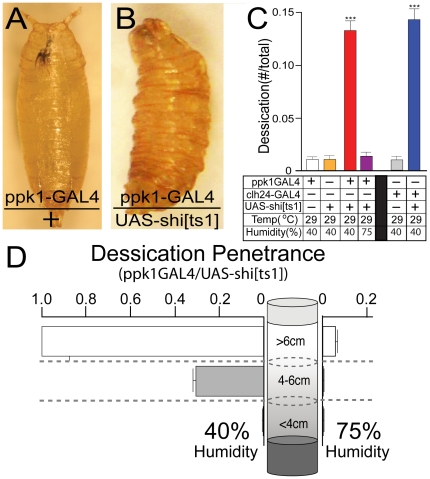
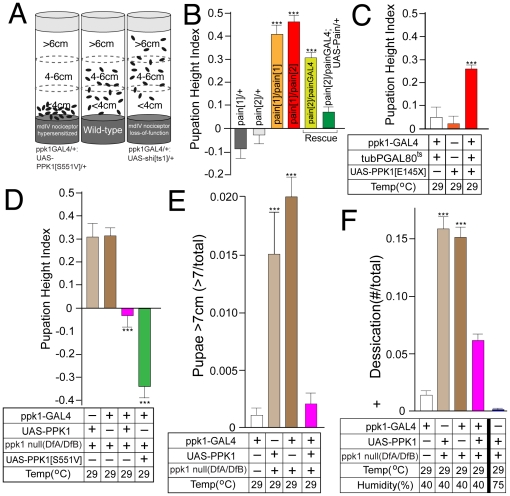
A subset of sensory neurons embedded within the Drosophila larval body wall have been characterized as high-threshold polymodal nociceptors capable of responding to noxious heat and noxious mechanical stimulation. They are also sensitized by UV-induced tissue damage leading to both thermal hyperalgesia and allodynia very similar to that observed in vertebrate nociceptors. We show that the class IV multiple-dendritic(mdIV) nociceptors are also required for a normal larval aversion to locomotion on to a dry surface environment. Drosophila melanogaster larvae are acutely susceptible to desiccation displaying a strong aversion to locomotion on dry surfaces severely limiting the distance of movement away from a moist food source. Transgenic inactivation of mdIV nociceptor neurons resulted in larvae moving inappropriately into regions of low humidity at the top of the vial reflected as an increased overall pupation height and larval desiccation. This larval lethal desiccation phenotype was not observed in wild-type controls and was completely suppressed by growth in conditions of high humidity. Transgenic hyperactivation of mdIV nociceptors caused a reciprocal hypersensitivity to dry surfaces resulting in drastically decreased pupation height but did not induce the writhing nocifensive response previously associated with mdIV nociceptor activation by noxious heat or harsh mechanical stimuli. Larvae carrying mutations in either the Drosophila TRP channel, Painless, or the degenerin/epithelial sodium channel subunit Pickpocket1(PPK1), both expressed in mdIV nociceptors, showed the same inappropriate increased pupation height and lethal desiccation observed with mdIV nociceptor inactivation. Larval aversion to dry surfaces appears to utilize the same or overlapping sensory transduction pathways activated by noxious heat and harsh mechanical stimulation but with strikingly different sensitivities and disparate physiological responses.
在果蝇幼虫体壁中嵌入的一组感觉神经元已被鉴定为高阈值多模态伤害感受器,能够对有害热和有害机械刺激作出反应。它们还被紫外线诱导的组织损伤敏化,导致热痛觉过敏和痛觉过敏,与脊椎动物伤害感受器观察到的非常相似。我们表明,IV 类多树突(mdIV)伤害感受器对于正常的幼虫回避在干燥表面环境中运动也是必需的。黑腹果蝇幼虫对脱水非常敏感,表现出对干燥表面运动的强烈厌恶,严重限制了它们远离潮湿食物源的运动距离。mdIV 伤害感受器神经元的转基因失活导致幼虫不适当地移动到小瓶顶部的低湿度区域,表现为整体化蛹高度增加和幼虫脱水。在野生型对照中没有观察到这种幼虫致命脱水表型,并且在高湿度条件下生长完全抑制了这种表型。mdIV 伤害感受器的转基因过度激活导致对干燥表面的反应过度敏感,导致化蛹高度急剧下降,但不会引起以前与有害热或剧烈机械刺激激活 mdIV 伤害感受器相关的扭曲防御反应。在果蝇 TRP 通道 Painless 或上皮钠通道亚基 Pickpocket1(PPK1)中携带突变的幼虫,这两种基因都在 mdIV 伤害感受器中表达,表现出与 mdIV 伤害感受器失活相同的不适当增加化蛹高度和致命脱水。幼虫对干燥表面的回避似乎利用了与有害热和剧烈机械刺激相同或重叠的感觉转导途径,但敏感性和生理反应截然不同。