Institut für Physikalische Chemie, Lehrstuhl für Molekulare Physikalische Chemie, Heinrich-Heine-Universität, Universitätsstraße 1, Geb. 26.32.02, 40225 Düsseldorf, Germany.
Chemphyschem. 2012 Mar;13(4):1036-53. doi: 10.1002/cphc.201100897. Epub 2012 Mar 7.
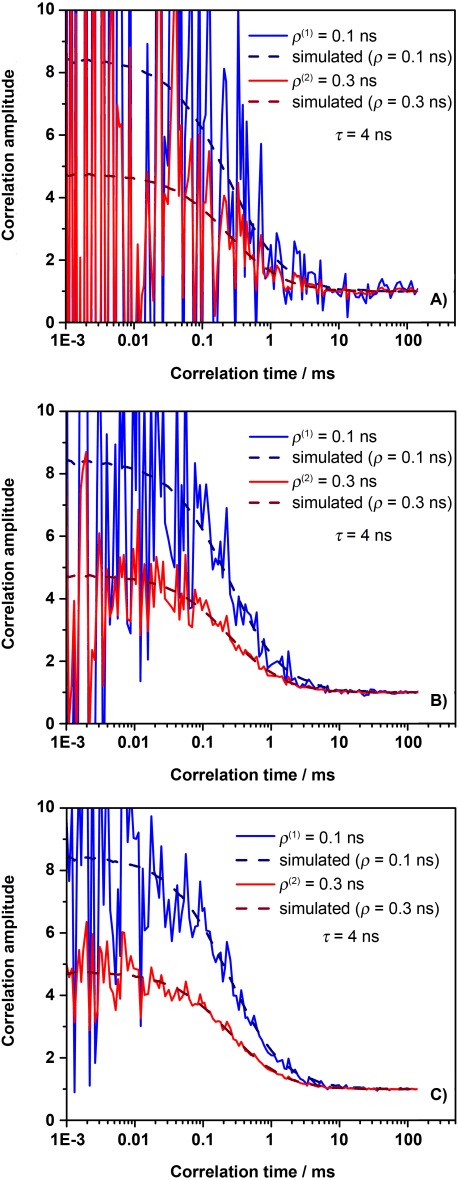
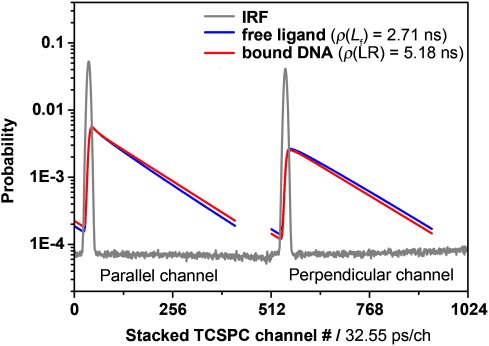
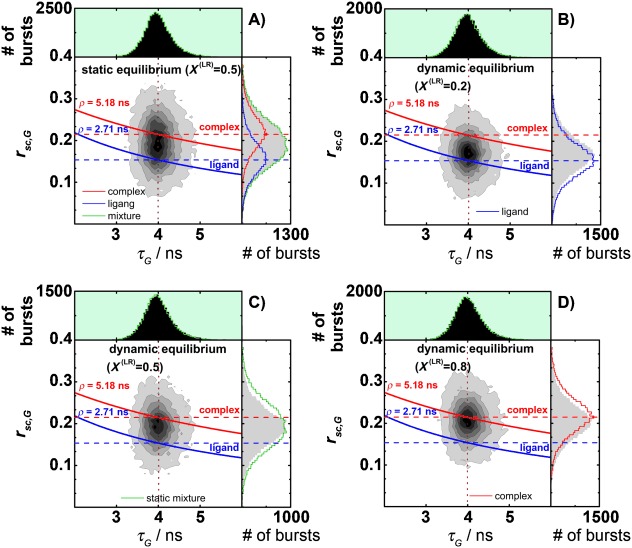
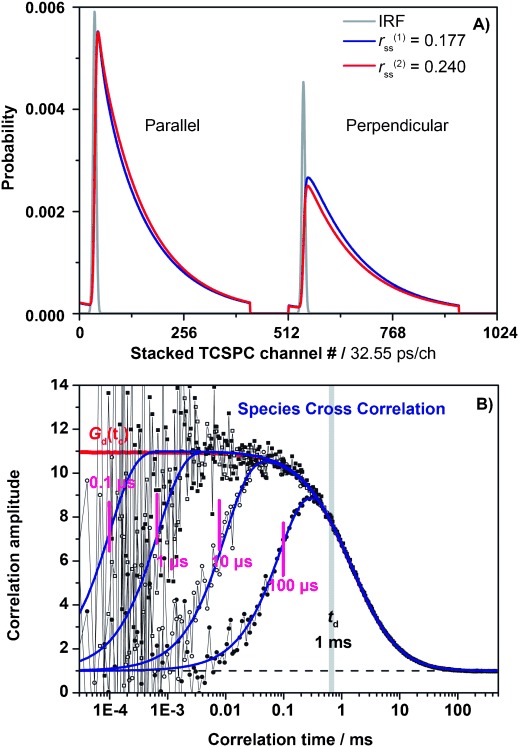
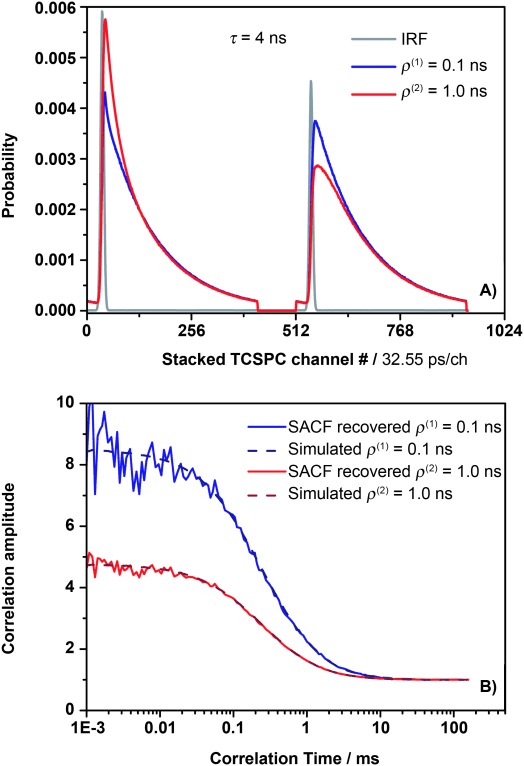
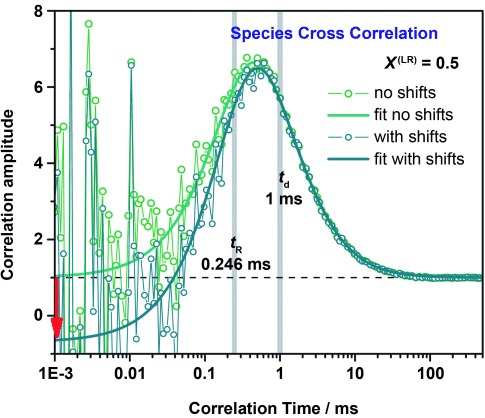
An analysis method of lifetime, polarization and spectrally filtered fluorescence correlation spectroscopy, referred to as filtered FCS (fFCS), is introduced. It uses, but is not limited to, multiparameter fluorescence detection to differentiate between molecular species with respect to their fluorescence lifetime, polarization and spectral information. Like the recently introduced fluorescence lifetime correlation spectroscopy (FLCS) [Chem. Phys. Lett. 2002, 353, 439-445], fFCS is based on pulsed laser excitation. However, it uses the species-specific polarization and spectrally resolved fluorescence decays to generate filters. We determined the most efficient method to generate global filters taking into account the anisotropy information. Thus, fFCS is able to distinguish species, even if they have very close or the same fluorescence lifetime, given differences in other fluorescence parameters. fFCS can be applied as a tool to compute species-specific auto- (SACF) and cross- correlation (SCCF) functions from a mixture of different species for accurate and quantitative analysis of their concentration, diffusion and kinetic properties. The computed correlation curves are also free from artifacts caused by unspecific background signal. We tested this methodology by simulating the extreme case of ligand-receptor binding processes monitored only by differences in fluorescence anisotropy. Furthermore, we apply fFCS to an experimental single-molecule FRET study of an open-to-closed conformational transition of the protein Syntaxin-1. In conclusion, fFCS and the global analysis of the SACFs and SCCF is a key tool to investigate binding processes and conformational dynamics of biomolecules in a nanosecond-to-millisecond time range as well as to unravel the involved molecular states.
一种寿命、偏振和光谱滤波荧光相关光谱分析方法,称为滤波 FCS(fFCS),被介绍。它使用但不限于多参数荧光检测来区分分子物种,以区分它们的荧光寿命、偏振和光谱信息。与最近引入的荧光寿命相关光谱(FLCS)[Chem. Phys. Lett. 2002, 353, 439-445]一样,fFCS 基于脉冲激光激发。然而,它使用物种特异性偏振和光谱分辨荧光衰减来生成滤波器。我们确定了最有效的方法来生成全局滤波器,同时考虑各向异性信息。因此,fFCS 能够区分物种,即使它们的荧光寿命非常接近或相同,只要它们在其他荧光参数上存在差异。fFCS 可以作为一种工具,从不同物种的混合物中计算物种特异性自相关(SACF)和互相关(SCCF)函数,以便对其浓度、扩散和动力学性质进行准确和定量分析。计算出的相关曲线也不受非特异性背景信号引起的伪影的影响。我们通过模拟仅通过荧光各向异性差异监测的配体-受体结合过程的极端情况来测试这种方法。此外,我们将 fFCS 应用于蛋白质 Syntaxin-1 的开放到闭合构象转变的单分子 FRET 实验研究。总之,fFCS 和 SACFs 和 SCCF 的全局分析是研究生物分子在纳秒到毫秒时间范围内的结合过程和构象动力学以及揭示相关分子状态的关键工具。