Department of Global Health and Development, London School of Hygiene and Tropical Medicine, London, United Kingdom.
PLoS One. 2012;7(3):e32900. doi: 10.1371/journal.pone.0032900. Epub 2012 Mar 6.
Intermittent preventive treatment of malaria in children (IPTc) is a highly efficacious method of malaria control where malaria transmission is highly seasonal. However, no studies published to date have examined community perceptions of IPTc.
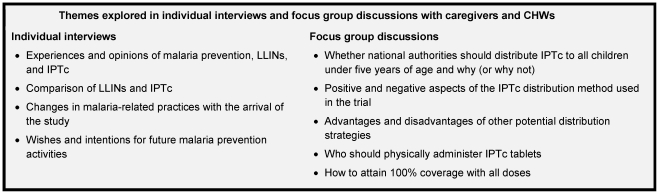
A qualitative study was undertaken in parallel with a double-blind, placebo-controlled, randomized trial of IPTc conducted in Mali and Burkina Faso in 2008-2009 to assess community perceptions of and recommendations for IPTc. Caregivers and community health workers (CHWs) were purposively sampled. Seventy-two in-depth individual interviews and 23 focus group discussions were conducted.
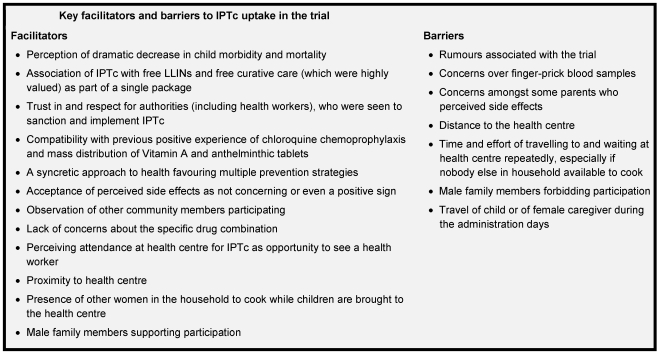
Widespread perceptions of health benefits for children led to enthusiasm for the trial and for IPTc specifically. Trust in and respect for those providing the tablets and a sense of obligation to the community to participate in sanctioned activities favoured initial adoption. IPTc fits in well with existing understandings of childhood illness. Participants did not express concerns about the specific drugs used for IPTc or about providing tablets to children without symptoms of malaria. There was no evidence that IPTc was perceived as a substitute for bed net usage, nor did it inhibit care seeking. Participants recommended that distribution be "closer to the population", but expressed concern over caregivers' ability to administer tablets at home.
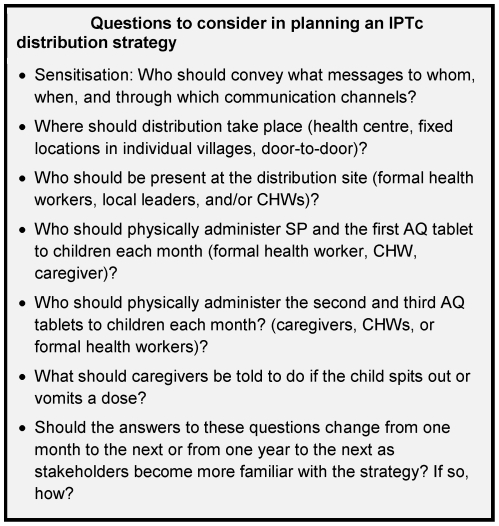
The trial context mediated perceptions of IPTc. Nonetheless, the results indicate that community perceptions of IPTc in the settings studied were largely favourable and that the delivery strategy rather than the tablets themselves presented the main areas of concern for caregivers and CHWs. The study identifies a number of key questions to consider in planning an IPTc distribution strategy. Single-dose formulations could increase the success of IPTc implementation, as could integration of IPTc within a package of activities, such as bed net distribution and free curative care, for which demand is already high.
间歇性预防治疗疟疾在儿童中(IPTc)是一种非常有效的疟疾控制方法,在疟疾传播具有高度季节性的地方。然而,迄今为止,尚无研究检查过社区对 IPTc 的看法。
2008-2009 年,在马里和布基纳法索进行了一项 IPTc 的双盲、安慰剂对照、随机试验,同时进行了一项定性研究,以评估社区对 IPTc 的看法和建议。护理人员和社区卫生工作者(CHWs)是有目的地抽样的。进行了 72 次深入的个人访谈和 23 次焦点小组讨论。
广泛的健康益处观念导致了对试验和 IPTc 的热情。对提供药片的人表示信任和尊重,以及对社区参与批准活动的义务感,促成了最初的采用。IPTc 非常符合人们对儿童疾病的现有认识。参与者没有对用于 IPTc 的特定药物表示担忧,也没有对向没有疟疾症状的儿童提供药片表示担忧。没有证据表明 IPTc 被视为蚊帐使用的替代品,也没有抑制寻求护理的行为。参与者建议将分发“更接近人群”,但对护理人员在家中给药的能力表示担忧。
试验背景影响了对 IPTc 的看法。尽管如此,结果表明,在所研究的环境中,社区对 IPTc 的看法在很大程度上是有利的,并且是提供战略而不是药片本身,引起了护理人员和 CHWs 的主要关注。该研究确定了在规划 IPTc 分发策略时需要考虑的一些关键问题。单剂量制剂可以提高 IPTc 实施的成功率,因为 IPTc 可以与其他活动(如蚊帐分发和免费治疗)整合在一起,这些活动的需求已经很高。