University College London, London, UK.
London School of Hygiene & Tropical Medicine, London, United Kingdom.
Glob Health Sci Pract. 2020 Sep 30;8(3):383-395. doi: 10.9745/GHSP-D-19-00410.
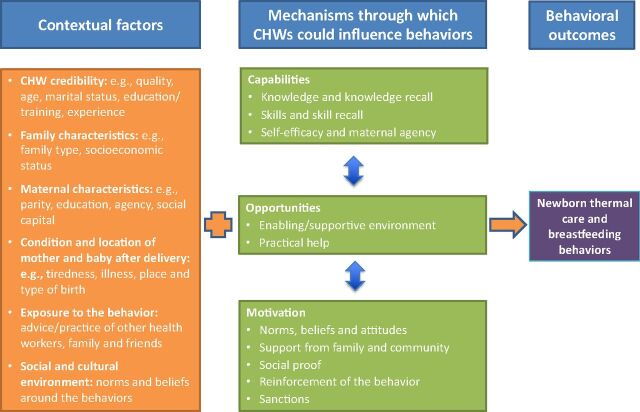
Changing behaviors is usually a core component of the role of community health workers (CHWs), but little is known about the mechanisms through which they change behavior. We collected qualitative data from 8 sites in Ethiopia and northern Nigeria where CHWs were active to understand how they change newborn care behaviors. In each country, we conducted 12 narrative interviews and 12-13 in-depth interviews with recent mothers and 4 focus group discussions each with mothers, fathers, grandmothers, and CHWs. We identified 2 key mechanisms of behavior change. The first was linked to the frequency and consistency of hearing messages that led to a perception that change had occurred in community-wide behaviors, collective beliefs, and social expectations. The second was linked to trust in the CHW, obligation, and hierarchy. We found little evidence that constructs that often inform the design of counseling approaches, such as knowledge of causality and perceived risks and benefits, were mechanisms of change.
改变行为通常是社区卫生工作者(CHW)角色的核心组成部分,但对于他们改变行为的机制知之甚少。我们从埃塞俄比亚和尼日利亚北部的 8 个 CHW 活跃的地点收集了定性数据,以了解他们如何改变新生儿护理行为。在每个国家,我们对最近的母亲进行了 12 次叙述性访谈和 12-13 次深入访谈,对母亲、父亲、祖母和 CHW 进行了 4 次焦点小组讨论。我们确定了 2 种行为改变的关键机制。第一个与反复听到导致社区行为、集体信仰和社会期望发生变化的信息的频率和一致性有关。第二个与对 CHW 的信任、义务和等级有关。我们几乎没有发现经常为咨询方法设计提供信息的结构,例如因果关系和感知风险和收益的知识,是改变的机制。