Institute of Biomedical Engineering, Department of Engineering Science , University of Oxford , Oxford , UK.
Interface Focus. 2011 Jun 6;1(3):408-16. doi: 10.1098/rsfs.2010.0025. Epub 2011 Mar 23.
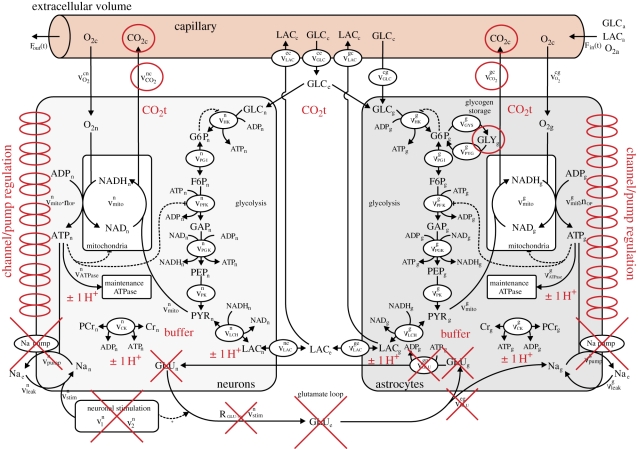
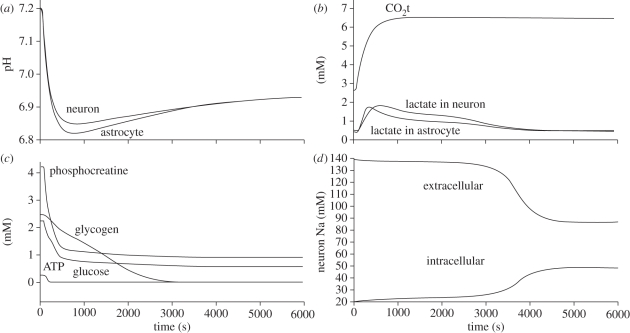
The identification of salvageable brain tissue is a major challenge at stroke presentation. Standard techniques used in this context, such as the perfusion-diffusion mismatch, remain controversial. There is thus a need for new methods to help guide treatment. The potential role of pH imaging in this context is currently being investigated. Intracellular pH varies as a function of local perfusion, intracellular energy stores and time. Low pH triggers the production of free radicals and affects the calcium balance of the cells, which may lead to apoptosis and cell death. Thus, the characterization of pH dynamics may have predictive value for cell death after stroke, particularly when combined with novel imaging techniques. Therefore, we have extended an existing model of brain cellular metabolism to simulate the pH response of cells to ischaemia. Simulation results for conditions of reduced cerebral blood flow show good agreement for the evolution of intracellular pH with previously reported measurements and encourage the development of quantitative pH imaging to validate the predictive value of pH.
在脑卒中发作时,对可挽救脑组织的识别是一项重大挑战。在这种情况下使用的标准技术,如灌注-弥散不匹配,仍然存在争议。因此,需要新的方法来帮助指导治疗。目前正在研究 pH 成像在这方面的潜在作用。细胞内 pH 值随局部灌注、细胞内能量储备和时间的变化而变化。低 pH 值会触发自由基的产生,并影响细胞的钙平衡,这可能导致细胞凋亡和死亡。因此,pH 值动力学的特征可能对中风后细胞死亡具有预测价值,特别是与新型成像技术结合使用时。因此,我们扩展了现有的脑细胞代谢模型,以模拟细胞对缺血的 pH 值反应。对于脑血流减少的情况,模拟结果与以前报道的测量结果在细胞内 pH 值的演变上具有很好的一致性,并鼓励开发定量 pH 成像技术来验证 pH 值的预测价值。