Department of Infectious Diseases and Pathology, Emerging Pathogens Institute, and Cancer Genetic Institute, University of Florida, Gainesville, FL, USA.
J Inflamm (Lond). 2012 Mar 16;9:7. doi: 10.1186/1476-9255-9-7.
The cellular and molecular mechanisms of inflammatory bowel disease are not fully understood; however, data indicate that uncontrolled chronic inflammation induced by bacterial gene products, including lipoteichoic acid (LTA), may trigger colonic inflammation resulting in disease pathogenesis. LTA is a constituent glycolipid of Gram-positive bacteria that shares many inflammatory properties with lipopolysaccharide and plays a critical role in the pathogenesis of severe inflammatory responses via Toll-like receptor 2. Accordingly, we elucidate the role of LTA in immune stimulation and induced colitis in vivo.
To better understand the molecular mechanisms utilized by the intestinal microbiota and their gene products to induce or subvert inflammation, specifically the effect(s) of altered surface layer protein expression on the LTA-mediated pro-inflammatory response, the Lactobacillus acidophilus surface layer protein (Slp) genes encoding SlpB and SlpX were deleted resulting in a SlpB- and SlpX- mutant that continued to express SlpA (assigned as NCK2031).
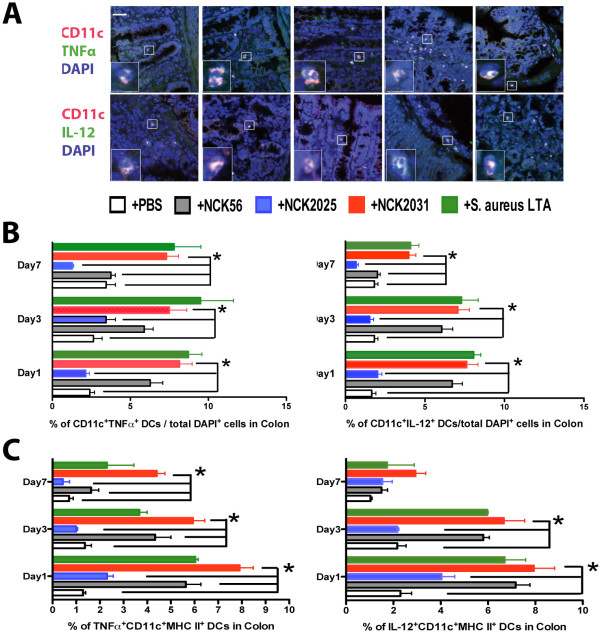
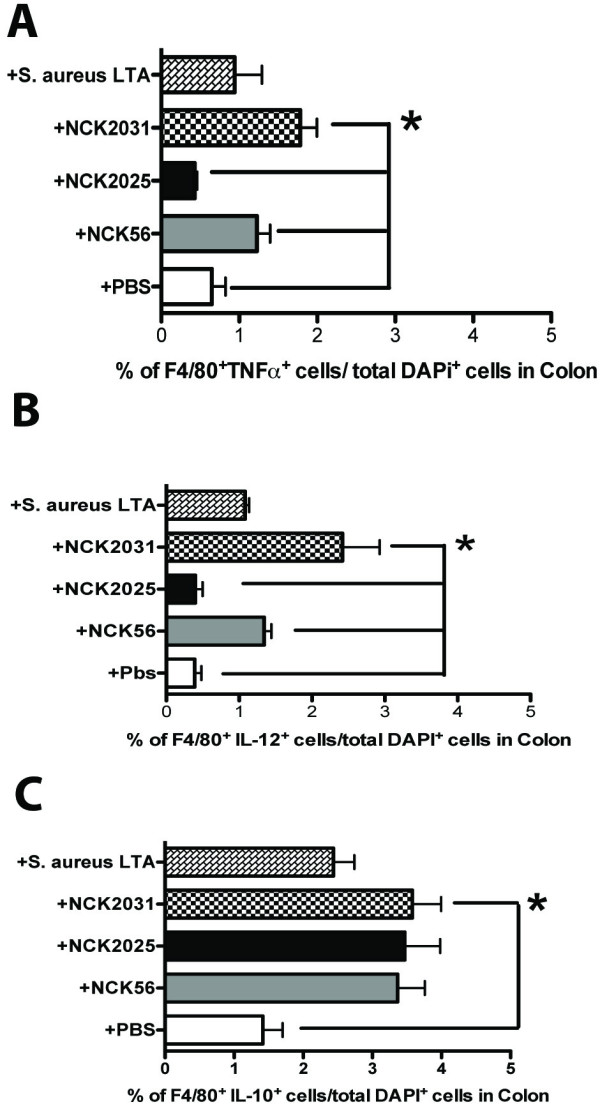
Our data show profound activation of dendritic cells by NCK2031, wild-type L. acidophilus (NCK56), and purified Staphylococcus aureus-LTA. In contrary to the LTA-deficient strain NCK2025, the LTA-expressing strains NCK2031 and NCK56, as well as S. aureus-LTA, induce pro-inflammatory innate and T cell immune responses in vivo. Additionally, neither NCK2031 nor S. aureus-LTA supplemented in drinking water protected mice from DSS-colitis, but instead, induced significant intestinal inflammation resulting in severe colitis and tissue destruction.
These findings suggest that directed alteration of two of the L. acidophilus NCFM-Slps did not ameliorate LTA-induced pro-inflammatory signals and subsequent colitis.
炎症性肠病的细胞和分子机制尚未完全阐明;然而,有数据表明,细菌基因产物(包括脂磷壁酸[LTA])引起的不受控制的慢性炎症可能引发结肠炎症,从而导致疾病发生。LTA 是革兰氏阳性菌的一种组成糖脂,它与脂多糖具有许多共同的炎症特性,并通过 Toll 样受体 2 在严重炎症反应的发病机制中发挥关键作用。因此,我们阐明了 LTA 在体内免疫刺激和诱导结肠炎中的作用。
为了更好地了解肠道微生物群及其基因产物用于诱导或颠覆炎症的分子机制,特别是改变表面层蛋白表达对 LTA 介导的促炎反应的影响,我们删除了嗜酸乳杆菌表面层蛋白(Slp)基因编码的 SlpB 和 SlpX,导致 SlpB 和 SlpX 突变体继续表达 SlpA(命名为 NCK2031)。
我们的数据显示,NCK2031、野生型嗜酸乳杆菌(NCK56)和纯化的金黄色葡萄球菌-LTA 可显著激活树突状细胞。与 LTA 缺陷株 NCK2025 相反,表达 LTA 的菌株 NCK2031 和 NCK56 以及金黄色葡萄球菌-LTA 可在体内诱导促炎性先天和 T 细胞免疫反应。此外,NCK2031 或金黄色葡萄球菌-LTA 补充饮用水既不能保护小鼠免受 DSS-结肠炎的影响,反而会诱导严重的肠道炎症,导致严重的结肠炎和组织破坏。
这些发现表明,对嗜酸乳杆菌 NCFM-Slps 中的两种进行定向改变并没有改善 LTA 诱导的促炎信号和随后的结肠炎。