Department of Psychosomatic Medicine, Central Institute of Mental Health Mannheim, Medical Faculty Mannheim/Heidelberg University, Heidelberg, Germany.
PLoS One. 2012;7(3):e33293. doi: 10.1371/journal.pone.0033293. Epub 2012 Mar 12.
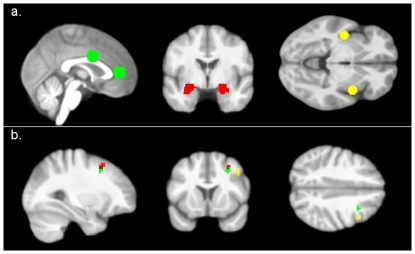
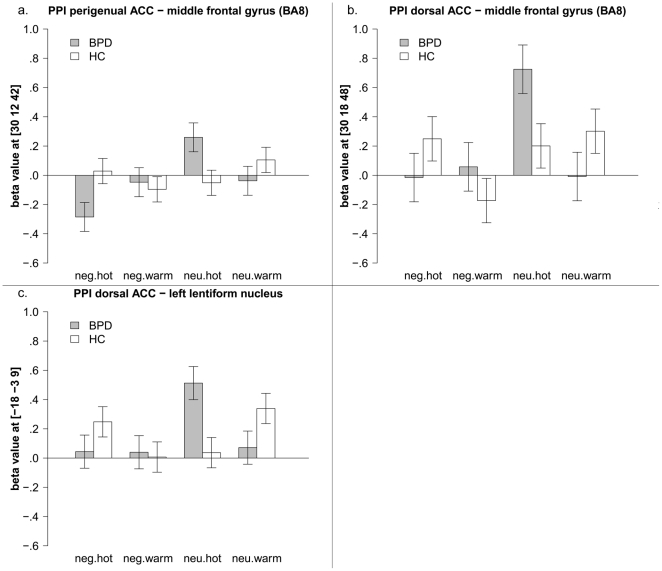
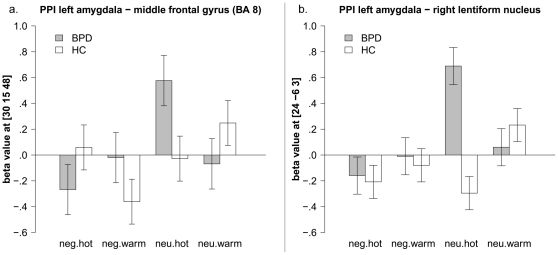
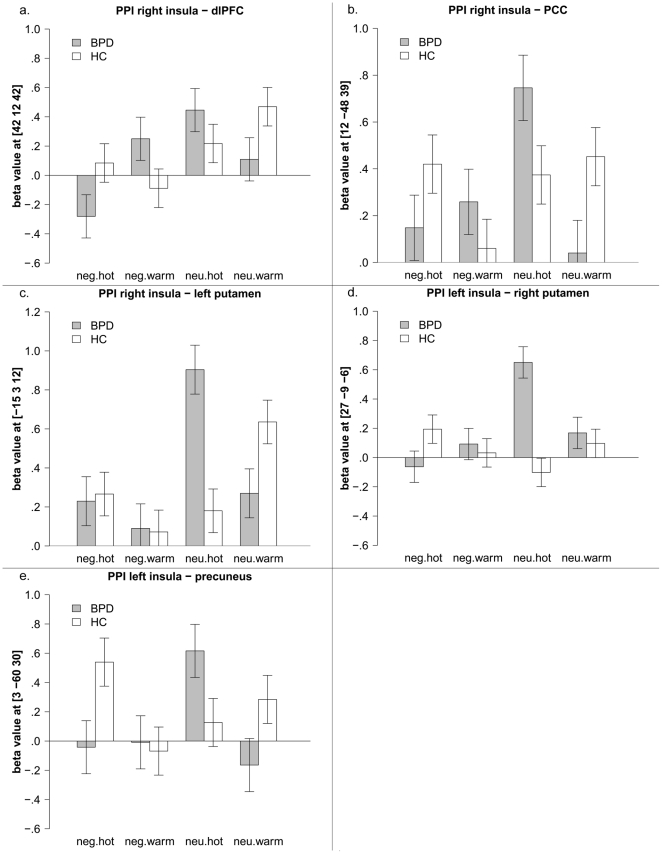
Affective instability and self-injurious behavior are important features of Borderline Personality Disorder. Whereas affective instability may be caused by a pattern of limbic hyperreactivity paired with dysfunctional prefrontal regulation mechanisms, painful stimulation was found to reduce affective arousal at the neural level, possibly underlying the soothing effect of pain in BPD.We used psychophysiological interactions to analyze functional connectivity of (para-) limbic brain structures (i.e. amygdala, insula, anterior cingulate cortex) in Borderline Personality Disorder in response to painful stimulation. Therefore, we re-analyzed a dataset from 20 patients with Borderline Personality Disorder and 23 healthy controls who took part in an fMRI-task inducing negative (versus neutral) affect and subsequently applying heat pain (versus warmth perception).Results suggest an enhanced negative coupling between limbic as well as paralimbic regions and prefrontal regions, specifically with the medial and dorsolateral prefrontal cortex, when patients experienced pain in addition to emotional arousing pictures. When neutral pictures were combined with painful heat sensation, we found positive connectivity in Borderline Personality Disorder between (para-)limbic brain areas and parts of the basal ganglia (lentiform nucleus, putamen), as well areas involved in self-referential processing (precuneus and posterior cingulate).We found further evidence for alterations in the emotion regulation process in Borderline Personality Disorder, in the way that pain improves the inhibition of limbic activity by prefrontal areas. This study provides new insights in pain processing in BPD, including enhanced coupling of limbic structures and basal ganglia.
情感不稳定和自伤行为是边缘型人格障碍的重要特征。情感不稳定可能由边缘系统过度反应模式与功能失调的前额叶调节机制共同引起,而研究发现疼痛刺激在神经层面可降低情感唤醒,这可能是边缘型人格障碍中疼痛起到舒缓作用的潜在机制。我们使用心理生理交互作用分析边缘型人格障碍患者在疼痛刺激下(边缘)脑区结构(即杏仁核、脑岛、前扣带回皮质)的功能连接。因此,我们重新分析了一个数据集,该数据集来自20名边缘型人格障碍患者和23名健康对照者,他们参与了一项功能磁共振成像任务,该任务先诱发负面(相对于中性)情绪,随后施加热痛(相对于热觉)。结果表明,当患者在观看引发情绪的图片时同时经历疼痛,边缘脑区以及边缘旁脑区与前额叶区域之间的负性耦合增强,特别是与内侧和背外侧前额叶皮质的负性耦合增强。当中性图片与热痛感觉相结合时,我们发现边缘型人格障碍患者的边缘(旁)脑区与基底神经节的部分区域(豆状核、壳核)以及参与自我参照加工的区域(楔前叶和后扣带回)之间存在正性连接。我们进一步发现了边缘型人格障碍患者情绪调节过程改变的证据,即疼痛改善了前额叶区域对边缘系统活动的抑制作用。这项研究为边缘型人格障碍的疼痛处理提供了新的见解,包括边缘结构与基底神经节之间耦合增强。