Department of Microbiology, National Reference Center for AIDS, University of Buenos Aires School of Medicine, Buenos Aires, Argentina.
PLoS One. 2012;7(3):e33061. doi: 10.1371/journal.pone.0033061. Epub 2012 Mar 14.
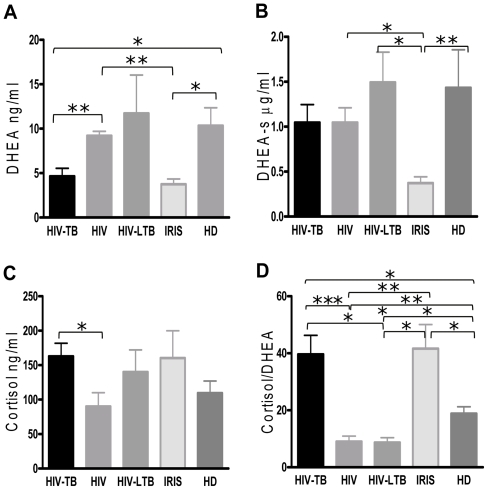
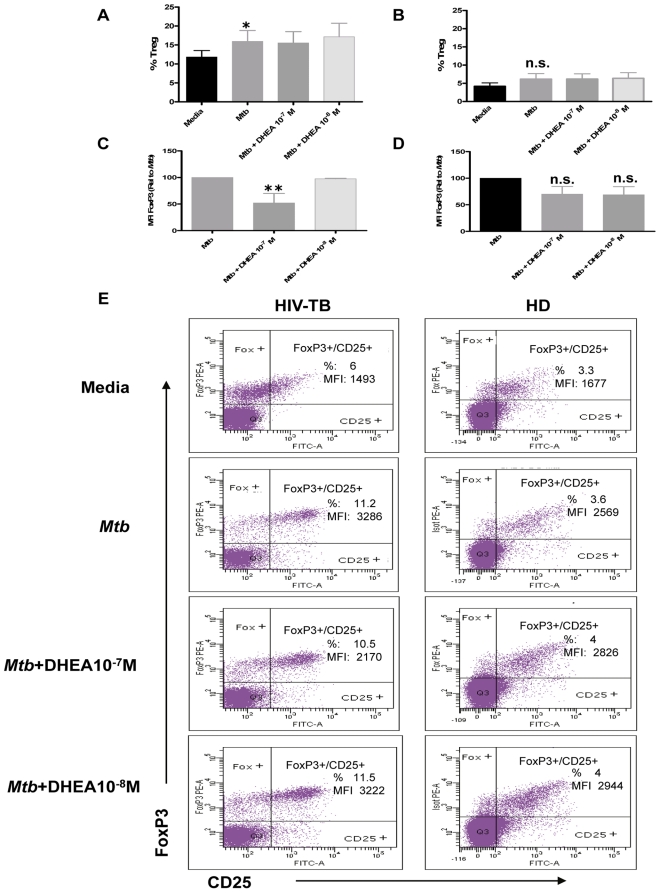
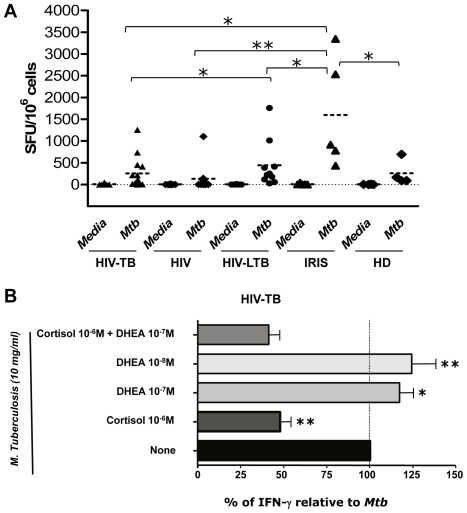
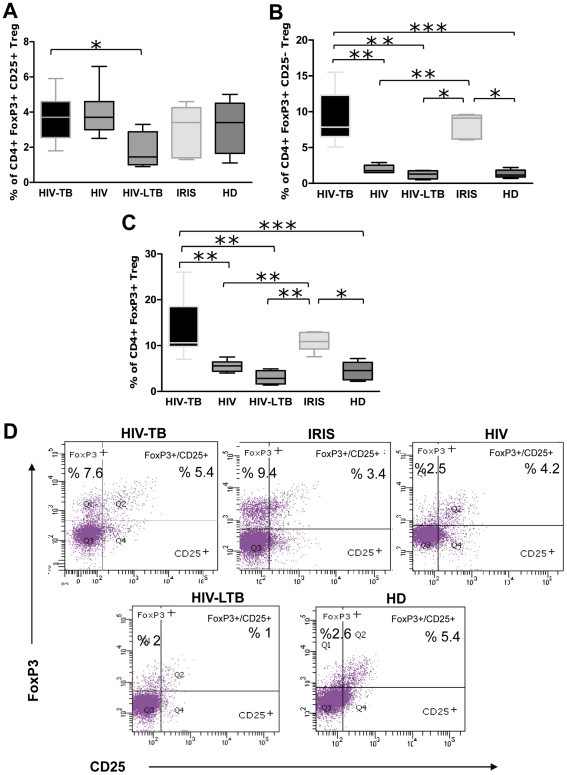
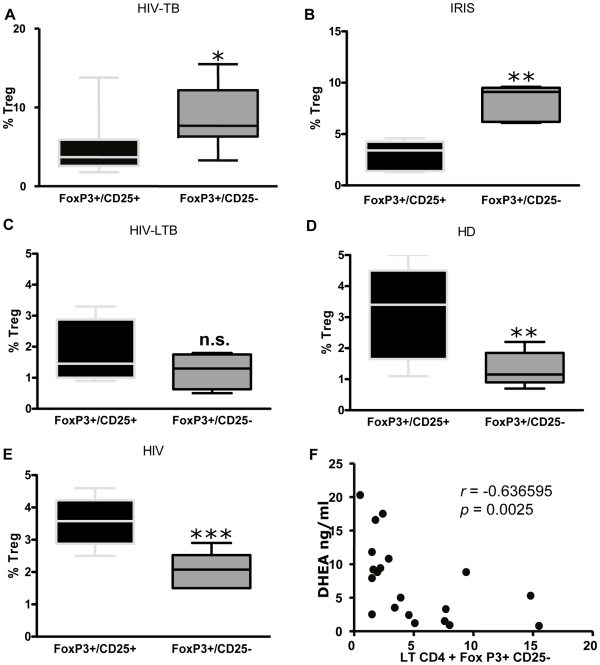
Tuberculosis (TB) remains the most frequent cause of illness and death from an infectious agent, and its interaction with HIV has devastating effects. We determined plasma levels of dehydroepiandrosterone (DHEA), its circulating form DHEA-suphate (DHEA-s) and cortisol in different stages of M. tuberculosis infection, and explored their role on the Th1 and Treg populations during different scenarios of HIV-TB coinfection, including the immune reconstitution inflammatory syndrome (IRIS), a condition related to antiretroviral treatment. DHEA levels were diminished in HIV-TB and HIV-TB IRIS patients compared to healthy donors (HD), HIV+ individuals and HIV+ individuals with latent TB (HIV-LTB), whereas dehydroepiandrosterone sulfate (DHEA-s) levels were markedly diminished in HIV-TB IRIS individuals. HIV-TB and IRIS patients presented a cortisol/DHEA ratio significantly higher than HIV+, HIV-LTB and HD individuals. A positive correlation was observed between DHEA-s and CD4 count among HIV-TB individuals. Conversely, cortisol plasma level inversely correlated with CD4 count within HIV-TB individuals. M. tuberculosis-specific Th1 lymphocyte count was increased after culturing PBMC from HIV-TB individuals in presence of DHEA. We observed an inverse correlation between DHEA-s plasma level and Treg frequency in co-infected individuals, and CD4+FoxP3+ Treg frequency was increased in HIV-TB and IRIS patients compared to other groups. Strikingly, we observed a prominent CD4+CD25-FoxP3+ population across HIV-TB and HIV-TB IRIS patients, which frequency correlated with DHEA plasma level. Finally, DHEA treatment negatively regulated FoxP3 expression without altering Treg frequency in co-infected patients. These data suggest an enhancing role for DHEA in the immune response against M. tuberculosis during HIV-TB coinfection and IRIS.
结核病(TB)仍然是由感染因子引起的最常见的疾病和死亡原因,其与 HIV 的相互作用具有破坏性影响。我们确定了在结核分枝杆菌感染的不同阶段血浆中脱氢表雄酮(DHEA)、其循环形式硫酸脱氢表雄酮(DHEA-s)和皮质醇的水平,并探讨了它们在不同的 HIV-TB 合并感染情况下,包括与抗逆转录病毒治疗相关的免疫重建炎症综合征(IRIS),对 Th1 和 Treg 群体的作用。与健康供体(HD)、HIV+个体和 HIV+潜伏性结核(HIV-LTB)个体相比,HIV-TB 和 HIV-TB IRIS 患者的 DHEA 水平降低,而 DHEA-s 水平在 HIV-TB IRIS 个体中明显降低。HIV-TB 和 IRIS 患者的皮质醇/DHEA 比值明显高于 HIV+、HIV-LTB 和 HD 个体。在 HIV-TB 个体中,观察到 DHEA-s 与 CD4 计数之间存在正相关。相反,在 HIV-TB 个体中,皮质醇血浆水平与 CD4 计数呈负相关。在存在 DHEA 的情况下,从 HIV-TB 个体的 PBMC 中培养出的结核分枝杆菌特异性 Th1 淋巴细胞计数增加。在合并感染个体中,观察到 DHEA-s 血浆水平与 Treg 频率之间存在负相关,并且与其他组相比,HIV-TB 和 IRIS 患者的 CD4+FoxP3+Treg 频率增加。值得注意的是,我们观察到 HIV-TB 和 HIV-TB IRIS 患者中存在一个突出的 CD4+CD25-FoxP3+群体,其频率与 DHEA 血浆水平相关。最后,DHEA 治疗在不改变合并感染患者 Treg 频率的情况下,负调节 FoxP3 的表达。这些数据表明,在 HIV-TB 合并感染和 IRIS 期间,DHEA 在针对结核分枝杆菌的免疫反应中具有增强作用。