Department of Radiology, Bundang Jesaeng General Hospital, Sungnam, Korea.
Korean J Radiol. 2012 Mar-Apr;13(2):136-43. doi: 10.3348/kjr.2012.13.2.136. Epub 2012 Mar 7.
We investigated low dose digital tomosynthesis (DT) for the evaluation of the paranasal sinus (PNS), and compared its diagnostic accuracy with a PNS radiography series (XR).
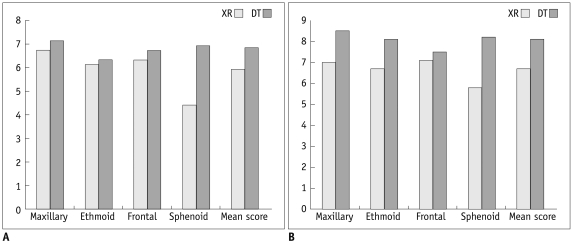
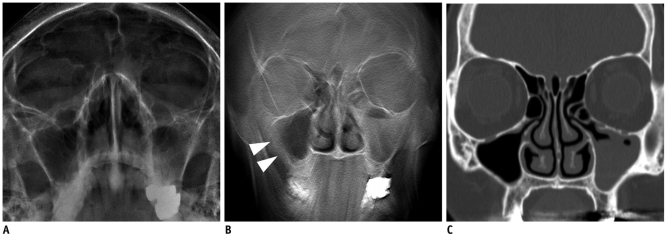
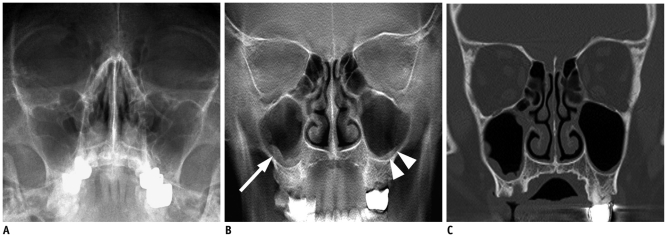
We enrolled 43 patients for whom XR, PNS DT, and OMU CT were performed. We measured effective doses (EDs) of XR, DT, and OMU CT using Monte Carlo simulation software. Two radiologists performed independent observation of both XR and DT. For seven PNSs, they scored anatomic conspicuity of sinuses and confidence on the presence of sinusitis using nine point scales. OMU CT was observed by the third radiologist and the findings were regarded as reference standard. We compared scores for conspicuity and sinusitis confidence between XR and DT.
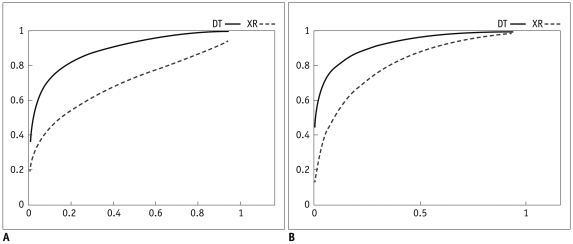
Mean EDs were 29 ± 6 µSv, 48 ± 10 µSv, and 980 ± 250 µSv, respectively, for XR, DT, and CT. Mean scores for conspicuity were 6.3 and 7.4, respectively, for XR and DT. Sensitivity per patient basis for sinusitis detection were 52% and 96%, respectively, for XR and DT in observer 1 (p = 0.001) and 80% and 92% for observer 2 (p = 0.25). Specificities for sinusitis exclusion were 100% for both XR and DT for observer 1 and 89% and 100% for observer 2 (p = 0.50). Accuracies for sinusitis diagnosis were 72% and 98%, respectively, for XR and DT for observer 1 (p = 0.001) and 84% and 95% for observer 2 (p = 0.125).
Patient radiation dose from low dose DT is comparable with that of PNS XR. Diagnostic sensitivity of DT for sinusitis was superior to PNS XR.
我们研究了低剂量数字断层融合摄影术(DT)在鼻窦(PNS)评估中的应用,并将其与 PNS 射线照相系列(XR)的诊断准确性进行了比较。
我们纳入了 43 名患者,他们接受了 XR、PNS DT 和 OMU CT 检查。我们使用蒙特卡罗模拟软件测量了 XR、DT 和 OMU CT 的有效剂量(ED)。两位放射科医生分别对 XR 和 DT 进行独立观察。对于七个鼻窦,他们使用九点量表对鼻窦的解剖显影程度和存在鼻窦炎的信心进行评分。第三位放射科医生观察 OMU CT,并将结果视为参考标准。我们比较了 XR 和 DT 对显影程度和鼻窦炎信心的评分。
XR、DT 和 CT 的平均 ED 分别为 29 ± 6 µSv、48 ± 10 µSv 和 980 ± 250 µSv。XR 和 DT 的平均显影程度评分分别为 6.3 和 7.4。观察者 1 对鼻窦炎检测的敏感度分别为 XR 的 52%和 DT 的 96%(p = 0.001),观察者 2 分别为 80%和 92%(p = 0.25)。对于鼻窦炎的排除,XR 和 DT 的特异度均为 100%,观察者 1 为 89%和 100%,观察者 2 为 89%和 100%(p = 0.50)。对于鼻窦炎的诊断准确性,观察者 1 为 XR 的 72%和 DT 的 98%(p = 0.001),观察者 2 为 84%和 DT 的 95%(p = 0.125)。
低剂量 DT 的患者辐射剂量与 PNS XR 相当。DT 对鼻窦炎的诊断敏感性优于 PNS XR。