Uchiyama Masateru, Jin Xiangyuan, Zhang Qi, Hirai Toshihito, Amano Atsushi, Bashuda Hisashi, Niimi Masanori
Department of Surgery, Teikyo University, 2-11-1 Kaga, Itabashi-ku, Tokyo 173-8605, Japan.
J Cardiothorac Surg. 2012 Mar 23;7:26. doi: 10.1186/1749-8090-7-26.
Interactions between the immune response and brain functions such as olfactory, auditory, and visual sensations are likely. This study investigated the effect of sounds on alloimmune responses in a murine model of cardiac allograft transplantation.
Naïve CBA mice (H2k) underwent transplantation of a C57BL/6 (B6, H2b) heart and were exposed to one of three types of music--opera (La Traviata), classical (Mozart), and New Age (Enya)--or one of six different single sound frequencies, for 7 days. Additionally, we prepared two groups of CBA recipients with tympanic membrane perforation exposed to opera for 7 days and CBA recipients exposed to opera for 7 days before transplantation (pre-treatment). An adoptive transfer study was performed to determine whether regulatory cells were generated in allograft recipients. Immunohistochemical, cell-proliferation, cytokine, and flow cytometry assessments were also performed.
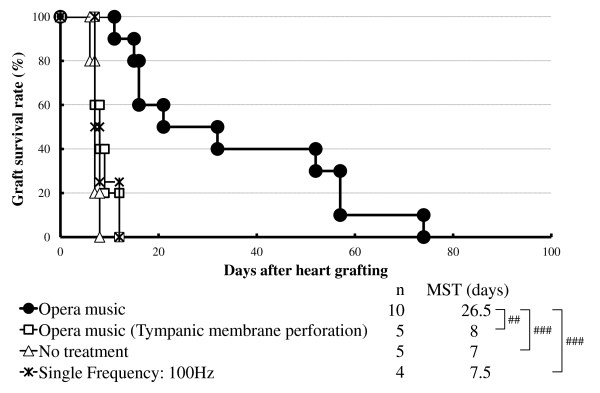
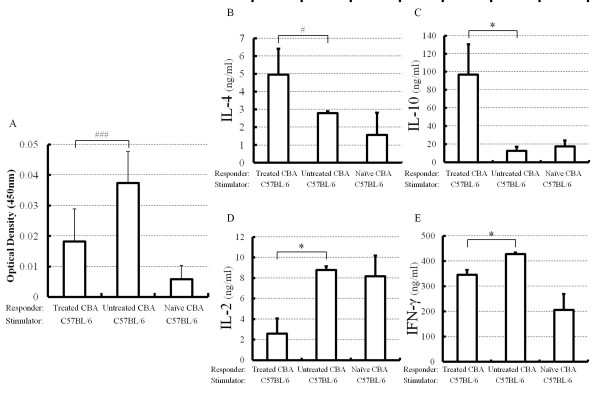
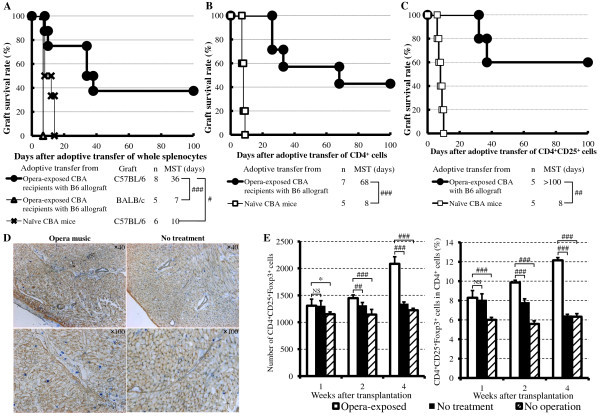
CBA recipients of a B6 cardiac graft that were exposed to opera music and Mozart had significantly prolonged allograft survival (median survival times [MSTs], 26.5 and 20 days, respectively), whereas those exposed to a single sound frequency (100, 500, 1000, 5000, 10,000, or 20,000 Hz) or Enya did not (MSTs, 7.5, 8, 9, 8, 7.5, 8.5 and 11 days, respectively). Untreated, CBA mice with tympanic membrane perforations and CBA recipients exposed to opera for 7 days before transplantation (pre-treatment) rejected B6 cardiac grafts acutely (MSTs, 7, 8 and 8 days, respectively). Adoptive transfer of whole splenocytes, CD4+ cells, or CD4+CD25+ cells from opera-exposed primary allograft recipients resulted in significantly prolonged allograft survival in naive secondary recipients (MSTs, 36, 68, and > 100 days, respectively). Proliferation of splenocytes, interleukin (IL)-2 and interferon (IFN)-γ production was suppressed in opera-exposed mice, and production of IL-4 and IL-10 from opera-exposed transplant recipients increased compared to that from splenocytes of untreated recipients. Flow cytometry studies showed an increased CD4+CD25+ Forkhead box P3 (Foxp3)+ cell population in splenocytes from those mice.
Our findings indicate that exposure to opera music, such as La traviata, could affect such aspects of the peripheral immune response as generation of regulatory CD4+CD25+ cells and up-regulation of anti-inflammatory cytokines, resulting in prolonged allograft survival.
免疫反应与嗅觉、听觉和视觉等脑功能之间可能存在相互作用。本研究在心脏同种异体移植的小鼠模型中研究了声音对同种异体免疫反应的影响。
将未接触过抗原的CBA小鼠(H2k)移植C57BL/6(B6,H2b)心脏,并使其暴露于三种类型的音乐之一——歌剧(《茶花女》)、古典音乐(莫扎特)和新纪元音乐(恩雅)——或六种不同的单声音频率之一,持续7天。此外,我们制备了两组鼓膜穿孔的CBA受体,使其暴露于歌剧7天,以及移植前暴露于歌剧7天的CBA受体(预处理)。进行过继转移研究以确定同种异体移植受体中是否产生了调节性细胞。还进行了免疫组织化学、细胞增殖、细胞因子和流式细胞术评估。
接受B6心脏移植的CBA受体中,暴露于歌剧音乐和莫扎特音乐的小鼠同种异体移植存活时间显著延长(中位存活时间[MSTs]分别为26.5天和20天),而暴露于单声音频率(100、500、1000、5000、10000或20000 Hz)或恩雅音乐的小鼠则没有(MSTs分别为7.5、8、9、8、7.5、8.5和11天)。未经处理的鼓膜穿孔CBA小鼠以及移植前暴露于歌剧7天的CBA受体(预处理)急性排斥B6心脏移植(MSTs分别为7天、8天和8天)。将来自暴露于歌剧的原发性同种异体移植受体的全脾细胞、CD4+细胞或CD4+CD25+细胞过继转移至未接触过抗原的继发性受体中,可显著延长同种异体移植存活时间(MSTs分别为36天、'68天和>100天)。暴露于歌剧的小鼠脾细胞增殖、白细胞介素(IL)-2和干扰素(IFN)-γ产生受到抑制,与未处理受体的脾细胞相比,暴露于歌剧的移植受体中IL-4和IL-10的产生增加。流式细胞术研究显示,这些小鼠的脾细胞中CD4+CD25+叉头框P3(Foxp3)+细胞群体增加。
我们的研究结果表明,暴露于歌剧音乐,如《茶花女》,可能会影响外周免疫反应的多个方面,如调节性CD4+CD25+细胞的产生和抗炎细胞因子的上调,从而延长同种异体移植存活时间。