Departamento de Sanidad Animal, Facultad de Veterinaria, Universidad Complutense, Madrid, Spain.
Parasit Vectors. 2012 Mar 27;5:60. doi: 10.1186/1756-3305-5-60.
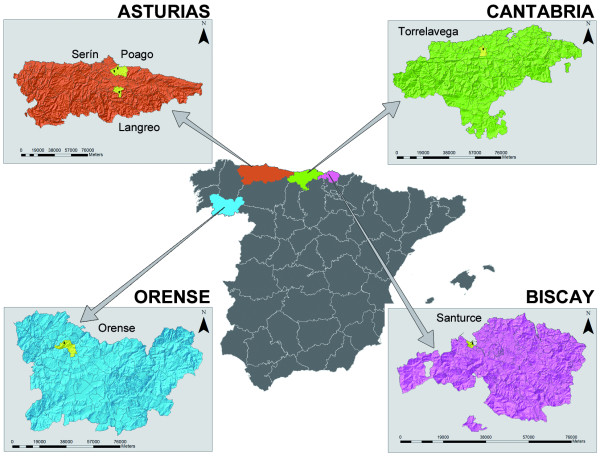
Canine leishmaniosis (CanL) caused by Leishmania infantum is a widespread endemic disease in the Mediterranean basin, though, so far, the north of Spain has been considered a non-endemic area. The aim of the present study was to determine the prevalence of specific antibodies to L. infantum among stray dogs living in shelters in this area, and to evaluate the clinical status (both clinical signs and clinico-pathological abnormalities) of seropositive dogs. Besides L. infantum infection, the epidemiological role of variables like sex, breed and age was also assessed.
Over the year 2011 a cross-sectional study was conducted on a total of 418 stray dogs. A preliminary entomological survey was carried out using CDC-light traps. The chi-squared test was used to examine relationships between L. infantum seroprevalence and the remaining variables.
The overall seroprevalence of L. infantum infection detected was 3% in the Cantabrian coast. In Orense the seroprevalence was 35.6%. In this latter region, the presence of sand fly, Phlebotomus perniciosus was also detected.In general, seropositivity for L. infantum was related to size (large breed dogs versus small) and age, with a significantly higher seroprevalence recorded in younger (0-3 years) and older dogs (> 7 years) than adult dogs. Clinical signs of CanL were observed in 41.3% of the seropositive dogs. The seropositivity for L. infantum infection associated with the presence of clinical signs and/or abnormal laboratory findings shows a prevalence of 4.5%.
Our data provide new insight into the prevalence of CanL across northern Spain. The situation observed in Orense seems to be worsening compared to the few reports available, with figures being similar to those cited for known endemic areas of Spain. Besides, the presence of P. perniciosus in Orense points out to a risk of the spread of this zoonotic disease in this geographical area. These findings identify a need for an active search for the sand fly vectors of L. infantum across the entire northern spanish region including the rest of Galicia, Asturias, Cantabria and the Basque Country.
由利什曼原虫引起的犬利什曼病(CanL)在地中海盆地广泛流行,但迄今为止,西班牙北部被认为是非流行地区。本研究的目的是确定该地区收容所中流浪犬对利什曼原虫的特异性抗体的流行率,并评估血清阳性犬的临床状况(临床症状和临床病理异常)。除利什曼原虫感染外,还评估了变量(如性别、品种和年龄)的流行病学作用。
2011 年进行了一项总计 418 只流浪犬的横断面研究。使用 CDC 诱捕器进行了初步的昆虫学调查。使用卡方检验检查利什曼原虫血清阳性率与其余变量之间的关系。
在坎塔布里亚海岸,利什曼原虫感染的总血清阳性率为 3%。在奥伦塞,血清阳性率为 35.6%。在后者地区,还检测到了沙蝇(Phlebotomus perniciosus)的存在。一般来说,利什曼原虫的血清阳性率与体型(大型犬与小型犬)和年龄有关,0-3 岁和>7 岁的幼犬比成年犬的血清阳性率明显更高。在 41.3%的血清阳性犬中观察到犬利什曼病的临床症状。与临床症状和/或异常实验室发现相关的利什曼原虫感染的血清阳性率为 4.5%。
我们的数据为西班牙北部的犬利什曼病的流行率提供了新的见解。奥伦塞的情况似乎比现有的少数报告更为严重,与西班牙已知流行地区的数据相似。此外,奥伦塞沙蝇的存在表明这种人畜共患疾病在该地理区域传播的风险。这些发现表明,需要在整个西班牙北部地区(包括加利西亚、阿斯图里亚斯、坎塔布里亚和巴斯克地区)积极寻找利什曼原虫的沙蝇媒介。