Department of Neurology and Stroke Centre, La Paz University Hospital, Neuroscience Area of IdiPAZ (Health Research Institute), Autónoma University of Madrid, Madrid, Spain.
J Cell Mol Med. 2012 Oct;16(10):2280-90. doi: 10.1111/j.1582-4934.2012.01575.x.
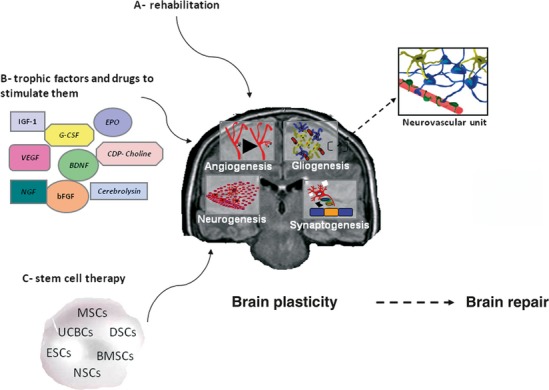
Brain repair involves a compendium of natural mechanisms that are activated following stroke. From a therapeutic viewpoint, reparative therapies that encourage cerebral plasticity are needed. In the last years, it has been demonstrated that modulatory treatments for brain repair such as trophic factor- and stem cell-based therapies can promote neurogenesis, gliogenesis, oligodendrogenesis, synaptogenesis and angiogenesis, all of which having a beneficial impact on infarct volume, cell death and, finally, and most importantly, on the functional recovery. However, even when promising results have been obtained in a wide range of experimental animal models and conditions these preliminary results have not yet demonstrated their clinical efficacy. Here, we focus on brain repair modulatory treatments for ischaemic stroke, that use trophic factors, drugs with trophic effects and stem cell therapy. Important and still unanswered questions for translational research ranging from experimental animal models to recent and ongoing clinical trials are reviewed here.
脑修复涉及一系列在中风后被激活的自然机制。从治疗的角度来看,需要促进大脑可塑性的修复疗法。在过去的几年中,已经证明,调节性脑修复治疗,如基于神经营养因子和干细胞的治疗,可以促进神经发生、神经胶质发生、少突胶质细胞发生、突触发生和血管生成,所有这些都对梗死体积、细胞死亡以及最终最重要的功能恢复产生有益的影响。然而,即使在广泛的实验动物模型和条件下获得了有希望的结果,这些初步结果尚未证明其临床疗效。在这里,我们专注于使用神经营养因子、具有神经营养作用的药物和干细胞治疗的缺血性中风的脑修复调节治疗。从实验动物模型到最近和正在进行的临床试验,这里回顾了转化研究中仍然存在的重要而未解决的问题。