Department of Veterinary Sciences, School of Agrarian and Veterinary Sciences, University of Trás-os-Montes e Alto Douro, Vila Real, Portugal.
Parasit Vectors. 2012 Mar 27;5:62. doi: 10.1186/1756-3305-5-62.
Canine vector-borne diseases (CVBDs) are caused by a wide range of pathogens transmitted to dogs by arthropods including ticks and insects. Many CVBD-agents are of zoonotic concern, with dogs potentially serving as reservoirs and sentinels for human infections. The present study aimed at assessing the seroprevalence of infection with or exposure to Dirofilaria immitis, Ehrlichia canis, Borrelia burgdorferi sensu lato, Anaplasma spp. and Leishmania infantum in dogs in Portugal.
Based on 120 veterinary medical centres from all the regions of mainland and insular Portugal, 557 apparently healthy and 628 CVBD-suspect dogs were sampled. Serum, plasma or whole blood was tested for qualitative detection of D. immitis antigen and antibodies to E. canis, B. burgdorferi s. l., Anaplasma spp. and L. infantum with two commercial in-clinic enzyme-linked immunosorbent assay kits. Odds ratios (OR) were calculated by logistic regression analysis to identify independent risk factors of exposure to the vector-borne agents.
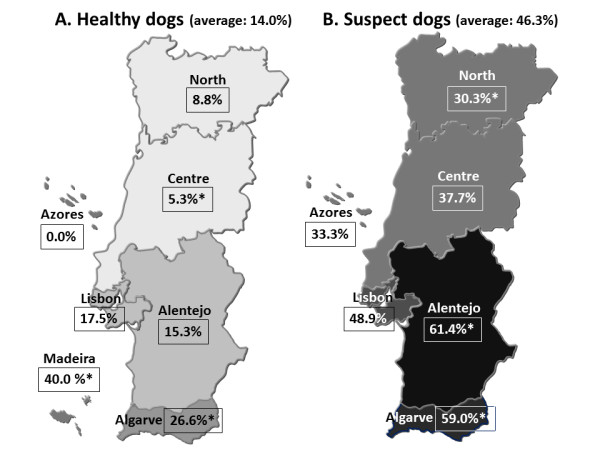
Total positivity levels to D. immitis, E. canis, B. burgdorferi, Anaplasma spp., L. infantum, one or more agents and mixed agents were 3.6%, 4.1%, 0.2%, 4.5%, 4.3%, 14.0% and 2.0% in the healthy group, and 8.9%, 16.4%, 0.5%, 9.2%, 25.2%, 46.3% and 11.6% in the clinically suspect group, respectively. Non-use of ectoparasiticides was a risk factor for positivity to one or more agents both in the apparently healthy (OR = 2.1) and CVBD-suspect (OR = 1.5) dogs. Seropositivity to L. infantum (OR = 7.6), E. canis (OR = 4.1) and D. immitis (OR = 2.4) were identified as risk factors for the presence of clinical signs compatible with CVBDs. Positivity to mixed agents was not found to be a risk factor for disease.
Dogs in Portugal are at risk of becoming infected with vector-borne pathogens, some of which are of zoonotic concern. CVBDs should be considered by practitioners and prophylactic measures must be put in place to protect dogs and limit the risk of transmission of vector-borne agents to humans. This study is expected to give veterinary and public health authorities an increased awareness about CVBDs in Portugal and to serve as a reference for future investigations and control actions.
犬媒介传染病(CVBDs)是由节肢动物(包括蜱虫和昆虫)传播给犬的多种病原体引起的。许多 CVBD 病原体具有人类病原体的特性,犬可能是人类感染的潜在储存宿主和监测哨点。本研究旨在评估葡萄牙犬感染或接触犬恶丝虫、犬埃立克体、伯氏疏螺旋体、无形体属和婴儿利什曼原虫的血清阳性率。
本研究基于葡萄牙大陆和岛屿的 120 个兽医医疗中心,对 557 只貌似健康的犬和 628 只疑似 CVBD 的犬进行了采样。使用两种商业化的临床酶联免疫吸附检测试剂盒对血清、血浆或全血进行定性检测,以检测犬恶丝虫抗原和犬埃立克体、伯氏疏螺旋体、无形体属和婴儿利什曼原虫抗体。采用逻辑回归分析计算比值比(OR),以确定接触媒介传播病原体的独立风险因素。
健康组和疑似 CVBD 组犬的犬恶丝虫、犬埃立克体、伯氏疏螺旋体、无形体属、婴儿利什曼原虫、一种或多种病原体以及混合病原体的总阳性率分别为 3.6%、4.1%、0.2%、4.5%、4.3%、14.0%和 2.0%,8.9%、16.4%、0.5%、9.2%、25.2%、46.3%和 11.6%。健康犬和疑似 CVBD 犬均未使用驱虫剂是感染一种或多种病原体的风险因素(健康犬:OR = 2.1;疑似 CVBD 犬:OR = 1.5)。血清学检测到婴儿利什曼原虫(OR = 7.6)、犬埃立克体(OR = 4.1)和犬恶丝虫(OR = 2.4)阳性与 CVBD 临床症状的存在相关。混合病原体阳性未被发现是疾病的风险因素。
葡萄牙犬存在感染媒介传播病原体的风险,其中一些病原体具有人类病原体的特性。从业者应考虑到 CVBDs 的存在,并采取预防措施,以保护犬只并限制媒介传播病原体向人类传播的风险。本研究有望提高葡萄牙兽医和公共卫生当局对 CVBDs 的认识,并为未来的调查和控制行动提供参考。