Department of Psychological and Brain Sciences, Center for Cognitive Neuroscience, Dartmouth College, Hanover NH, USA.
Front Neural Circuits. 2012 Mar 20;6:7. doi: 10.3389/fncir.2012.00007. eCollection 2012.
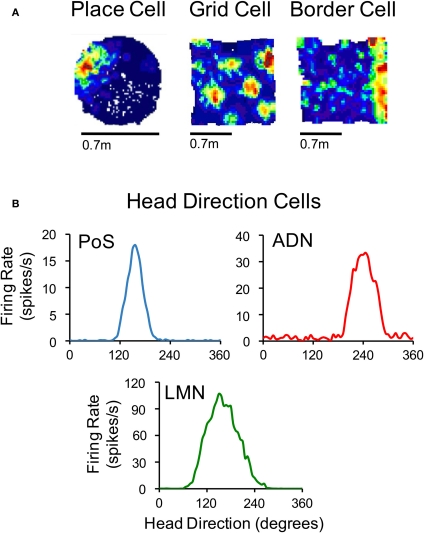
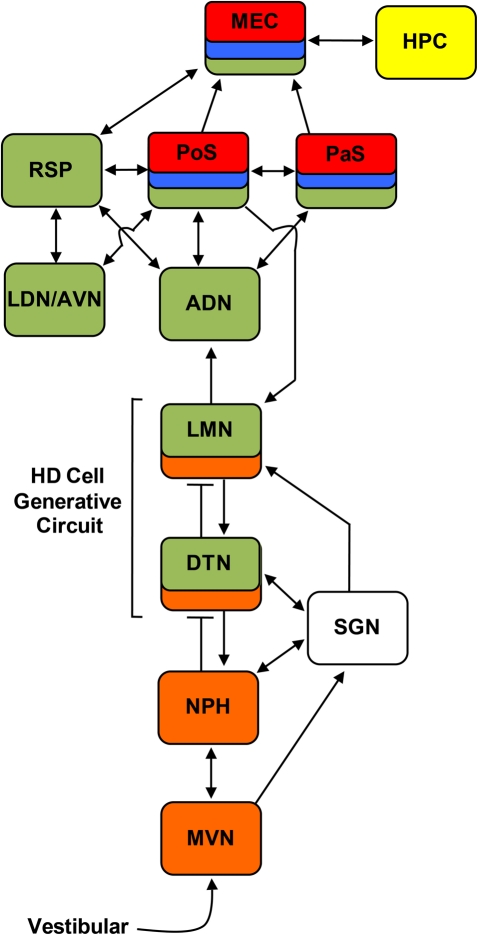
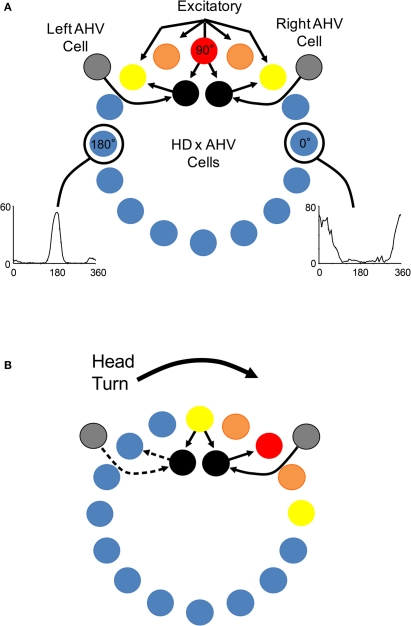
Accurate navigation depends on a network of neural systems that encode the moment-to-moment changes in an animal's directional orientation and location in space. Within this navigation system are head direction (HD) cells, which fire persistently when an animal's head is pointed in a particular direction (Sharp et al., 2001a; Taube, 2007). HD cells are widely thought to underlie an animal's sense of spatial orientation, and research over the last 25+ years has revealed that this robust spatial signal is widely distributed across subcortical and cortical limbic areas. The purpose of the present review is to summarize some of the recent studies arguing that the origin of the HD signal resides subcortically, specifically within the reciprocal connections of the dorsal tegmental and lateral mammillary nuclei. Furthermore, we review recent work identifying "bursting" cellular activity in the HD cell circuit after lesions of the vestibular system, and relate these observations to the long held view that attractor network mechanisms underlie HD signal generation. Finally, we summarize anatomical and physiological work suggesting that this attractor network architecture may reside within the tegmento-mammillary circuit.
准确的导航依赖于一个神经网络系统,该系统对动物在空间中的方向和位置的瞬间变化进行编码。在这个导航系统中,有头部方向(HD)细胞,当动物的头部指向特定方向时,这些细胞会持续发射(Sharp 等人,2001a;Taube,2007)。人们普遍认为 HD 细胞是动物空间方向感的基础,过去 25 多年的研究表明,这种强大的空间信号广泛分布于皮质下和皮质边缘区域。本综述的目的是总结一些最近的研究,这些研究表明 HD 信号的起源位于皮质下,特别是在背侧被盖和外侧乳状核的相互连接中。此外,我们回顾了最近的工作,这些工作在对前庭系统进行损伤后识别了 HD 细胞回路中的“爆发”细胞活动,并将这些观察结果与长期以来认为的吸引子网络机制是 HD 信号产生的基础的观点联系起来。最后,我们总结了一些解剖学和生理学工作,这些工作表明这种吸引子网络结构可能存在于被盖-乳状核回路中。