Bajardi P, Poletto C, Balcan D, Hu H, Goncalves B, Ramasco Jj, Paolotti D, Perra N, Tizzoni M, Van den Broeck W, Colizza V, Vespignani A
Computational Epidemiology Laboratory, Institute for Scientific Interchange, Turin, Italy.
Emerg Health Threats J. 2009;2:e11. doi: 10.3134/ehtj.09.011. Epub 2009 Nov 2.
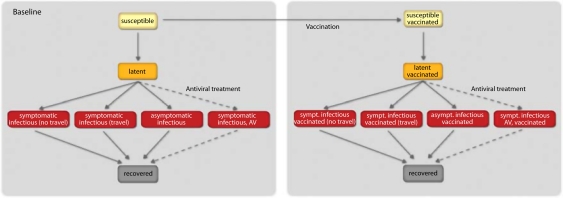
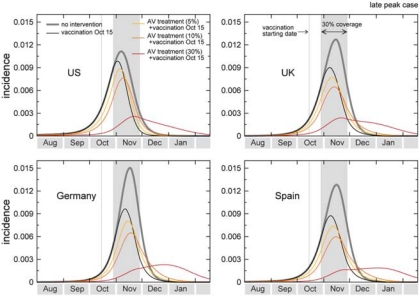
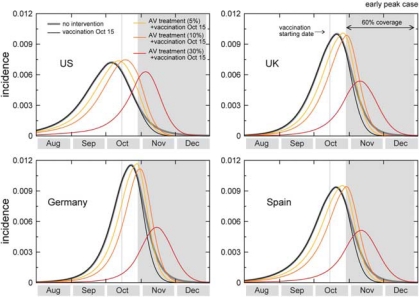
The unfolding of pandemic influenza A(H1N1) for Fall 2009 in the Northern Hemisphere is still uncertain. Plans for vaccination campaigns and vaccine trials are underway, with the first batches expected to be available early October. Several studies point to the possibility of an anticipated pandemic peak that could undermine the effectiveness of vaccination strategies. Here, we use a structured global epidemic and mobility metapopulation model to assess the effectiveness of massive vaccination campaigns for the Fall/Winter 2009. Mitigation effects are explored depending on the interplay between the predicted pandemic evolution and the expected delivery of vaccines. The model is calibrated using recent estimates on the transmissibility of the new A(H1N1) influenza. Results show that if additional intervention strategies were not used to delay the time of pandemic peak, vaccination may not be able to considerably reduce the cumulative number of cases, even when the mass vaccination campaign is started as early as mid-October. Prioritized vaccination would be crucial in slowing down the pandemic evolution and reducing its burden.
2009年秋季北半球甲型H1N1流感大流行的发展态势仍不明朗。疫苗接种运动和疫苗试验计划正在进行中,首批疫苗预计10月初可供应。多项研究指出,可能出现预期的大流行高峰,这可能会削弱疫苗接种策略的有效性。在此,我们使用一个结构化的全球疫情和人口流动元种群模型来评估2009年秋冬大规模疫苗接种运动的有效性。根据预测的大流行演变与预期的疫苗交付之间的相互作用,探讨缓解效果。该模型使用最近对新型甲型H1N1流感传播性的估计进行校准。结果表明,如果不使用额外的干预策略来推迟大流行高峰时间,即使早在10月中旬就开始大规模疫苗接种运动,疫苗接种也可能无法大幅减少累计病例数。优先接种疫苗对于减缓大流行的发展并减轻其负担至关重要。