• 文献检索
  • 文档翻译
  • 深度研究
  • 学术资讯
  • Suppr Zotero 插件Zotero 插件
  • 邀请有礼
  • 套餐&价格
  • 历史记录
应用&插件
Suppr Zotero 插件Zotero 插件浏览器插件Mac 客户端Windows 客户端微信小程序
定价
高级版会员购买积分包购买API积分包
服务
文献检索文档翻译深度研究API 文档MCP 服务
关于我们
关于 Suppr公司介绍联系我们用户协议隐私条款
关注我们

Suppr 超能文献

核心技术专利:CN118964589B侵权必究
粤ICP备2023148730 号-1Suppr @ 2026

文献检索

告别复杂PubMed语法,用中文像聊天一样搜索,搜遍4000万医学文献。AI智能推荐,让科研检索更轻松。

立即免费搜索

文件翻译

保留排版,准确专业,支持PDF/Word/PPT等文件格式,支持 12+语言互译。

免费翻译文档

深度研究

AI帮你快速写综述,25分钟生成高质量综述,智能提取关键信息,辅助科研写作。

立即免费体验

青少年时期体力活动变化的预测因素:一项为期 3.5 年的随访研究。

Predictors of physical activity change during adolescence: a 3.5-year follow-up.

机构信息

Postgraduate Program in Epidemiology, Federal University of Pelotas, Pelotas, Brazil.

出版信息

Public Health Nutr. 2012 Dec;15(12):2237-45. doi: 10.1017/S1368980012000948. Epub 2012 Mar 30.

DOI:10.1017/S1368980012000948
PMID:22464063
原文链接:https://pmc.ncbi.nlm.nih.gov/articles/PMC3501818/
Abstract

OBJECTIVE

To investigate the predictors of change in physical activity (PA) from early to mid adolescence in a cohort of adolescents.

DESIGN

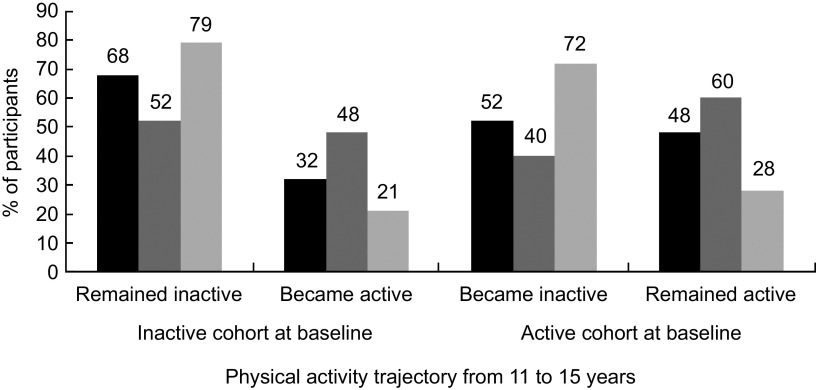
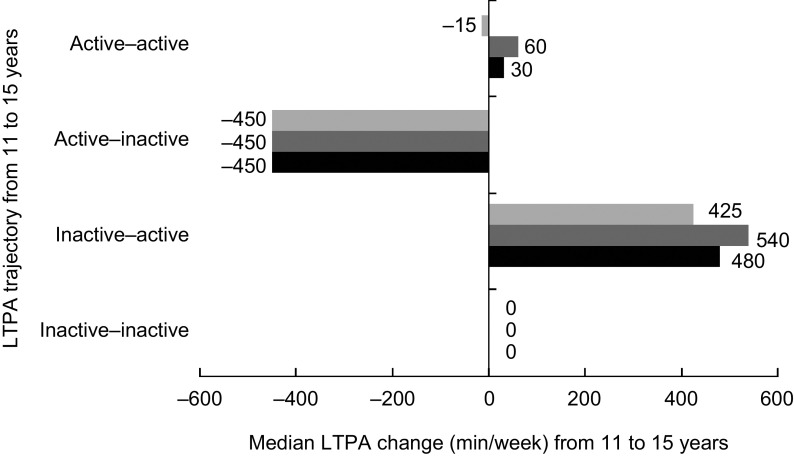
Prospective, population-based birth cohort study. PA level was evaluated by means of questionnaire, and was analysed in continuous form (min/week) and as a trajectory (inactive-inactive, inactive-active, active-inactive, active-active) based on the cut-off point of 300 min/week.

SETTING

Pelotas, a city of 340 000 inhabitants in southern Brazil.

SUBJECTS

Adolescents (n 4120) followed from 11 to 15 years of age.

RESULTS

Maternal PA change and more exposure to outdoors were directly associated with a positive change in PA level (min/week) for both genders. Higher maturation status (among boys) and later menarche were also associated with positive PA change in min/week. Predictors to remain inactive were: maternal PA change (inverse association), more exposure to outdoors, higher socio-economic level, fear of living in the neighbourhood and non-overweight girls. Predictors to become inactive were higher socio-economic level among boys and increase in screen time among girls.

CONCLUSIONS

The study demonstrates that social, family, biological, behavioural and environmental factors exert an important role in the PA change among youngsters as they move into adolescence. These findings may be relevant to the design of policies and intervention programmes aimed at promoting PA in teenagers.

摘要

目的

在青少年队列中研究从青春期早期到中期身体活动(PA)变化的预测因素。

设计

前瞻性、基于人群的出生队列研究。通过问卷评估 PA 水平,并以连续形式(分钟/周)和轨迹(不活动-不活动、不活动-活动、活动-不活动、活动-活动)进行分析,基于 300 分钟/周的截止值。

地点

巴西南部拥有 34 万居民的佩洛塔斯市。

受试者

从 11 岁到 15 岁的青少年(n=4120)。

结果

母亲 PA 变化和更多的户外活动与两性 PA 水平(分钟/周)的积极变化直接相关。较高的成熟状态(男孩)和较晚的初潮也与每周 PA 的积极变化有关。保持不活动的预测因素包括:母亲 PA 变化(负相关)、更多的户外活动、更高的社会经济水平、对邻里生活的恐惧和非超重女孩。成为不活跃的预测因素是男孩的社会经济水平较高,女孩的屏幕时间增加。

结论

该研究表明,社会、家庭、生物、行为和环境因素在青少年进入青春期时对 PA 变化起着重要作用。这些发现可能与设计旨在促进青少年 PA 的政策和干预计划有关。
https://cdn.ncbi.nlm.nih.gov/pmc/blobs/68a2/10271252/d6ef79a780eb/S1368980012000948_fig2.jpg
https://cdn.ncbi.nlm.nih.gov/pmc/blobs/68a2/10271252/5db686cf6f65/S1368980012000948_fig1.jpg
https://cdn.ncbi.nlm.nih.gov/pmc/blobs/68a2/10271252/d6ef79a780eb/S1368980012000948_fig2.jpg
https://cdn.ncbi.nlm.nih.gov/pmc/blobs/68a2/10271252/5db686cf6f65/S1368980012000948_fig1.jpg
https://cdn.ncbi.nlm.nih.gov/pmc/blobs/68a2/10271252/d6ef79a780eb/S1368980012000948_fig2.jpg

相似文献

1
Predictors of physical activity change during adolescence: a 3.5-year follow-up.青少年时期体力活动变化的预测因素:一项为期 3.5 年的随访研究。
Public Health Nutr. 2012 Dec;15(12):2237-45. doi: 10.1017/S1368980012000948. Epub 2012 Mar 30.
2
Facilitators and barriers to physical activity among English adolescents in secondary schools: a mixed method study.促进和阻碍英国中学青少年体育活动的因素:一项混合方法研究。
Front Public Health. 2023 Aug 16;11:1235086. doi: 10.3389/fpubh.2023.1235086. eCollection 2023.
3
Behavioral classes related to physical activity and sedentary behavior on the evaluation of health and mental outcomes among Brazilian adolescents.巴西青少年健康和心理结果评估中与身体活动和久坐行为相关的行为类别。
PLoS One. 2020 Jun 22;15(6):e0234374. doi: 10.1371/journal.pone.0234374. eCollection 2020.
4
Tracking of physical activity during adolescence: the 1993 Pelotas Birth Cohort, Brazil.青少年时期身体活动的追踪研究:巴西1993年佩洛塔斯出生队列研究
Rev Saude Publica. 2014 Dec;48(6):925-30. doi: 10.1590/S0034-8910.2014048005313.
5
Identifying Predictors of Changes in Physical Activity Level in Adolescence: A Prospective Analysis in Bosnia and Herzegovina.识别青少年身体活动水平变化的预测因素:波斯尼亚和黑塞哥维那的前瞻性分析。
Int J Environ Res Public Health. 2019 Jul 18;16(14):2573. doi: 10.3390/ijerph16142573.
6
Factors predicting changes in physical activity through adolescence: the Young-HUNT Study, Norway.预测青少年身体活动变化的因素:挪威 Young-HUNT 研究。
J Adolesc Health. 2011 Jun;48(6):616-24. doi: 10.1016/j.jadohealth.2010.09.013. Epub 2010 Dec 18.
7
Associations between self-reported physical activity and screen time with cardiometabolic risk factors in adolescents: Findings from the 1993 Pelotas (Brazil) Birth Cohort Study.自报体力活动与屏幕时间与青少年心血管代谢风险因素的关联:来自 1993 年佩洛塔斯(巴西)出生队列研究的结果。
Prev Med. 2019 Feb;119:31-36. doi: 10.1016/j.ypmed.2018.12.008. Epub 2018 Dec 19.
8
Age, period and cohort effects and the predictors of physical activity and sedentary behaviour among Chinese children, from 2004 to 2011.2004年至2011年中国儿童身体活动和久坐行为的年龄、时期和队列效应及预测因素
BMC Public Health. 2017 Apr 24;17(1):353. doi: 10.1186/s12889-017-4215-x.
9
Prevalence of insufficient physical activity and associated factors in Brazilian adolescents.巴西青少年身体活动不足的患病率及其相关因素
J Phys Act Health. 2008 Nov;5(6):777-94.
10
Predictors and health consequences of screen-time change during adolescence--1993 Pelotas (Brazil) birth cohort study.青少年时期屏幕时间变化的预测因素及其健康后果——1993 年佩洛塔斯(巴西)出生队列研究。
J Adolesc Health. 2012 Dec;51(6 Suppl):S16-21. doi: 10.1016/j.jadohealth.2012.06.025. Epub 2012 Nov 10.

引用本文的文献

1
Developing an Evidence- and Theory-Informed Mother-Daughter mHealth Intervention Prototype Targeting Physical Activity in Preteen Girls of Low Socioeconomic Position: Multiphase Co-Design Study.针对社会经济地位较低的青春期前女孩的身体活动,开发一个基于证据和理论的母女移动健康干预原型:多阶段协同设计研究。
JMIR Pediatr Parent. 2025 Jan 6;8:e62795. doi: 10.2196/62795.
2
Parental physical activity support for parents of children with disabilities in Saudi Arabia.沙特阿拉伯为残疾儿童家长提供的家长体育活动支持。
Heliyon. 2024 Apr 6;10(7):e29351. doi: 10.1016/j.heliyon.2024.e29351. eCollection 2024 Apr 15.
3
"It's what mothers do." A qualitative exploration of mothers' experiences of supporting their daughter to be physically active.

本文引用的文献

1
Physical activity change during adolescence: a systematic review and a pooled analysis.青少年时期体力活动的变化:系统评价和汇总分析。
Int J Epidemiol. 2011 Jun;40(3):685-98. doi: 10.1093/ije/dyq272. Epub 2011 Jan 18.
2
The 11-year follow-up of the 1993 Pelotas (Brazil) birth cohort study: methods.1993 年佩洛塔斯(巴西)出生队列研究的 11 年随访:方法。
Cad Saude Publica. 2010 Oct;26(10):1875-86. doi: 10.1590/s0102-311x2010001000003.
3
Three-year follow-up of physical activity in Norwegian youth from two ethnic groups: associations with socio-demographic factors.
“这是母亲们应该做的。”一项关于母亲支持女儿进行身体活动的经验的定性研究。
PLoS One. 2024 Apr 1;19(4):e0299260. doi: 10.1371/journal.pone.0299260. eCollection 2024.
4
The Degree of Problematic Technology Use Negatively Affects Physical Activity Level, Adherence to Mediterranean Diet and Psychological State of Adolescents.问题性技术使用程度对青少年的身体活动水平、坚持地中海饮食情况及心理状态产生负面影响。
Healthcare (Basel). 2023 Jun 11;11(12):1706. doi: 10.3390/healthcare11121706.
5
Improving Body Mass Index in Students with Excess Weight through a Physical Activity Programme.通过体育活动计划提高超重学生的体重指数
Children (Basel). 2022 Oct 27;9(11):1638. doi: 10.3390/children9111638.
6
Factors associated with changes in physical activity and sedentary behaviour during one year among university-based young adults.与大学青年成年人一年内身体活动和久坐行为变化相关的因素。
Sports Med Health Sci. 2021 Oct 1;3(4):236-242. doi: 10.1016/j.smhs.2021.09.002. eCollection 2021 Dec.
7
Parental Factors Related to Physical Activity among Adolescent Men Living in Built and Natural Environment: A Population-Based MOPO Study.父母因素与居住在人工和自然环境中的青少年男性身体活动的关系:基于人群的 MOPO 研究。
J Environ Public Health. 2021 May 24;2021:3234083. doi: 10.1155/2021/3234083. eCollection 2021.
8
Factors Predicting Physical Activity and Sports Participation in Adolescence.预测青少年体育活动和运动参与的因素。
J Environ Public Health. 2021 Feb 24;2021:9105953. doi: 10.1155/2021/9105953. eCollection 2021.
9
Physical Activity Trajectories among Persons of Turkish Descent Living in Germany-A Cohort Study.生活在德国的土耳其裔人群的身体活动轨迹:一项队列研究。
Int J Environ Res Public Health. 2020 Aug 31;17(17):6349. doi: 10.3390/ijerph17176349.
10
Combined Patterns Of Physical Activity And Screen-Related Sedentary Behavior Among Chinese Adolescents And Their Correlations With Depression, Anxiety And Self-Injurious Behaviors.中国青少年身体活动与屏幕相关久坐行为的综合模式及其与抑郁、焦虑和自伤行为的相关性
Psychol Res Behav Manag. 2019 Nov 11;12:1041-1050. doi: 10.2147/PRBM.S220075. eCollection 2019.
对两个种族群体的挪威青少年身体活动情况进行的三年随访:与社会人口学因素的关联
BMC Public Health. 2008 Dec 22;8:419. doi: 10.1186/1471-2458-8-419.
4
Self-efficacy moderates the relation between declines in physical activity and perceived social support in high school girls.自我效能感调节了高中女生体育活动减少与感知到的社会支持之间的关系。
J Pediatr Psychol. 2009 May;34(4):441-51. doi: 10.1093/jpepsy/jsn100. Epub 2008 Sep 23.
5
Longitudinal stability of sedentary behaviors and physical activity during early adolescence.青春期早期久坐行为和身体活动的纵向稳定性。
Pediatr Exerc Sci. 2008 Aug;20(3):251-62. doi: 10.1123/pes.20.3.251.
6
A longitudinal examination of the influence of maturation on physical self-perceptions and the relationship with physical activity in early adolescent girls.对青春期早期女孩成熟度对身体自我认知的影响及其与体育活动关系的纵向研究。
J Adolesc. 2009 Jun;32(3):555-66. doi: 10.1016/j.adolescence.2008.06.001. Epub 2008 Aug 8.
7
Moderate-to-vigorous physical activity from ages 9 to 15 years.9至15岁的中度至剧烈体育活动。
JAMA. 2008 Jul 16;300(3):295-305. doi: 10.1001/jama.300.3.295.
8
Influence of physical activity on change in weight status as children become adolescents.儿童成长为青少年过程中,身体活动对体重状况变化的影响。
Int J Pediatr Obes. 2008;3(2):69-77. doi: 10.1080/17477160701789794.
9
Changes in physical activity in adolescent girls: a latent growth modelling approach.青春期女孩身体活动的变化:一种潜在增长模型方法。
Acta Paediatr. 2008 May;97(5):647-52. doi: 10.1111/j.1651-2227.2008.00748.x.
10
[Biological and socio-cultural determinants of physical activity in adolescents].[青少年身体活动的生物学和社会文化决定因素]
Cad Saude Publica. 2008 Apr;24(4):721-36. doi: 10.1590/s0102-311x2008000400002.