Department of Neurology, Christian-Albrechts University, Kiel, Germany.
PLoS One. 2012;7(3):e33928. doi: 10.1371/journal.pone.0033928. Epub 2012 Mar 21.
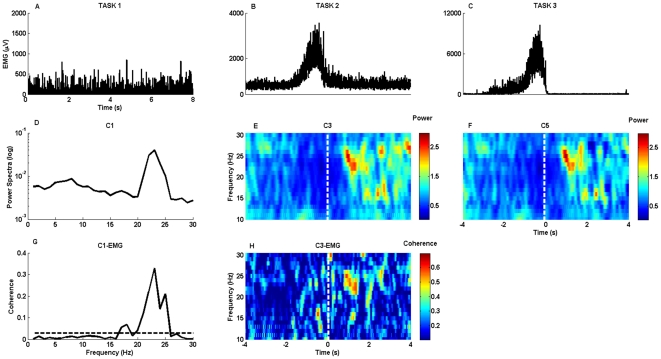
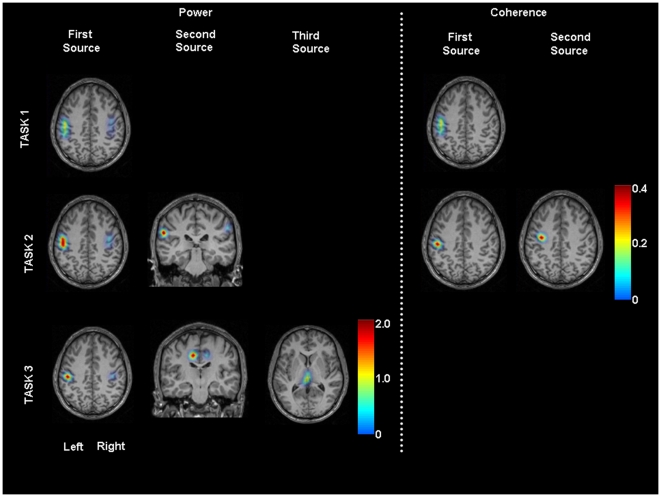
We hypothesized that post-movement beta synchronization (PMBS) and cortico-muscular coherence (CMC) during movement termination relate to each other and have similar role in sensorimotor integration. We calculated the parameters and estimated the sources of these phenomena.We measured 64-channel EEG simultaneously with surface EMG of the right first dorsal interosseus muscle in 11 healthy volunteers. In Task1, subjects kept a medium-strength contraction continuously; in Task2, superimposed on this movement, they performed repetitive self-paced short contractions. In Task3 short contractions were executed alone. Time-frequency analysis of the EEG and CMC was performed with respect to the offset of brisk movements and averaged in each subject. Sources of PMBS and CMC were also calculated.High beta power in Task1, PMBS in Task2-3, and CMC in Task1-2 could be observed in the same individual frequency bands. While beta synchronization in Task1 and PMBS in Task2-3 appeared bilateral with contralateral predominance, CMC in Task1-2 was strictly a unilateral phenomenon; their main sources did not differ contralateral to the movement in the primary sensorimotor cortex in 7 of 11 subjects in Task1, and in 6 of 9 subjects in Task2. In Task2, CMC and PMBS had the same latency but their amplitudes did not correlate with each other. In Task2, weaker PMBS source was found bilaterally within the secondary sensory cortex, while the second source of CMC was detected in the premotor cortex, contralateral to the movement. In Task3, weaker sources of PMBS could be estimated in bilateral supplementary motor cortex and in the thalamus. PMBS and CMC appear simultaneously at the end of a phasic movement possibly suggesting similar antikinetic effects, but they may be separate processes with different active functions. Whereas PMBS seems to reset the supraspinal sensorimotor network, cortico-muscular coherence may represent the recalibration of cortico-motoneuronal and spinal systems.
我们假设运动终止时的后运动β同步(PMBS)和皮质-肌肉相干性(CMC)相互关联,并且在感觉运动整合中具有相似的作用。我们计算了这些现象的参数并估计了其来源。我们在 11 名健康志愿者中同时测量了 64 通道 EEG 和右侧第一背间骨间肌的表面肌电图。在任务 1 中,受试者持续保持中等强度的收缩;在任务 2 中,在这个运动之上叠加了重复的自我调节的短收缩。在任务 3 中,单独执行短收缩。针对快速运动的偏移对 EEG 和 CMC 进行了时频分析,并在每个受试者中进行了平均。还计算了 PMBS 和 CMC 的源。在同一个个体的相同频带中,可以观察到任务 1 中的高β功率、任务 2-3 中的 PMBS 和任务 1-2 中的 CMC。虽然任务 1 中的β同步和任务 2-3 中的 PMBS 表现出双侧优势,但任务 1-2 中的 CMC 是一种严格的单侧现象;在任务 1 中,7 名受试者中有 6 名和任务 2 中 9 名受试者中有 6 名,其主要源在运动对侧的初级感觉运动皮层中没有差异。在任务 2 中,CMC 和 PMBS 具有相同的潜伏期,但它们的幅度彼此不相关。在任务 2 中,在次级感觉皮层中双侧发现了较弱的 PMBS 源,而 CMC 的第二个源则在运动对侧的运动前皮层中检测到。在任务 3 中,可以在双侧补充运动皮层和丘脑估计较弱的 PMBS 源。PMBS 和 CMC 可能在相运动结束时同时出现,这可能表明类似的抗运动效应,但它们可能是具有不同主动功能的不同过程。虽然 PMBS 似乎重置了脊髓上的感觉运动网络,但皮质-肌肉相干性可能代表皮质-运动神经元和脊髓系统的重新校准。