Tamás Gertrúd, Chirumamilla Venkata C, Anwar Abdul R, Raethjen Jan, Deuschl Günther, Groppa Sergiu, Muthuraman Muthuraman
Department of Neurology, Semmelweis University, Budapest, Hungary.
Section of Movement Disorders and Neurostimulation, Biomedical Statistics and Multimodal Signal Processing Unit, Department of Neurology, Focus Program Translational Neuroscience (FTN), University Medical Center of the Johannes Gutenberg University Mainz, Mainz, Germany.
Front Hum Neurosci. 2018 Apr 6;12:130. doi: 10.3389/fnhum.2018.00130. eCollection 2018.
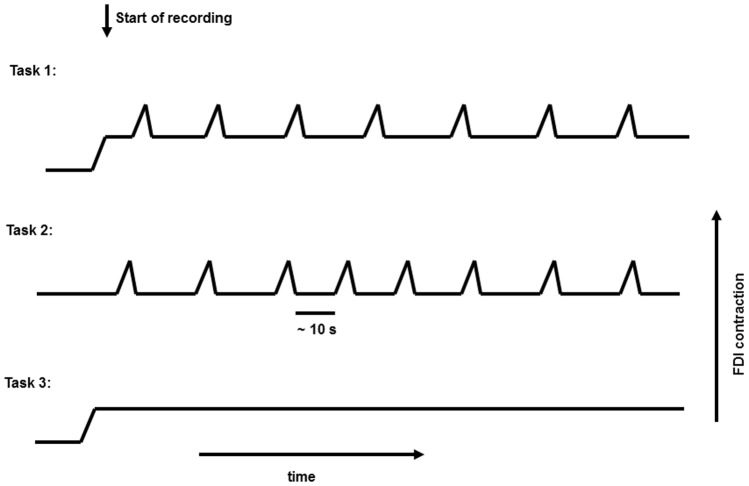
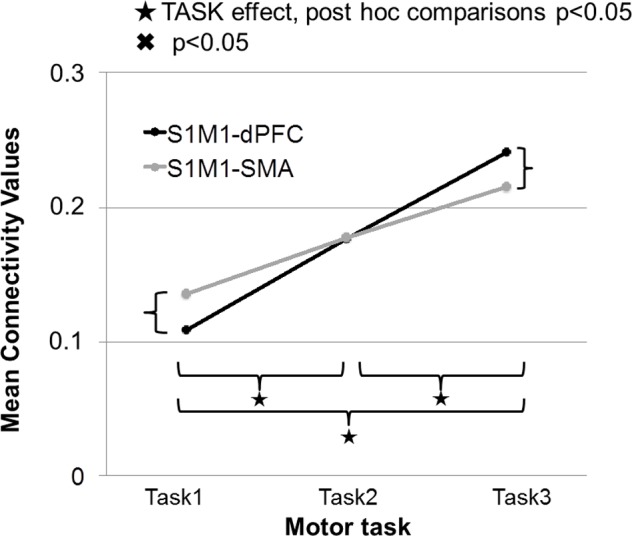
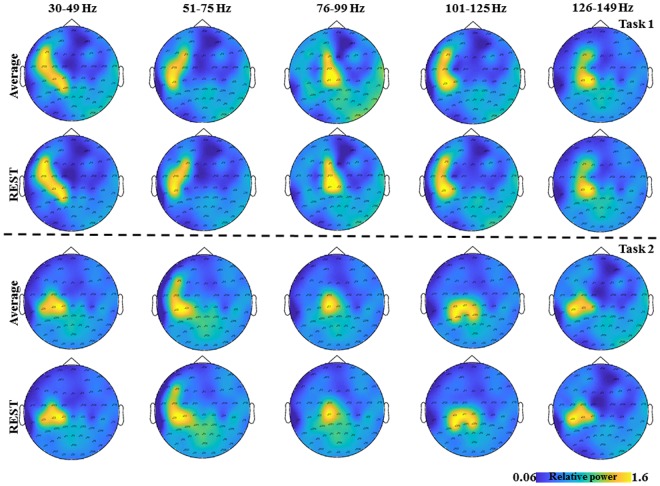
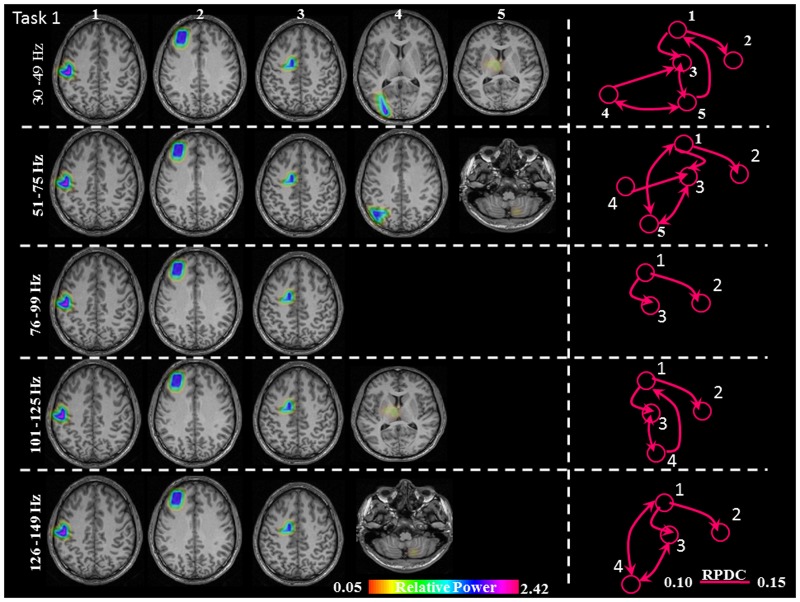
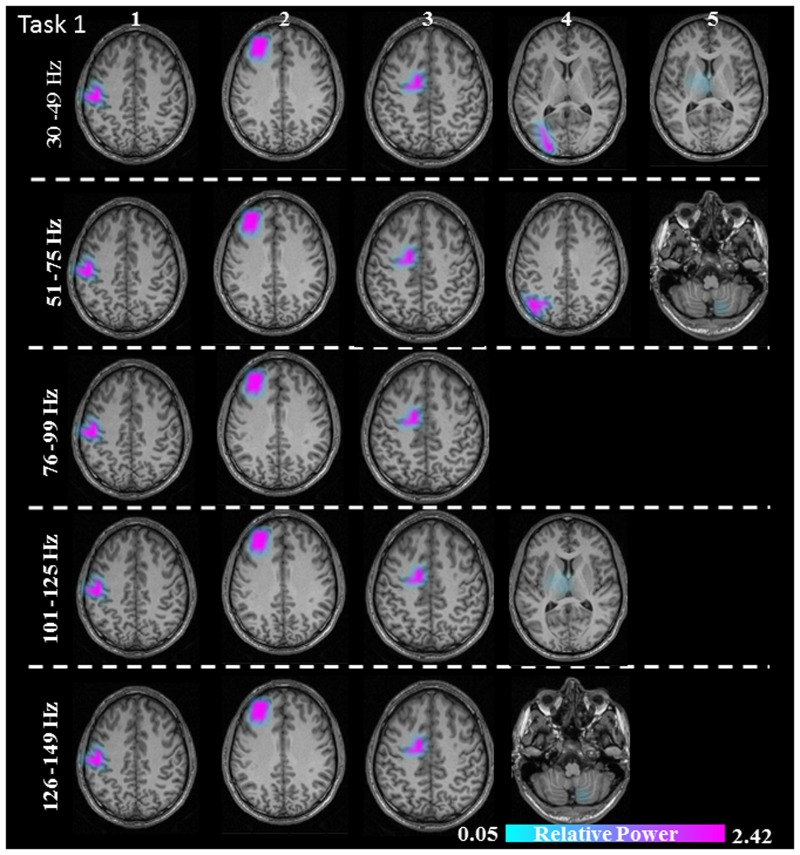
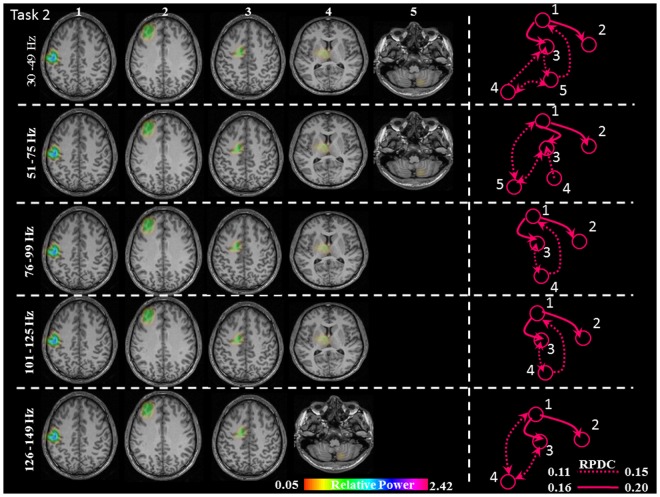
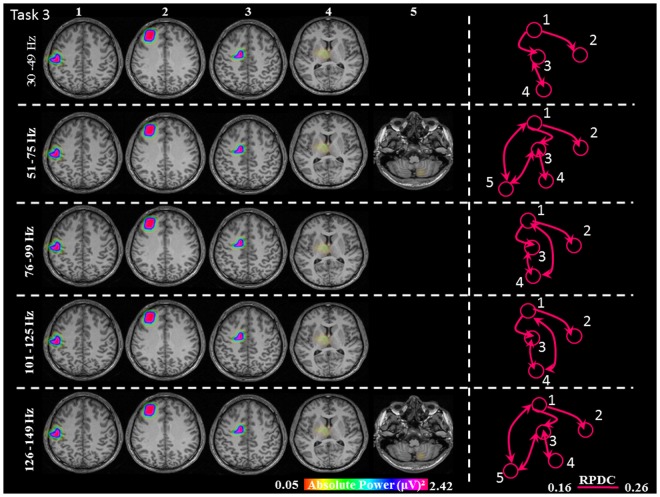
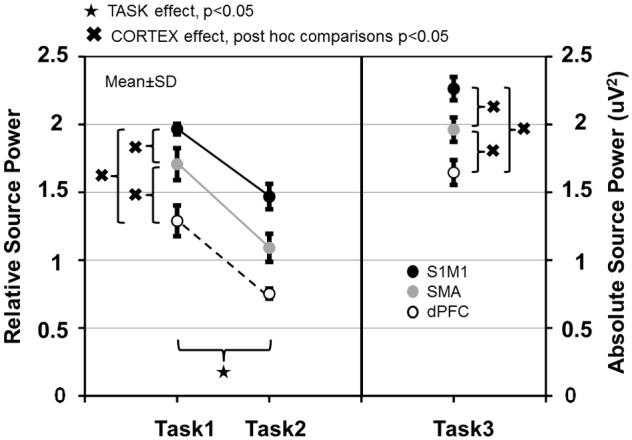
Gamma synchronization (GS) may promote the processing between functionally related cortico-subcortical neural populations. Our aim was to identify the sources of GS and to analyze the direction of information flow in cerebral networks at the beginning of phasic movements, and during medium-strength isometric contraction of the hand. We measured 64-channel electroencephalography in 11 healthy volunteers (age: 25 ± 8 years; four females); surface electromyography detected the movements of the dominant hand. In Task 1, subjects kept a constant medium-strength contraction of the first dorsal interosseus muscle, and performed a superimposed repetitive voluntary self-paced brisk squeeze of an object. In Task 2, brisk, and in Task 3, constant contractions were performed. Time-frequency analysis of the EEG signal was performed with the multitaper method. GS sources were identified in five frequency bands (30-49, 51-75, 76-99, 101-125, and 126-149 Hz) with beamformer inverse solution dynamic imaging of coherent sources. The direction of information flow was estimated by renormalized partial directed coherence for each frequency band. The data-driven surrogate test, and the time reversal technique were performed to identify significant connections. In all tasks, we depicted the first three common sources for the studied frequency bands that were as follows: contralateral primary sensorimotor cortex (S1M1), dorsolateral prefrontal cortex (dPFC) and supplementary motor cortex (SMA). GS was detected in narrower low- (∼30-60 Hz) and high-frequency bands (>51-60 Hz) in the contralateral thalamus and ipsilateral cerebellum in all three tasks. The contralateral posterior parietal cortex was activated only in Task 1. In every task, S1M1 had efferent information flow to the SMA and the dPFC while dPFC had no detected afferent connections to the network in the gamma range. Cortical-subcortical information flow captured by the GS was dynamically variable in the narrower frequency bands for the studied movements. A distinct cortical network was identified for GS in voluntary hand movement tasks. Our study revealed that S1M1 modulated the activity of interconnected cortical areas through GS, while subcortical structures modulated the motor network dynamically, and specifically for the studied movement program.
γ同步化(GS)可能促进功能相关的皮质 - 皮质下神经群体之间的信息处理。我们的目的是确定GS的来源,并分析在阶段性运动开始时以及手部中等强度等长收缩期间大脑网络中的信息流方向。我们对11名健康志愿者(年龄:25±8岁;4名女性)进行了64通道脑电图测量;表面肌电图检测优势手的运动。在任务1中,受试者保持第一背侧骨间肌的持续中等强度收缩,并对物体进行叠加的重复性自主节奏轻快挤压。在任务2中进行轻快收缩,在任务3中进行持续收缩。使用多 taper 方法对脑电图信号进行时频分析。通过相干源的波束形成器逆解动态成像在五个频带(30 - 49、51 - 75、76 - 99、101 - 125和126 - 149 Hz)中识别GS源。通过对每个频带进行重新归一化偏相干来估计信息流方向。进行数据驱动的替代测试和时间反转技术以识别显著连接。在所有任务中,我们描绘了所研究频带的前三个常见源,如下所示:对侧初级感觉运动皮层(S1M1)、背外侧前额叶皮层(dPFC)和辅助运动皮层(SMA)。在所有三个任务中,在对侧丘脑和同侧小脑中较窄的低频带(约30 - 60 Hz)和高频带(>51 - 60 Hz)中检测到GS。对侧后顶叶皮层仅在任务1中被激活。在每个任务中,S1M1向SMA和dPFC有传出信息流,而在γ范围内未检测到dPFC与网络的传入连接。GS捕获的皮质 - 皮质下信息流在较窄频带中针对所研究的运动是动态可变的。在自愿手部运动任务中为GS识别出一个独特的皮质网络。我们的研究表明,S1M1通过GS调节相互连接的皮质区域的活动,而皮质下结构动态调节运动网络,并且具体针对所研究的运动程序。