Centro de Investigaciones sobre Enfermedades Infecciosas-CISEI, Instituto Nacional de Salud Pública-INSP, Cuernavaca-62100, México.
BMC Public Health. 2012 Apr 2;12:262. doi: 10.1186/1471-2458-12-262.
Vector control programs, which have focused mainly on the patient house and peridomestic areas around dengue cases, have not produced the expected impact on transmission. This project will evaluate the assumption that the endemic/epidemic transmission of dengue begins around peridomestic vicinities of the primary cases. Its objective is to assess the relationship between symptomatic dengue case exposure and peridomestic infection incidence.
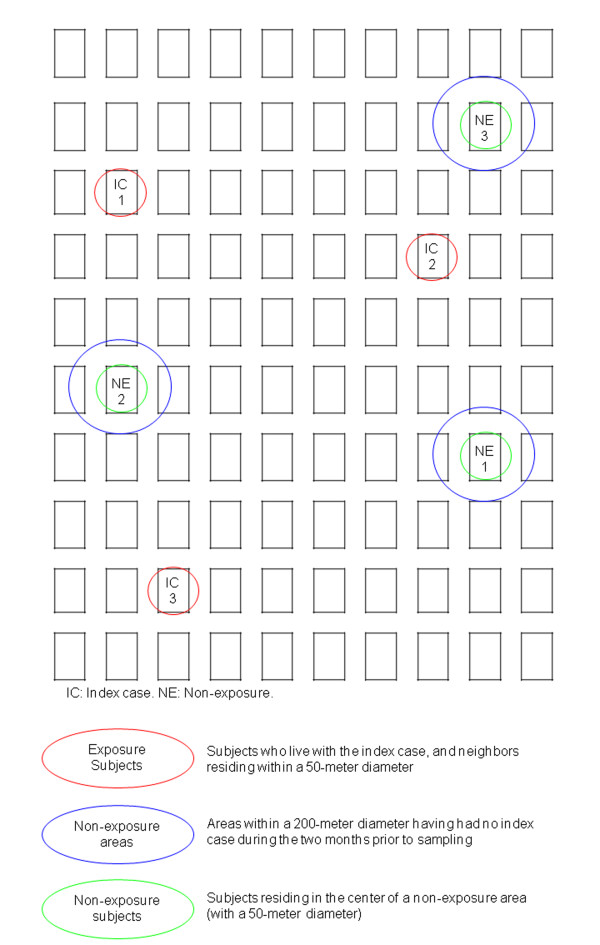
METHODS/DESIGN: A prospective cohort study will be conducted (in Tepalcingo and Axochiapan, in the state of Morelos, Mexico), using the state surveillance system for the detection of incident cases. Paired blood specimens will be collected from both the individuals who live with the incident cases and a sample of subjects residing within a 25-meter radius of such cases (exposed cohort), in order to measure dengue-specific antibodies. Other subjects will be selected from areas which have not presented any incident cases within 200 meters, during the two months preceding the sampling (non-exposed cohort). Symptomatic/asymptomatic incident infection will be considered as the dependent variable, exposure to confirmed dengue cases, as the principal variable, and the socio-demographic, environmental and socio-cultural conditions of the subjects, as additional explanatory variables.
Results indicating a high infection rate among the exposed subjects would justify the application of peridomestic control measures and call for an evaluation of alternate causes for insufficient program impact. On the other hand, a low incidence of peridomestic-infected subjects would support the hypothesis that infection occurs outside the domicile, and would thus explain why the vector control measures applied in the past have exerted such a limited impact on cases incidence rates. The results of the present study may therefore serve to reassess site selection for interventions of this type.
以登革热病例的病家和周边地区为重点的病媒控制项目,并未对传播产生预期的影响。本项目将评估以下假设,即登革热的地方性/流行传播始于主要病例的周边家庭环境。其目的是评估有症状的登革热病例接触与家庭周边感染发病率之间的关系。
方法/设计:将在墨西哥莫雷洛斯州的特帕琴戈和阿肖克潘进行一项前瞻性队列研究,利用该州的监测系统来发现新发病例。将从与新发病例同住的个体以及居住在距此类病例 25 米半径范围内的样本中采集配对的血液标本(暴露队列),以测量登革热特异性抗体。还将从距离采样前两个月内未出现任何新发病例的 200 米范围内的区域中选择其他个体(非暴露队列)。将有症状/无症状的新发病例感染视为因变量,确诊的登革热病例暴露作为主要变量,以及研究对象的社会人口学、环境和社会文化条件作为附加解释变量。
如果暴露组中的感染率很高,结果将证明实施家庭周边控制措施是合理的,并需要评估造成项目效果不佳的其他原因。另一方面,如果家庭周边感染的发生率较低,则支持感染发生在家庭之外的假设,这可以解释过去应用的病媒控制措施为何对病例发病率的影响如此有限。因此,本研究的结果可用于重新评估此类干预措施的地点选择。