Department of Chemistry, University of Toronto Scarborough, Toronto, Ontario, Canada.
Environ Health Perspect. 2012 Apr;120(4):554-9. doi: 10.1289/ehp.1104236. Epub 2012 Jan 24.
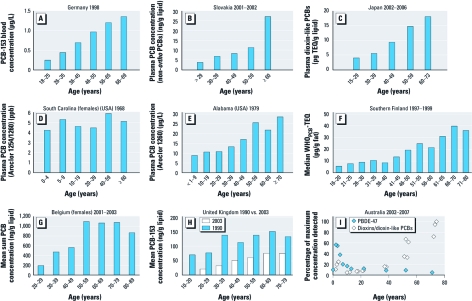
Body burdens of persistent bioaccumulative contaminants estimated from the cross-sectional biomonitoring of human populations are often plotted against age. Such relationships have previously been assumed to reflect the role of age in bioaccumulation.
We used a mechanistic modeling approach to reproduce concentration-versus-age relationships and investigate factors that influence them.
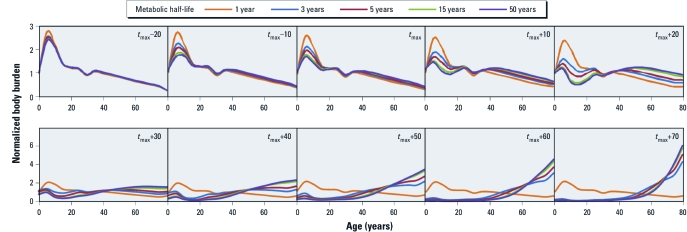
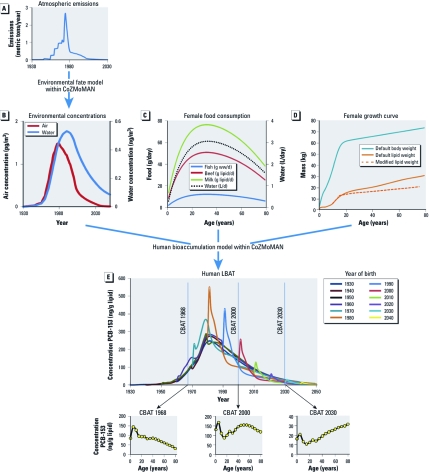
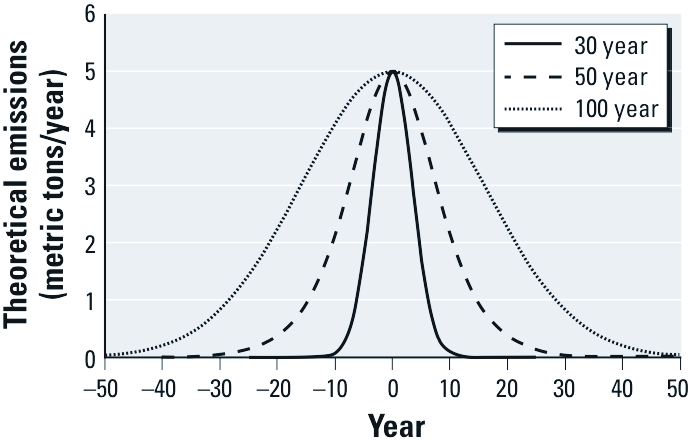
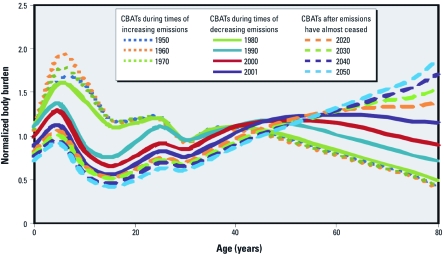
CoZMoMAN is an environmental fate and human food chain bioaccumulation model that estimates time trends in human body burdens in response to time-variant environmental emissions. Trends of polychlorinated biphenyl (PCB) congener 153 concentrations versus age for population cross sections were estimated using simulated longitudinal data for individual women born at different times. The model was also used to probe the influence of partitioning and degradation properties, length of emissions, and model assumptions regarding lipid content and liver metabolism on concentration-age trends of bioaccumulative and persistent contaminants.
Body burden-age relationships for population cross sections and individuals over time are not equivalent. The time lapse between the peak in emissions and sample collection for biomonitoring is the most influential factor controlling the shape of concentration-age trends for chemicals with human metabolic half-lives longer than 1 year. Differences in observed concentration-age trends for PCBs and polybrominated diphenyl ethers are consistent with differences in emission time trends and human metabolic half-lives.
Bioaccumulation does not monotonically increase with age. Our model suggests that the main predictors of cross-sectional body burden trends with age are the amount of time elapsed after peak emissions and the human metabolic and environmental degradation rates.
通过对人群进行横断面生物监测来估计持久性生物蓄积污染物的体内负荷,通常会根据年龄绘制这些负荷与年龄的关系图。此前,人们曾假设这种关系反映了年龄对生物蓄积的作用。
我们使用一种基于机制的建模方法来再现浓度与年龄的关系,并研究影响这些关系的因素。
CoZMoMAN 是一种环境归宿和人类食物链生物累积模型,它根据时变的环境排放来估计人体负荷随时间的变化趋势。利用不同时期出生的个体的模拟纵向数据,估算了人群横断面中多氯联苯 (PCB) 同系物 153 浓度随年龄的变化趋势。该模型还用于探讨分配和降解特性、排放持续时间、以及关于脂质含量和肝脏代谢的模型假设对生物蓄积和持久性污染物浓度-年龄趋势的影响。
人群横断面和个体随时间的体负荷-年龄关系并不等效。从排放高峰期到生物监测采样的时间间隔是控制化学物质浓度-年龄趋势形状的最具影响力的因素,这些化学物质的人体代谢半衰期超过 1 年。观察到的 PCB 和多溴联苯醚的浓度-年龄趋势差异与排放时间趋势和人体代谢半衰期差异一致。
生物蓄积不会随年龄单调增加。我们的模型表明,与年龄相关的横断面体负荷趋势的主要预测因子是从排放高峰期到现在的时间间隔以及人体代谢和环境降解率。