Central Sericultural Research and Training Institute, Central Silk board, Berhampore 742 101 , India.
AoB Plants. 2011;2011:plr002. doi: 10.1093/aobpla/plr002. Epub 2011 Jan 20.
Micro-morphological characteristics can influence fungal infectivity. We sought links between micro-morphology and resistance to powdery mildew in mulberry with the intention of assisting selection of disease-resistant lines.
Over 3 years and under field conditions, we evaluated 30 lines of mulberry with contrasting susceptibilities to powdery mildew (15 resistant and 15 susceptible). Disease severity was related statistically to stomatal area, stomatal density, stomatal index, upper and lower cuticular thicknesses, leaf thickness and trichome density.
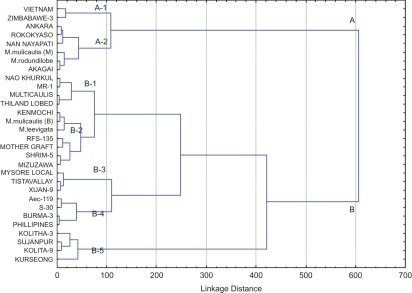
Differences between lines were significant (P <0.05) for all characters studied. Variation between the resistant and susceptible groups was statistically highly significant (P <0.01) for stomatal index, stomatal area and trichome density. The powdery mildew-resistant group was distinguished by 17.4 % lower stomatal density, 12.5 % smaller stomatal index per unit leaf area, 20.0 % greater trichome density and 18.0 % higher stomatal area compared with the susceptible group. Trichome density was negatively correlated with disease severity index and with the accumulative area under disease progression curves. Stomatal density was positively correlated with both measures of disease severity. Although stomatal area was negatively related to disease severity index (r = -0.28; P <0.05), the correlation was weak. There was no statistically significant relationship between stomatal area and the accumulative area under disease progression curves. The germplasm was partitioned into seven sub-groups based on hierarchical cluster analysis derived from pooled disease severity index scores and three highly significant micro-morphological characters. Eighty per cent of the resistant germplasm accumulated in three cluster components (A1, A2 and B2) characterized by high trichome densities and a high stomatal density and stomatal index.
Resistance to powdery mildew in mulberry is associated with trichome and stomatal features rather than leaf and epidermal thicknesses. Trichome density, stomatal density and stomatal index are shown to be promising markers for screening powdery mildew resistance in breeding programmes.
微观形态特征会影响真菌的感染力。我们试图在桑树中寻找微观形态与白粉病抗性之间的联系,目的是帮助筛选抗病品系。
在 3 年的时间里,我们在田间条件下评估了 30 个具有不同白粉病抗性的桑树品系(15 个抗性和 15 个易感)。严重程度与气孔面积、气孔密度、气孔指数、上下表皮厚度、叶片厚度和毛状体密度进行了统计学关联。
所有研究性状的品系间差异均具有统计学意义(P<0.05)。抗性和敏感组间的变异在气孔指数、气孔面积和毛状体密度方面具有统计学高度显著性(P<0.01)。与易感组相比,白粉病抗性组的气孔密度低 17.4%,单位叶面积的气孔指数小 12.5%,毛状体密度大 20.0%,气孔面积大 18.0%。毛状体密度与病情严重指数和病情进展曲线下累积面积呈负相关。气孔密度与两种病情严重度衡量指标均呈正相关。虽然气孔面积与病情严重指数呈负相关(r=-0.28;P<0.05),但相关性较弱。气孔面积与病情进展曲线下累积面积无统计学显著关系。基于 pooled 病情严重指数得分和三个高度显著微观形态学特征,通过层次聚类分析将种质分为七个亚组。80%的抗性种质积累在三个聚类成分(A1、A2 和 B2)中,其特征是毛状体密度高,气孔密度和气孔指数高。
桑树对白粉病的抗性与毛状体和气孔特征有关,而与叶片和表皮厚度无关。毛状体密度、气孔密度和气孔指数被证明是筛选抗病性的有前途的标记。