Department of Entomology, North Carolina State University, Raleigh, North Carolina, United States of America.
PLoS One. 2012;7(3):e34601. doi: 10.1371/journal.pone.0034601. Epub 2012 Mar 29.
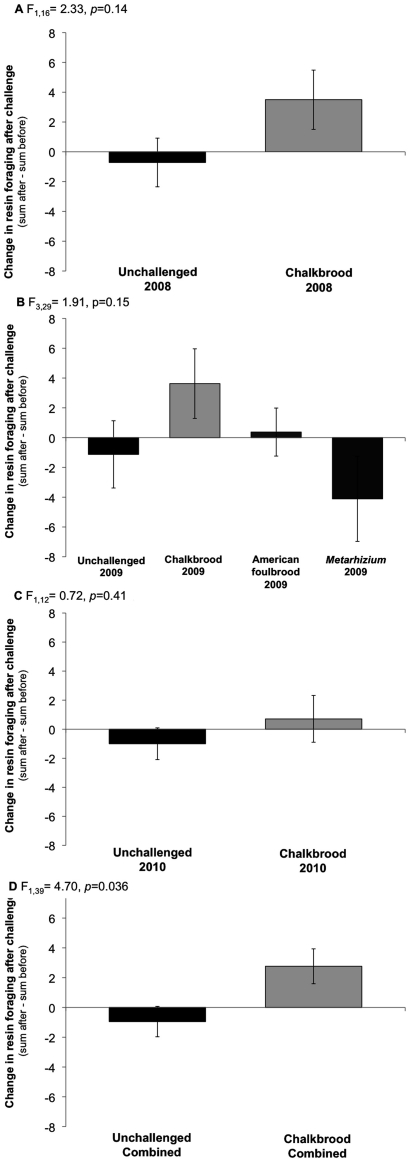
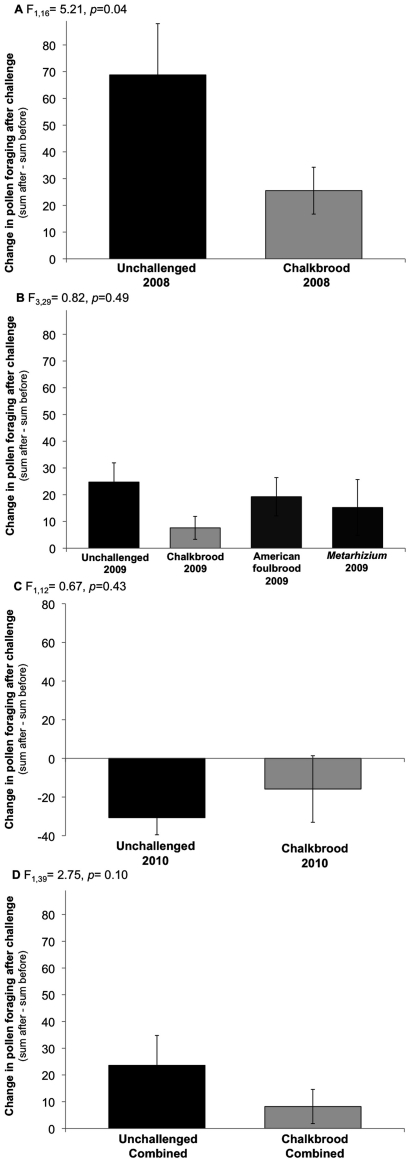
The constant pressure posed by parasites has caused species throughout the animal kingdom to evolve suites of mechanisms to resist infection. Individual barriers and physiological defenses are considered the main barriers against parasites in invertebrate species. However, behavioral traits and other non-immunological defenses can also effectively reduce parasite transmission and infection intensity. In social insects, behaviors that reduce colony-level parasite loads are termed "social immunity." One example of a behavioral defense is resin collection. Honey bees forage for plant-produced resins and incorporate them into their nest architecture. This use of resins can reduce chronic elevation of an individual bee's immune response. Since high activation of individual immunity can impose colony-level fitness costs, collection of resins may benefit both the individual and colony fitness. However the use of resins as a more direct defense against pathogens is unclear. Here we present evidence that honey bee colonies may self-medicate with plant resins in response to a fungal infection. Self-medication is generally defined as an individual responding to infection by ingesting or harvesting non-nutritive compounds or plant materials. Our results show that colonies increase resin foraging rates after a challenge with a fungal parasite (Ascophaera apis: chalkbrood or CB). Additionally, colonies experimentally enriched with resin had decreased infection intensities of this fungal parasite. If considered self-medication, this is a particularly unique example because it operates at the colony level. Most instances of self-medication involve pharmacophagy, whereby individuals change their diet in response to direct infection with a parasite. In this case with honey bees, resins are not ingested but used within the hive by adult bees exposed to fungal spores. Thus the colony, as the unit of selection, may be responding to infection through self-medication by increasing the number of individuals that forage for resin.
寄生虫的持续压力导致动物界的各个物种进化出一系列抵抗感染的机制。个体屏障和生理防御被认为是无脊椎动物物种抵御寄生虫的主要屏障。然而,行为特征和其他非免疫防御也可以有效地减少寄生虫的传播和感染强度。在社会性昆虫中,降低群体寄生虫负荷的行为被称为“社会免疫”。一种行为防御的例子是树脂收集。蜜蜂采集植物产生的树脂并将其纳入巢结构中。这种树脂的使用可以降低单个蜜蜂免疫反应的慢性升高。由于个体免疫的高度激活会对群体适应度造成代价,因此收集树脂可能对个体和群体适应度都有益。然而,树脂作为一种更直接的防御病原体的手段尚不清楚。在这里,我们提供的证据表明,蜜蜂群体可能会对真菌感染自我用药,即用植物树脂进行治疗。自我用药一般被定义为个体通过摄取或收获非营养化合物或植物材料来应对感染。我们的研究结果表明,在受到真菌寄生虫(Ascophaera apis: chalkbrood 或 CB)的挑战后,蜜蜂群体增加了树脂觅食的速度。此外,实验中用树脂富集的群体感染这种真菌寄生虫的强度降低。如果被认为是自我用药,这是一个特别独特的例子,因为它是在群体水平上运作的。大多数自我用药的例子都涉及到药理学,即个体通过改变饮食来应对寄生虫的直接感染。在这种情况下,蜜蜂不是摄取树脂,而是将暴露在真菌孢子中的成年蜜蜂在蜂巢内使用树脂。因此,作为选择单位的群体可能通过增加寻找树脂的个体数量来对感染做出自我用药的反应。