Hsu Chien-Wei, Sun Shu-Fen, Lin Shoa-Lin, Huang Hsiu-Hua, Wong Kam-Fai
Intensive Care Unit, Department of Medicine, Kaohsiung Veterans General Hospital, 386 Ta-Chung 1st Road, Kaohsiung City 813, Taiwan.
Crit Care. 2012 Dec 12;16(2):R56. doi: 10.1186/cc11299.
Hyperglycemia and protein loss are common in critically ill patients. Insulin can be used to lower blood glucose and inhibit proteolysis. The impact of moderate insulin therapy on protein metabolism in critically ill patients has not been evaluated. We compared urinary nitrogen excretion, nitrogen balance, serum albumin concentrations, prealbumin concentrations, and clinical outcomes between patients receiving moderate insulin therapy (MIT) and conventional insulin therapy (CIT) in a medical ICU.
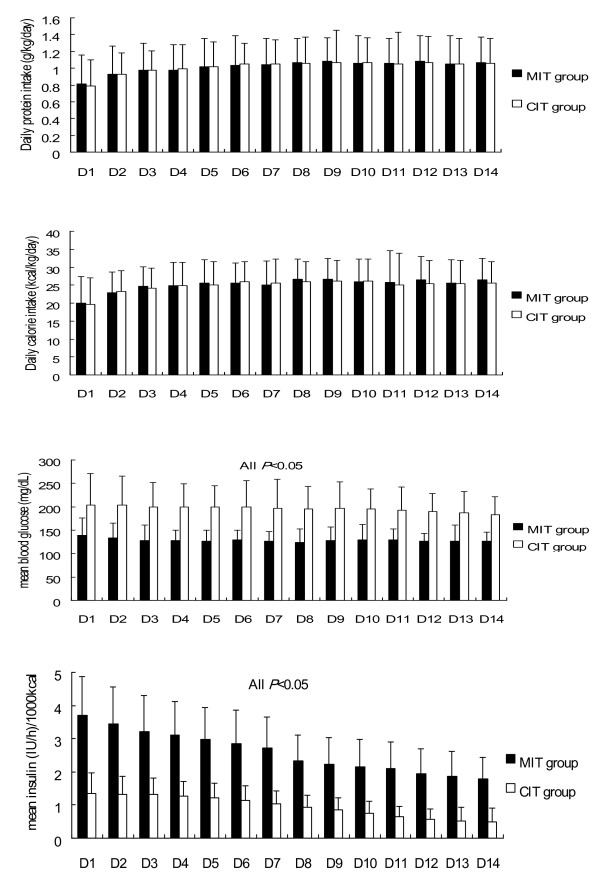
Patients were randomly divided into groups and treated with MIT (glucose target 120 to 140 mg/dl) or CIT (glucose target 180 to 200 mg/dl). Calories and protein intake were recorded each day. On days 3, 7 and 14, the 24-hour urinary nitrogen excretion, nitrogen balance, and serum albumin and prealbumin concentrations were measured. Clinical outcomes data were collected.
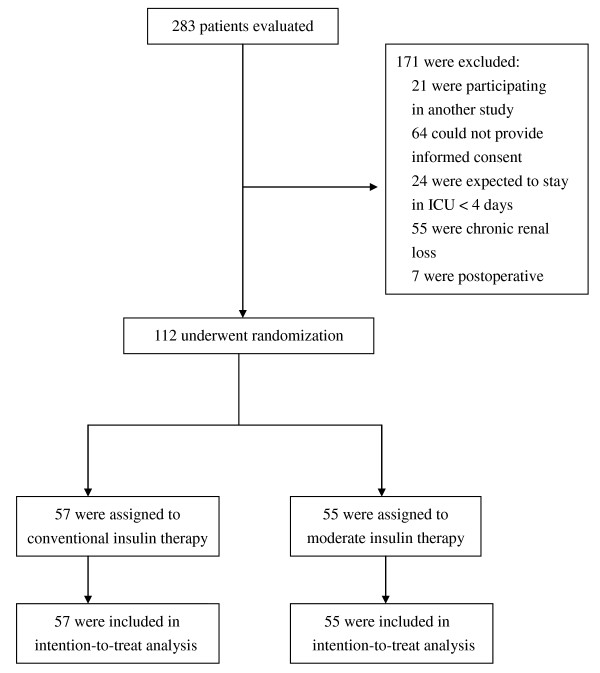
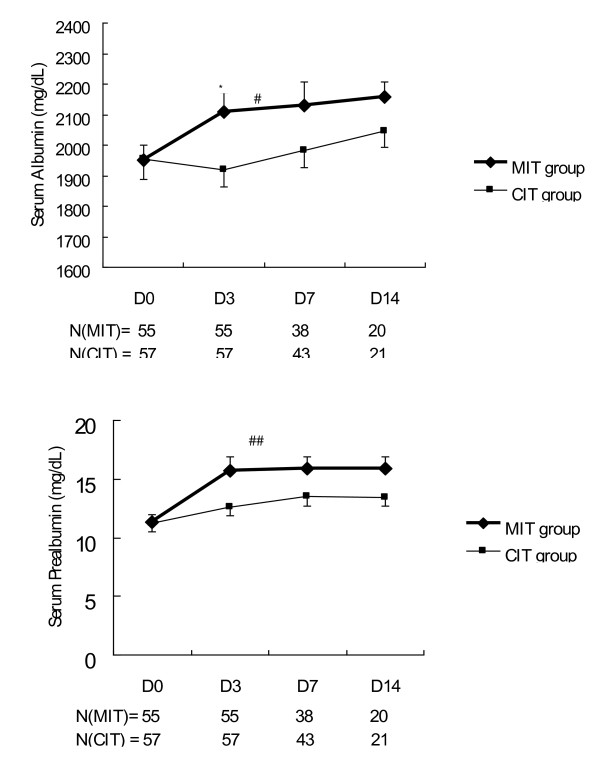
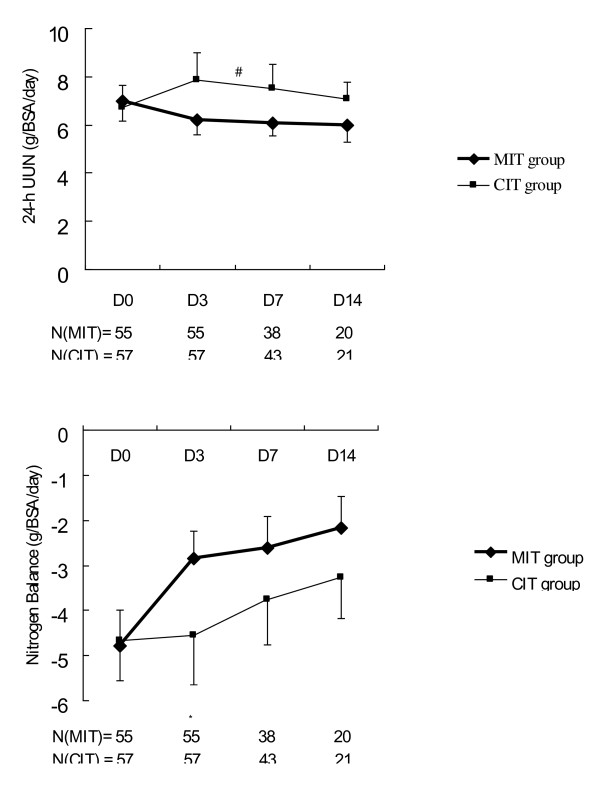
A total of 112 medical ICU patients were included, with 55 patients randomized to the MIT group and 57 patients randomized to the CIT group. Patients treated with MIT showed a trend towards increased nitrogen balance (P = 0.070), significantly lower urinary nitrogen excretion (P = 0.027), and higher serum albumin (P = 0.047) and prealbumin (P = 0.001) concentrations than patients treated with CIT. The differences between the two groups were most significant on day 3, when all factors showed significant differences (P < 0.05).
Moderate glucose control results in less negative nitrogen balances in medical ICU patients. Differences are more significant in the early stages compared with the late stages of critical illness.
ClinicalTrial.Gov NCT 01227148.
高血糖和蛋白质流失在重症患者中很常见。胰岛素可用于降低血糖并抑制蛋白水解。中度胰岛素治疗对重症患者蛋白质代谢的影响尚未得到评估。我们比较了内科重症监护病房(ICU)中接受中度胰岛素治疗(MIT)和常规胰岛素治疗(CIT)的患者之间的尿氮排泄、氮平衡、血清白蛋白浓度、前白蛋白浓度及临床结局。
将患者随机分组,分别接受MIT(血糖目标值120至140mg/dl)或CIT(血糖目标值180至200mg/dl)治疗。每天记录热量和蛋白质摄入量。在第3、7和14天,测量24小时尿氮排泄、氮平衡以及血清白蛋白和前白蛋白浓度。收集临床结局数据。
共纳入112例内科ICU患者,55例随机分配至MIT组,57例随机分配至CIT组。与接受CIT治疗的患者相比,接受MIT治疗的患者氮平衡有增加趋势(P = 0.070),尿氮排泄显著降低(P = 0.027),血清白蛋白(P = 0.047)和前白蛋白(P = 0.001)浓度更高。两组之间的差异在第3天最为显著,此时所有因素均显示出显著差异(P < 0.05)。
在内科ICU患者中,适度的血糖控制可减少负氮平衡。与危重病后期相比,早期差异更为显著。
ClinicalTrial.Gov NCT 01227148。