Department of Public Health, Erasmus MC, University Medical Centre Rotterdam, PO Box 2040, Rotterdam 3000 CA, The Netherlands.
Gut. 2013 May;62(5):727-34. doi: 10.1136/gutjnl-2011-301917. Epub 2012 Apr 5.
The sensitivity and specificity of a single faecal immunochemical test (FIT) are limited. The performance of FIT screening can be improved by increasing the screening frequency or by providing more than one sample in each screening round. This study aimed to evaluate if two-sample FIT screening is cost-effective compared with one-sample FIT.
The MISCAN-colon microsimulation model was used to estimate costs and benefits of strategies with either one or two-sample FIT screening. The FIT cut-off level varied between 50 and 200 ng haemoglobin/ml, and the screening schedule was varied with respect to age range and interval. In addition, different definitions for positivity of the two-sample FIT were considered: at least one positive sample, two positive samples, or the mean of both samples being positive.
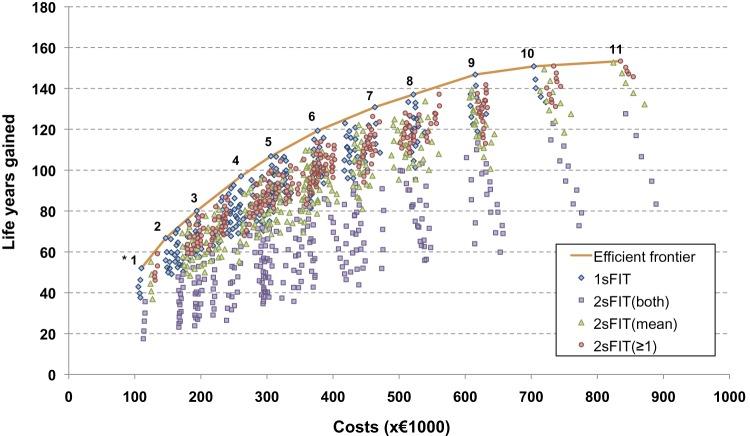
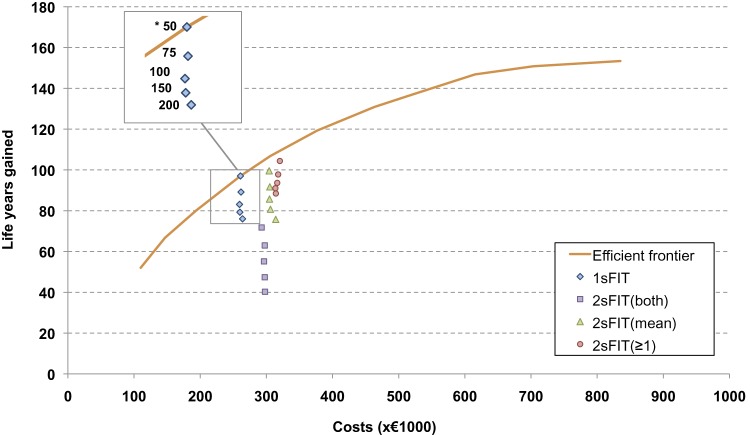
Within an exemplary screening strategy, biennial FIT from the age of 55-75 years, one-sample FIT provided 76.0-97.0 life-years gained (LYG) per 1000 individuals, at a cost of € 259,000-264,000 (range reflects different FIT cut-off levels). Two-sample FIT screening with at least one sample being positive provided 7.3-12.4 additional LYG compared with one-sample FIT at an extra cost of € 50,000-59,000. However, when all screening intervals and age ranges were considered, intensifying screening with one-sample FIT provided equal or more LYG at lower costs compared with two-sample FIT.
If attendance to screening does not differ between strategies it is recommended to increase the number of screening rounds with one-sample FIT screening, before considering increasing the number of FIT samples provided per screening round.
单次粪便免疫化学检测(FIT)的灵敏度和特异性有限。通过增加筛查频率或在每轮筛查中提供多个样本,可以提高 FIT 筛查的性能。本研究旨在评估两样本 FIT 筛查是否比单样本 FIT 更具成本效益。
使用 MISCAN-colon 微观模拟模型来估计具有单样本或两样本 FIT 筛查的策略的成本和效益。FIT 截止值在 50 至 200ng 血红蛋白/ml 之间变化,筛查方案根据年龄范围和间隔进行变化。此外,还考虑了两种样本 FIT 阳性的不同定义:至少有一个阳性样本、两个阳性样本,或两个样本的平均值为阳性。
在一个示例筛查策略中,从 55-75 岁开始每两年进行一次 FIT,单样本 FIT 为每 1000 人提供 76.0-97.0 个生命年增益(LYG),成本为 259000-264000 欧元(范围反映了不同的 FIT 截止值)。与单样本 FIT 相比,两样本 FIT 筛查中至少有一个样本呈阳性可提供 7.3-12.4 个额外的 LYG,额外成本为 50000-59000 欧元。然而,当考虑所有筛查间隔和年龄范围时,与两样本 FIT 相比,增加单样本 FIT 筛查的轮次数量可以以更低的成本提供相等或更多的 LYG。
如果两种策略的筛查参与率没有差异,则建议在考虑增加每轮筛查提供的 FIT 样本数量之前,增加单样本 FIT 筛查的轮次数量。