Department of Physiology and Biophysics, University of Washington School of Medicine, Seattle, WA 98195, USA.
J Cell Biol. 2012 Apr 16;197(2):231-7. doi: 10.1083/jcb.201108147. Epub 2012 Apr 9.
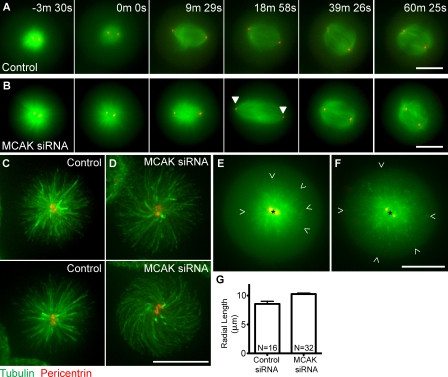
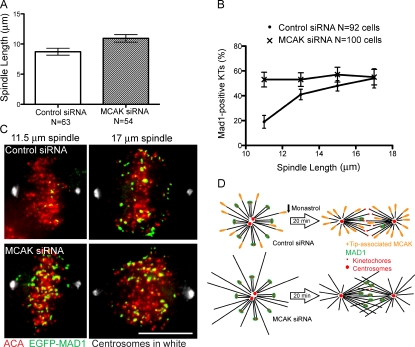
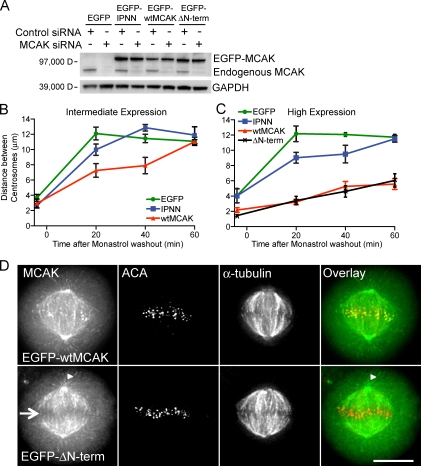
Mitotic centromere-associated kinesin (MCAK) is a microtubule-depolymerizing kinesin-13 member that can track with polymerizing microtubule tips (hereafter referred to as tip tracking) during both interphase and mitosis. MCAK tracks with microtubule tips by binding to end-binding proteins (EBs) through the microtubule tip localization signal SKIP, which lies N terminal to MCAK's neck and motor domain. The functional significance of MCAK's tip-tracking behavior during mitosis has never been explained. In this paper, we identify and define a mitotic function specific to the microtubule tip-associated population of MCAK: negative regulation of microtubule length within the assembling bipolar spindle. This function depends on MCAK's ability to bind EBs and track with polymerizing nonkinetochore microtubule tips. Although this activity antagonizes centrosome separation during bipolarization, it ultimately benefits the dividing cell by promoting robust kinetochore attachments to the spindle microtubules.
有丝分裂着丝粒相关运动蛋白(MCAK)是一种微管解聚驱动蛋白-13 家族成员,可在有丝分裂间期和有丝分裂过程中与聚合微管尖端(此后称为尖端追踪)一起追踪。MCAK 通过其微管尖端定位信号 SKIP 与末端结合蛋白(EBs)结合,从而追踪微管尖端,该信号位于 MCAK 的颈部和马达结构域的 N 端。MCAK 在有丝分裂期间的尖端追踪行为的功能意义从未得到解释。在本文中,我们确定并定义了 MCAK 与微管尖端相关群体的一个特定的有丝分裂功能:在组装的双极纺锤体中负调控微管长度。该功能取决于 MCAK 结合 EBs 和追踪聚合非着丝粒微管尖端的能力。尽管这种活性拮抗了两极化过程中的中心体分离,但它最终通过促进强劲的动粒附着到纺锤体微管上,使正在分裂的细胞受益。