Walch Stephan G, Lachenmeier Dirk W, Kuballa Thomas, Stühlinger Wolf, Monakhova Yulia B
Department for Public Health and Health Technology Assessment, University for Health Sciences, Medical Informatics and Technology, Eduard Wallnöfer-Zentrum 1, A-6060 Hall in Tyrol, Austria.
Anal Chem Insights. 2012;7:1-12. doi: 10.4137/ACI.S8946. Epub 2012 Mar 21.
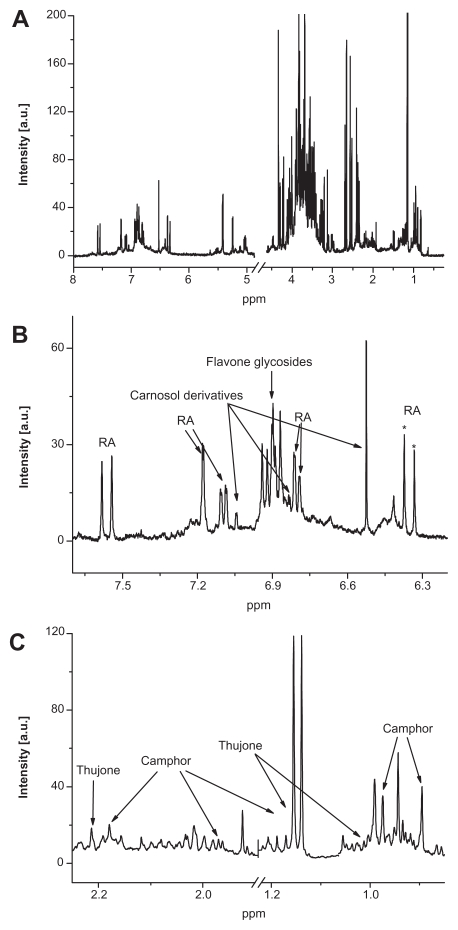
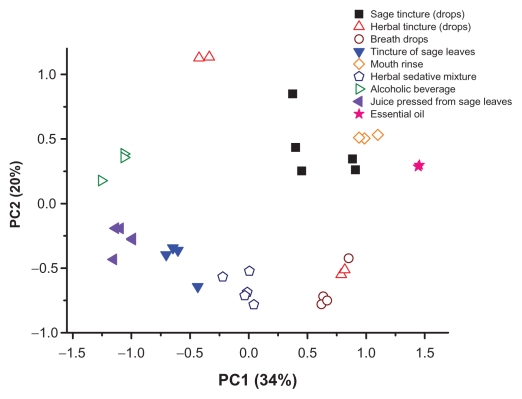
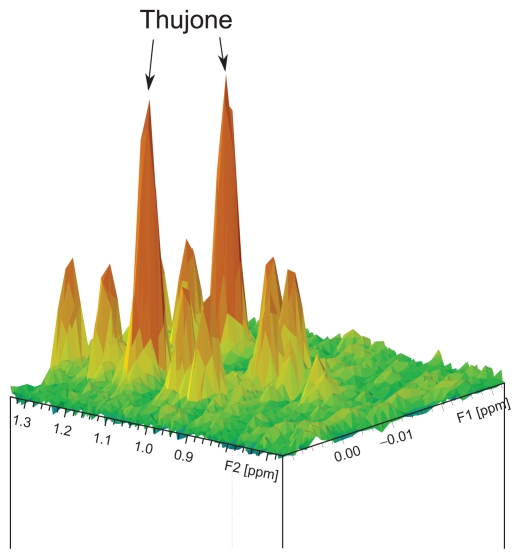
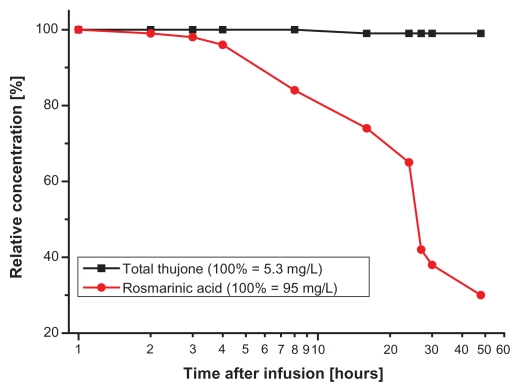
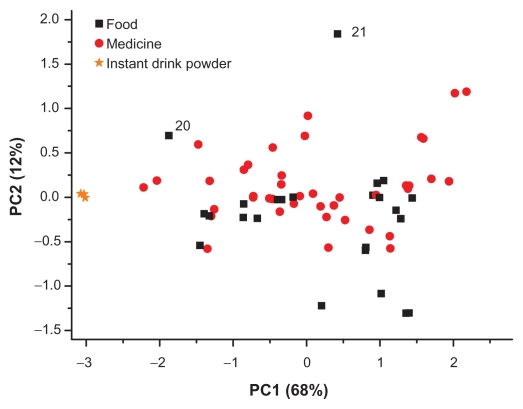
A methodology that utilizes (1)H-NMR spectroscopy has been developed to simultaneously analyze toxic terpenes (thujone and camphor), major polyphenolic compounds, the total antioxidant capacity (ORAC) and the Folin-Ciocalteu (FC) index in foods and medicines containing sage. The quantitative determination of rosmarinic acid (limit of detection (LOD) = 10 mg/L) and total thujone (LOD = 0.35 mg/L) was possible using direct integration of the signals. For other parameters (derivatives of rosmarinic acid, carnosol and flavone glycosides, ORAC and FC index), chemometric regression models obtained separately for alcohol-based tinctures (R(2) = 0.94-0.98) and aqueous tea infusions (R(2) = 0.79-0.99) were suitable for screening analysis. The relative standard deviations for authentic samples were below 10%. The developed methodology was applied for the analysis of a wide variety of sage products (n = 108). The total thujone content in aqueous tea infusions was found to be in the range of not detectable (nd) to 37.5 mg/L (average 9.2 mg/L), while tinctures contained higher levels (range nd-409 mg/L, average 107 mg/L). The camphor content varied from 2.1 to 43.7 mg/L in aqueous infusions and from not detectable to 748 mg/L in tinctures (averages were 14.1 and 206 mg/L, respectively). Phenolic compounds were also detected in the majority of the investigated products. (1)H-NMR spectroscopy was proven to have the ability to holistically control all important adverse and beneficial compounds in sage products in a single experiment, considerably saving time, resources and costs as NMR replaces four separate methodologies that were previously needed to analyze the same parameters.
一种利用¹H-NMR光谱学的方法已被开发出来,用于同时分析含有鼠尾草的食品和药品中的有毒萜类化合物(侧柏酮和樟脑)、主要多酚化合物、总抗氧化能力(ORAC)和福林-西奥尔特(FC)指数。使用信号的直接积分可以对迷迭香酸(检测限(LOD)=10 mg/L)和总侧柏酮(LOD = 0.35 mg/L)进行定量测定。对于其他参数(迷迭香酸衍生物、鼠尾草酚和黄酮苷、ORAC和FC指数),分别为醇基酊剂(R² = 0.94 - 0.98)和水性茶浸液(R² = 0.79 - 0.99)获得的化学计量回归模型适用于筛选分析。真实样品的相对标准偏差低于10%。所开发的方法被应用于分析多种鼠尾草产品(n = 108)。发现水性茶浸液中的总侧柏酮含量在未检出(nd)至37.5 mg/L范围内(平均9.2 mg/L),而酊剂中的含量更高(范围nd - 409 mg/L,平均107 mg/L)。水性浸液中樟脑含量在2.1至43.7 mg/L之间,酊剂中在未检出至748 mg/L之间(平均值分别为14.1和206 mg/L)。在大多数被研究的产品中也检测到了酚类化合物。事实证明,¹H-NMR光谱学能够在一次实验中全面控制鼠尾草产品中所有重要的有害和有益化合物,由于NMR取代了之前分析相同参数所需的四种单独方法,从而大大节省了时间、资源和成本。