Warren Christopher M, Holroyd Clay B
Department of Psychology, University of Victoria Victoria, BC, Canada.
Front Neurosci. 2012 Apr 3;6:43. doi: 10.3389/fnins.2012.00043. eCollection 2012.
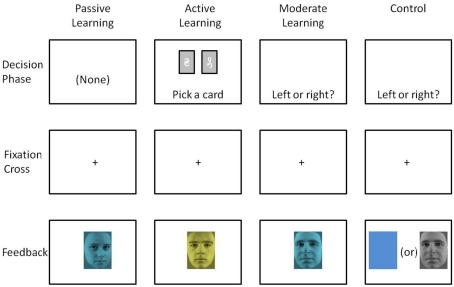
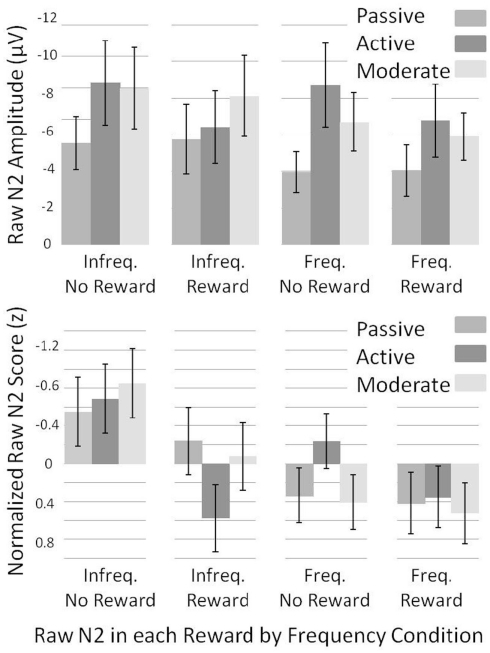
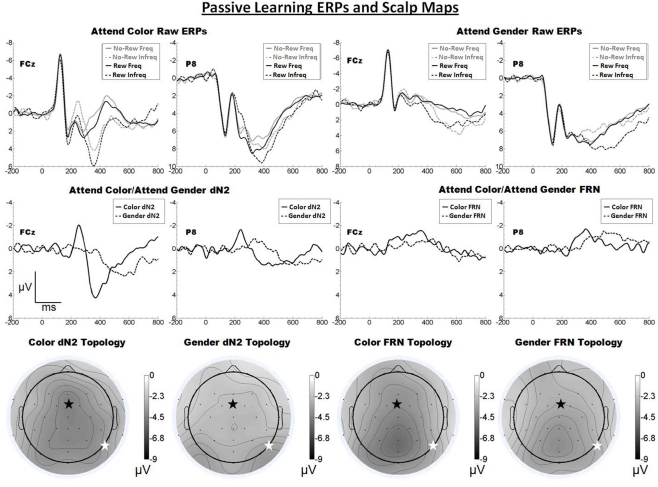
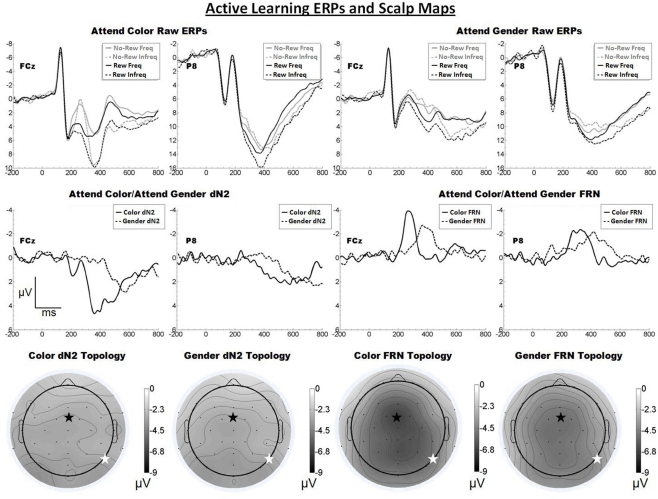
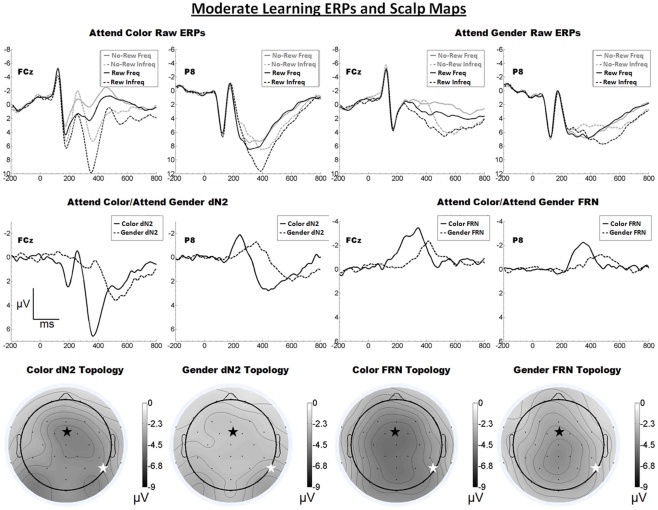
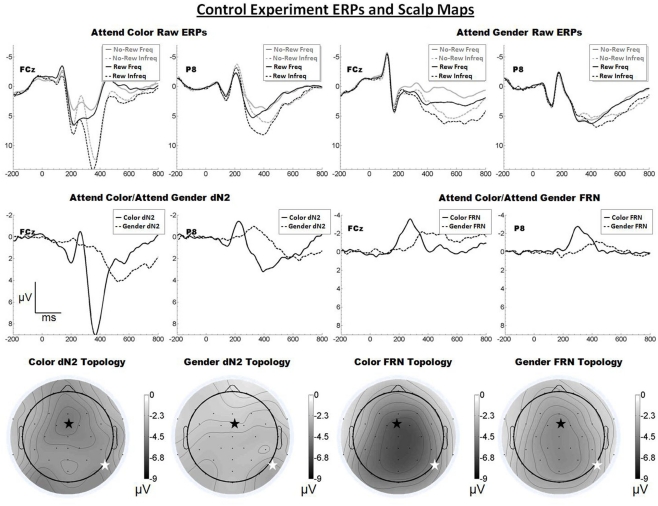
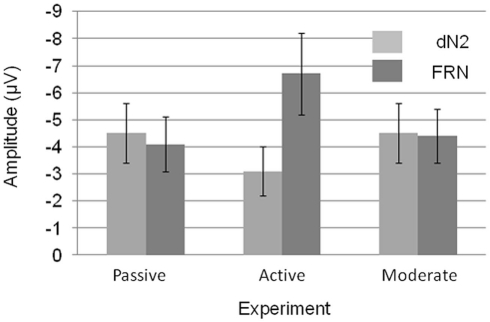
We applied the event-related brain potential (ERP) technique to investigate the involvement of two neuromodulatory systems in learning and decision making: The locus coeruleus-norepinephrine system (NE system) and the mesencephalic dopamine system (DA system). We have previously presented evidence that the N2, a negative deflection in the ERP elicited by task-relevant events that begins approximately 200 ms after onset of the eliciting stimulus and that is sensitive to low-probability events, is a manifestation of cortex-wide noradrenergic modulation recruited to facilitate the processing of unexpected stimuli. Further, we hold that the impact of DA reinforcement learning signals on the anterior cingulate cortex (ACC) produces a component of the ERP called the feedback-related negativity (FRN). The N2 and the FRN share a similar time range, a similar topography, and similar antecedent conditions. We varied factors related to the degree of cognitive deliberation across a series of experiments to dissociate these two ERP components. Across four experiments we varied the demand for a deliberative strategy, from passively watching feedback, to more complex/challenging decision tasks. Consistent with our predictions, the FRN was largest in the experiment involving active learning and smallest in the experiment involving passive learning whereas the N2 exhibited the opposite effect. Within each experiment, when subjects attended to color, the N2 was maximal at frontal-central sites, and when they attended to gender it was maximal over lateral-occipital areas, whereas the topology of the FRN was frontal-central in both task conditions. We conclude that both the DA system and the NE system act in concert when learning from rewards that vary in expectedness, but that the DA system is relatively more exercised when subjects are relatively more engaged by the learning task.
我们应用事件相关脑电位(ERP)技术来研究两个神经调节系统在学习和决策过程中的参与情况:蓝斑-去甲肾上腺素系统(NE系统)和中脑多巴胺系统(DA系统)。我们之前已经提出证据表明,N2是由与任务相关的事件诱发的ERP中的一个负向偏转,它在诱发刺激开始后约200毫秒开始,并且对低概率事件敏感,是为促进对意外刺激的处理而募集的全皮质去甲肾上腺素能调制的一种表现。此外,我们认为DA强化学习信号对前扣带回皮质(ACC)的影响会产生ERP的一个成分,称为反馈相关负波(FRN)。N2和FRN具有相似的时间范围、相似的地形图和相似的先行条件。我们在一系列实验中改变了与认知思考程度相关的因素,以区分这两个ERP成分。在四个实验中,我们改变了对深思熟虑策略的要求,从被动观察反馈到更复杂/更具挑战性的决策任务。与我们的预测一致,FRN在涉及主动学习的实验中最大,在涉及被动学习的实验中最小,而N2则表现出相反的效果。在每个实验中,当受试者关注颜色时,N2在额中央部位最大,当他们关注性别时,N2在枕外侧区域最大,而在两种任务条件下,FRN的地形图都是额中央的。我们得出结论,当从预期不同的奖励中学习时,DA系统和NE系统协同作用,但当受试者相对更投入学习任务时,DA系统相对更活跃。