Ramadhany Ririn, Yasugi Mayo, Nakamura Shota, Daidoji Tomo, Watanabe Yohei, Takahashi Kazuo, Ikuta Kazuyoshi, Nakaya Takaaki
International Research Center for Infectious Diseases, Research Institute for Microbial Diseases, Osaka University Suita, Osaka, Japan.
Front Microbiol. 2012 Apr 4;3:128. doi: 10.3389/fmicb.2012.00128. eCollection 2012.
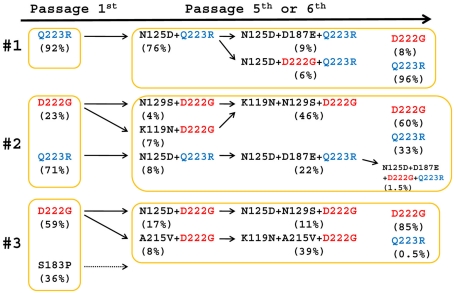
Substitutions at the receptor-binding site of the pandemic H1N1 2009 influenza A virus (H1N1pdm) hemagglutinin (HA) gene may be critical in determining whether a virus binds to human or avian receptors. Previous reports suggest that HA Gly(222) and/or Arg(223) allow viruses to bind preferentially to the α2,3-linked sialic acid found in avian species. We also demonstrated that serial passaging of influenza A virus in embryonated chicken eggs increased viral growth 32- to 64-fold, coincident with the increased prevalence of Gly(222) or Arg(223) in HA protein (Yasugi et al., 2012). In this study, we showed that the minor genotype of α2,3-linkage-tropic viruses in upper airways became dominant after passaging through chicken eggs. Viruses possessing HA containing N125D-Q223R, N125D-D187E-Q223R, K119N-D222G, and K119N-N129S-D222G, were detected in both clinical specimens and egg-passaged samples. These results might suggest that egg-adapted viruses, likely represented by α2,3-linkage-tropic virus, were also present in human upper airways as a minor population and transmitted in humans during the outbreak of H1N1pdm.
2009年甲型H1N1流感病毒(H1N1pdm)血凝素(HA)基因受体结合位点的替换可能对决定病毒是否与人或禽受体结合至关重要。先前的报道表明,HA的甘氨酸(222)和/或精氨酸(223)能使病毒优先结合禽类中发现的α2,3 - 连接的唾液酸。我们还证明,甲型流感病毒在鸡胚中连续传代可使病毒生长增加32至64倍,这与HA蛋白中甘氨酸(222)或精氨酸(223)的流行率增加相一致(安杉等人,2012年)。在本研究中,我们发现上呼吸道中α2,3 - 连接嗜性病毒的次要基因型在通过鸡胚传代后成为优势基因型。在临床标本和经鸡胚传代的样本中均检测到含有N125D - Q223R、N125D - D187E - Q223R、K119N - D222G和K119N - N129S - D222G的HA的病毒。这些结果可能表明,以α2,3 - 连接嗜性病毒为代表的适应鸡胚的病毒在人类上呼吸道中也以少数群体存在,并在H1N1pdm爆发期间在人类中传播。