Department of Pediatric Intensive Care, University Medical Center Utrecht, Wilhelmina Children's Hospital, Utrecht, The Netherlands.
PLoS One. 2012;7(4):e35070. doi: 10.1371/journal.pone.0035070. Epub 2012 Apr 10.
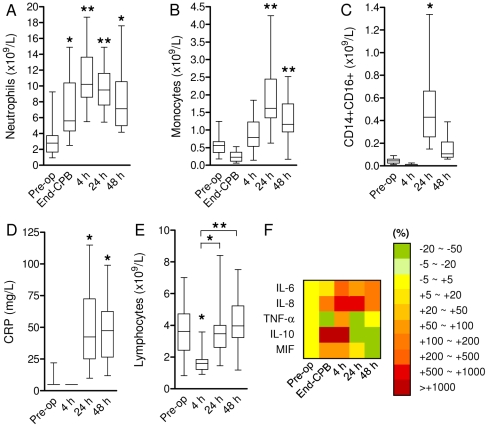
Cardiopulmonary bypass (CPB) surgery initiates a controlled systemic inflammatory response characterized by a cytokine storm, monocytosis and transient monocyte activation. However, the responsiveness of monocytes to Toll-like receptor (TLR)-mediated activation decreases throughout the postoperative course. The purpose of this study was to identify the major signaling pathway involved in plasma-mediated inhibition of LPS-induced tumor necrosis factor (TNF)-α production by monocytes.
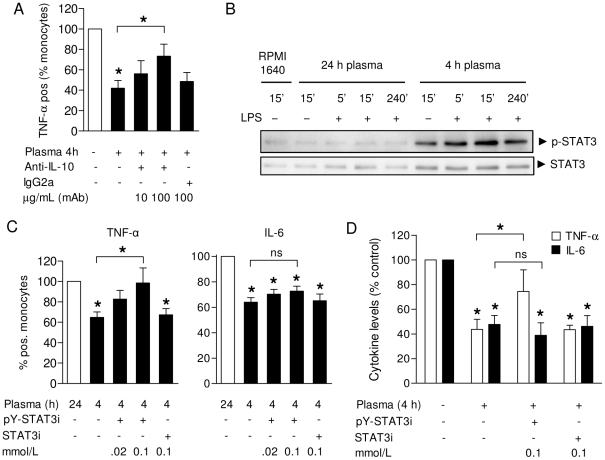
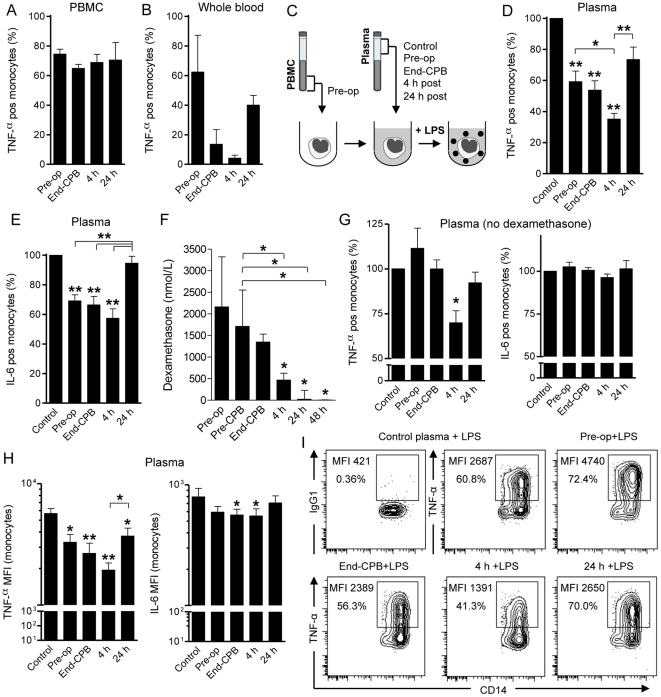
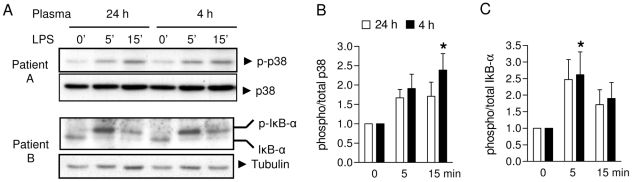
METHODOLOGY/PRINCIPAL FINDINGS: Pediatric patients that underwent CPB-assisted surgical correction of simple congenital heart defects were enrolled (n = 38). Peripheral blood mononuclear cells (PBMC) and plasma samples were isolated at consecutive time points. Patient plasma samples were added back to monocytes obtained pre-operatively for ex vivo LPS stimulations and TNF-α and IL-6 production was measured by flow cytometry. LPS-induced p38 mitogen-activated protein kinase (MAPK) and nuclear factor (NF)-κB activation by patient plasma was assessed by Western blotting. A cell-permeable peptide inhibitor was used to block STAT3 signaling. We found that plasma samples obtained 4 h after surgery, regardless of pre-operative dexamethasone treatment, potently inhibited LPS-induced TNF-α but not IL-6 synthesis by monocytes. This was not associated with attenuation of p38 MAPK activation or IκB-α degradation. However, abrogation of the IL-10/STAT3 pathway restored LPS-induced TNF-α production in the presence of suppressive patient plasma.
CONCLUSIONS/SIGNIFICANCE: Our findings suggest that STAT3 signaling plays a crucial role in the downregulation of TNF-α synthesis by human monocytes in the course of systemic inflammation in vivo. Thus, STAT3 might be a potential molecular target for pharmacological intervention in clinical syndromes characterized by systemic inflammation.
体外循环(CPB)手术引发了一种受控制的全身炎症反应,其特征是细胞因子风暴、单核细胞增多症和短暂的单核细胞激活。然而,单核细胞对 Toll 样受体(TLR)介导的激活的反应性在整个术后过程中会降低。本研究的目的是确定涉及血浆介导的抑制 LPS 诱导的单核细胞产生肿瘤坏死因子(TNF)-α的主要信号通路。
方法/主要发现:纳入了接受 CPB 辅助手术矫正单纯先天性心脏缺陷的儿科患者(n = 38)。在连续的时间点分离外周血单核细胞(PBMC)和血浆样本。将患者的血浆样本添加到术前获得的单核细胞中进行体外 LPS 刺激,并通过流式细胞术测量 TNF-α和 IL-6 的产生。通过 Western 印迹评估患者血浆诱导的 LPS 诱导的 p38 丝裂原活化蛋白激酶(MAPK)和核因子(NF)-κB 激活。使用细胞通透性肽抑制剂阻断 STAT3 信号。我们发现,手术后 4 小时获得的血浆样本,无论术前是否接受地塞米松治疗,都能强烈抑制 LPS 诱导的 TNF-α,但不能抑制单核细胞合成 IL-6。这与 p38 MAPK 激活或 IκB-α降解的减弱无关。然而,在抑制性患者血浆存在的情况下,阻断 IL-10/STAT3 通路恢复了 LPS 诱导的 TNF-α产生。
结论/意义:我们的发现表明,STAT3 信号在体内全身炎症过程中人类单核细胞 TNF-α合成的下调中起着至关重要的作用。因此,STAT3 可能是临床综合征中全身炎症特征的潜在分子治疗靶点。