Althaus Mike
Institute of Animal Physiology, Justus Liebig University of Giessen Giessen, Germany.
Front Physiol. 2012 Apr 9;3:83. doi: 10.3389/fphys.2012.00083. eCollection 2012.
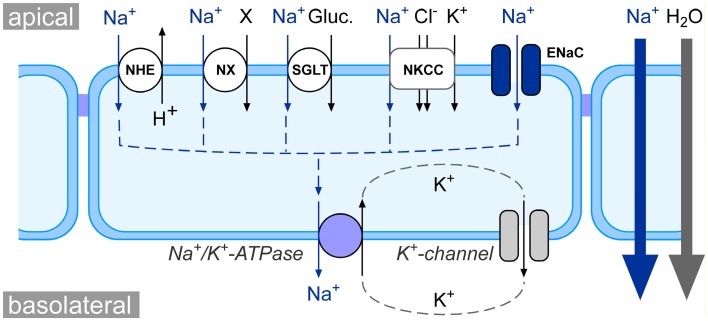
The vectorial transport of Na(+) across epithelia is crucial for the maintenance of Na(+) and water homeostasis in organs such as the kidneys, lung, or intestine. Dysregulated Na(+) transport processes are associated with various human diseases such as hypertension, the salt-wasting syndrome pseudohypoaldosteronism type 1, pulmonary edema, cystic fibrosis, or intestinal disorders, which indicate that a precise regulation of epithelial Na(+) transport is essential. Novel regulatory signaling molecules are gasotransmitters. There are currently three known gasotransmitters: nitric oxide (NO), carbon monoxide (CO), and hydrogen sulfide (H(2)S). These molecules are endogenously produced in mammalian cells by specific enzymes and have been shown to regulate various physiological processes. There is a growing body of evidence which indicates that gasotransmitters may also regulate Na(+) transport across epithelia. This review will summarize the available data concerning NO, CO, and H(2)S dependent regulation of epithelial Na(+) transport processes and will discuss whether or not these mediators can be considered as true physiological regulators of epithelial Na(+) transport biology.
钠离子(Na⁺)跨上皮细胞的矢量运输对于维持肾脏、肺或肠道等器官中的Na⁺和水平衡至关重要。Na⁺转运过程失调与多种人类疾病相关,如高血压、1型假性醛固酮减少症盐耗综合征、肺水肿、囊性纤维化或肠道疾病,这表明精确调节上皮细胞Na⁺转运至关重要。新型调节信号分子是气体递质。目前已知有三种气体递质:一氧化氮(NO)、一氧化碳(CO)和硫化氢(H₂S)。这些分子由特定酶在哺乳动物细胞内产生,并已证明可调节各种生理过程。越来越多的证据表明,气体递质也可能调节Na⁺跨上皮细胞的运输。本综述将总结有关NO、CO和H₂S依赖性调节上皮细胞Na⁺转运过程的现有数据,并将讨论这些介质是否可被视为上皮细胞Na⁺转运输生物学的真正生理调节剂。