Department of Informative Clinical Medicine, First Department of Internal Medicine, Gifu University Graduate School of Medicine, 1-1 Yanagido, Gifu 501-1194, Japan.
Sci Rep. 2012;2:367. doi: 10.1038/srep00367. Epub 2012 Apr 16.
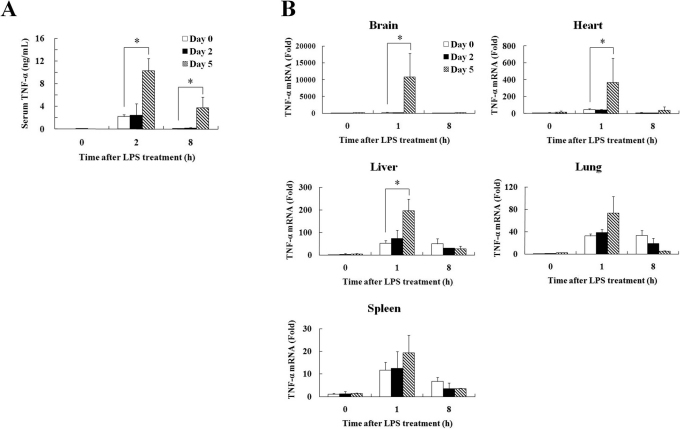
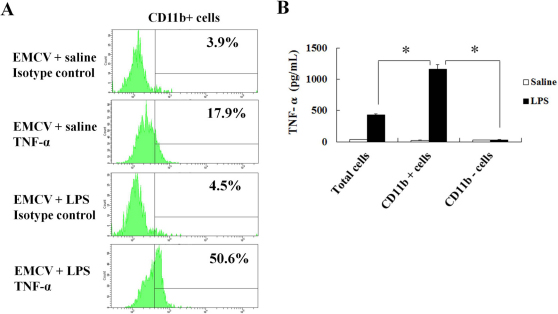
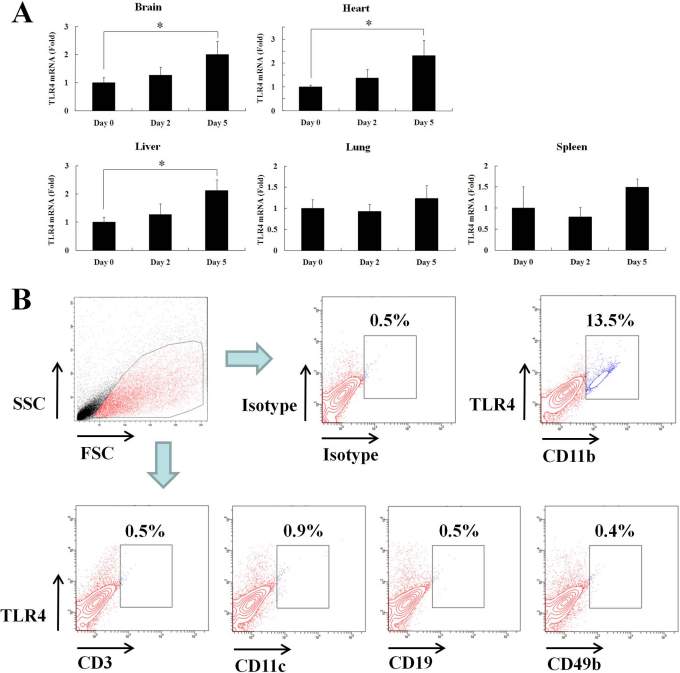
Secondary bacterial infection in humans is one of the pathological conditions requiring clinical attention. In this study, we examined the effect of lipopolysaccharide (LPS) on encephalomyocarditis virus (EMCV) infected mice. All mice inoculated with EMCV at 5 days before LPS challenge died within 24 h. LPS-induced TNF-α mRNA expression was significantly increased in the brain and heart at 5 days after EMCV infection. CD11b(+)/TLR4(+) cell population in the heart was remarkably elevated at 5 days after EMCV infection, and sorted CD11b(+) cells at 5 days after EMCV infection produced a large amount of TNF-α on LPS stimulation in vivo and in vitro. In conclusion, we found that the infiltration of CD11b(+) cells into infected organs is involved in the subsequent LPS-induced lethal shock in viral encephalomyocarditis. This new experimental model can help define the mechanism by which secondary bacterial infection causes a lethal shock in viral encephalomyocarditis.
人类继发性细菌感染是需要临床关注的病理状况之一。在这项研究中,我们研究了脂多糖(LPS)对感染脑炎心肌炎病毒(EMCV)的小鼠的影响。所有在 LPS 攻击前 5 天接种 EMCV 的小鼠在 24 小时内死亡。在 EMCV 感染后 5 天,LPS 诱导的 TNF-α mRNA 在大脑和心脏中的表达显著增加。在 EMCV 感染后 5 天,心脏中的 CD11b(+)/TLR4(+)细胞群显著升高,在 EMCV 感染后 5 天分选的 CD11b(+)细胞在体内和体外 LPS 刺激下产生大量 TNF-α。总之,我们发现 CD11b(+)细胞浸润感染器官与随后的 LPS 诱导的病毒性脑炎心肌炎致死性休克有关。这种新的实验模型可以帮助确定继发性细菌感染如何导致病毒性脑炎心肌炎的致死性休克。