Kim Yun Jung, Jang Byoung Kuk, Kim Eun Soo, Park Kyung Sik, Cho Kwang Bum, Chung Woo Jin, Hwang Jae Seok
Department of Internal Medicine, Keimyung University School of Medicine, Daegu, Korea.
Korean J Hepatol. 2012 Mar;18(1):41-7. doi: 10.3350/kjhep.2012.18.1.41. Epub 2012 Mar 22.
BACKGROUND/AIMS: The treatment for chronic hepatitis C (CHC) is removal of the virus in order to prevent progression to liver cirrhosis and hepatocellular carcinoma (HCC). Few data have been presented regarding the clinical significance of changes in the alanine aminotransferase (ALT) level in this context. We analyzed the patterns of changes in ALT level and investigated the relationship between the rapid normalization of ALT and sustained virologic response (SVR) after combined treatment with peginterferon and ribavirin.
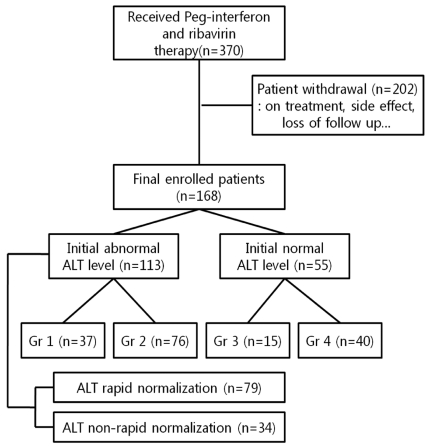
CHC patients (n=370) were classified into four groups according to the initial ALT level and subsequent changes: (1) initially abnormal ALT level and sustained abnormal ALT level during treatment, (2) initially abnormal ALT level but achievement of ALT normalization, (3) initially normal ALT level and variable ALT abnormality during treatment, and (4) initially normal ALT level and sustained normalization of ALT level during treatment. We subdivided groups 1 and 2 into those with patterns of decreased and normalization of ALT, with or without rapid normalization. We checked the end-treatment response (ETR) and SVR rates in each group and the factors associated with SVR, including patterns of changes in ALT level.
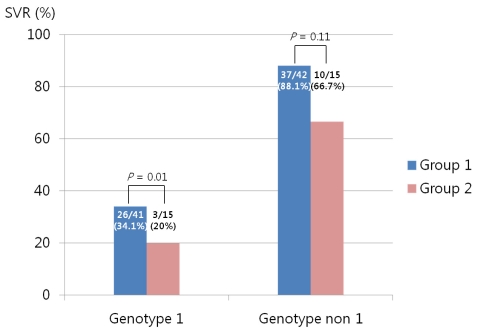
A total of 168 patients completed the therapy (age=54.34±10.64 years [mean±SD], 95 males [56.5%], genotype 1:82 [48.8%]). SVR was achieved in 115 (68.45%) of the completely treated patients. The SVR rate was significantly lower in group 1 than in group 2 (37.8 vs. 81.6%, P<0.001), and significantly higher in the rapid normalization group than in the group without rapid normalization (78.5% vs. 41.2%, P<0.001). Multiple logistic regression analysis revealed that age (odds ratio [OR]=0.94, 95% confidence interval [CI]=0.91-0.98, P=0.005), viral genotype (OR=2.76, 95% CI=1.20-6.38, P=0.017), and initial hepatitis C virus RNA titer (OR=0.28, 95% CI=0.10-0.75, P=0.012) were identified as independent significant predictive factors for SVR.
The SVR rate is significantly associated with normalization, and especially rapid normalization of ALT. Rapid normalization of ALT by 4 weeks after treatment might be a useful response factor that is readily available in clinical practice, and especially for genotype 1 patients.
背景/目的:慢性丙型肝炎(CHC)的治疗目的是清除病毒,以防止发展为肝硬化和肝细胞癌(HCC)。关于在此背景下丙氨酸氨基转移酶(ALT)水平变化的临床意义,目前报道的数据较少。我们分析了ALT水平的变化模式,并研究了聚乙二醇干扰素和利巴韦林联合治疗后ALT快速恢复正常与持续病毒学应答(SVR)之间的关系。
根据初始ALT水平及后续变化,将370例CHC患者分为四组:(1)初始ALT水平异常且治疗期间ALT持续异常;(2)初始ALT水平异常但ALT恢复正常;(3)初始ALT水平正常且治疗期间ALT出现波动异常;(4)初始ALT水平正常且治疗期间ALT持续正常。我们将第1组和第2组再细分为ALT下降和恢复正常的模式,无论是否快速恢复正常。我们检查了每组的治疗结束应答(ETR)和SVR率以及与SVR相关的因素,包括ALT水平的变化模式。
共有168例患者完成治疗(年龄=54.34±10.64岁[均值±标准差],男性95例[56.5%],基因1型:82例[48.8%])。115例(68.45%)完成治疗的患者获得了SVR。第1组的SVR率显著低于第2组(37.8%对81.6%,P<0.001),快速恢复正常组的SVR率显著高于未快速恢复正常组(78.5%对41.2%,P<0.001)。多因素logistic回归分析显示,年龄(比值比[OR]=0.94,95%置信区间[CI]=0.91-0.98,P=0.005)、病毒基因型(OR=2.76,95%CI=1.20-6.38,P=0.017)和初始丙型肝炎病毒RNA滴度(OR=0.28,95%CI=0.10-0.75,P=·012)被确定为SVR的独立显著预测因素。
SVR率与ALT恢复正常,尤其是快速恢复正常显著相关。治疗后4周内ALT快速恢复正常可能是一个在临床实践中容易获得的有用应答指标,尤其是对于基因1型患者。