
与泰国那空叻差是玛地区的花卉玉米花粉相比,来自蜜蜂蜂巢的玉米花粉的化学成分和自由基清除活性。
Chemical constituents and free radical scavenging activity of corn pollen collected from Apis mellifera hives compared to floral corn pollen at Nan, Thailand.
机构信息
Program of Biotechnology, Faculty of Science, Chulalongkorn University, 254 Phayathai Road, Bangkok10330, Thailand.
出版信息
BMC Complement Altern Med. 2012 Apr 18;12:45. doi: 10.1186/1472-6882-12-45.
BACKGROUND
Bee pollen is composed of floral pollen mixed with nectar and bee secretion that is collected by foraging honey (Apis sp.) and stingless bees. It is rich in nutrients, such as sugars, proteins, lipids, vitamins and flavonoids, and has been ascribed antiproliferative, anti-allergenic, anti-angiogenic and free radical scavenging activities. This research aimed at a preliminary investigation of the chemical constituents and free radical scavenging activity in A. mellifera bee pollen.
METHODS
Bee pollen was directly collected from A. mellifera colonies in Nan province, Thailand, in June, 2010, whilst floral corn (Zea mays L.) pollen was collected from the nearby corn fields. The pollen was then sequentially extracted with methanol, dichloromethane (DCM) and hexane, and each crude extract was tested for free radical scavenging activity using the DPPH assay, evaluating the percentage scavenging activity and the effective concentration at 50% (EC50). The most active crude fraction from the bee pollen was then further enriched for bioactive components by silica gel 60 quick and adsorption or Sephadex LH-20 size exclusion chromatography. The purity of all fractions in each step was observed by thin layer chromatography and the bioactivity assessed by the DPPH assay. The chemical structures of the most active fractions were analyzed by nuclear magnetic resonance.
RESULTS
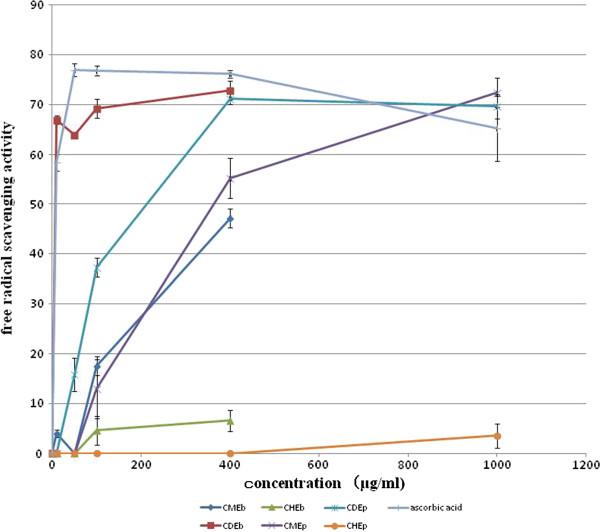
The crude DCM extract of both the bee corn pollen and floral corn pollen provided the highest active free radical scavenging activity of the three solvent extracts, but it was significantly (over 28-fold) higher in the bee corn pollen (EC(50) = 7.42 ± 0.12 μg/ml), than the floral corn pollen (EC(50) = 212 ± 13.6% μg/ml). After fractionation to homogeneity, the phenolic hydroquinone and the flavone 7-O-R-apigenin were found as the minor and major bioactive compounds, respectively. Bee corn pollen contained a reasonably diverse array of nutritional components, including biotin (56.7 μg/100 g), invert sugar (19.9 g/100 g), vitamin A and β carotene (1.53 mg/100 g).
CONCLUSIONS
Bee pollen derived from corn (Z. mays), a non-toxic or edible plant, provided a better free radical scavenging activity than floral corn pollen.
背景
蜂花粉是由觅食的蜜蜂(Apis sp.)采集的花卉花粉与花蜜和蜂分泌物混合而成。它富含营养物质,如糖、蛋白质、脂肪、维生素和类黄酮,并具有抗增殖、抗变应原、抗血管生成和自由基清除活性。本研究旨在初步研究意大利蜜蜂蜂花粉的化学成分和自由基清除活性。
方法
2010 年 6 月,直接从泰国 Nan 省的意大利蜜蜂蜂群中采集蜂花粉,同时从附近的玉米田中采集玉米花粉。然后,花粉依次用甲醇、二氯甲烷(DCM)和正己烷提取,并用 DPPH 法测定每个粗提取物的自由基清除活性,评估 50%清除活性的百分比和有效浓度(EC50)。从蜂花粉中分离出最具活性的粗提物,然后通过硅胶 60 快速吸附或 Sephadex LH-20 排阻层析进一步富集生物活性成分。在每个步骤中,通过薄层色谱观察所有馏分的纯度,并通过 DPPH 法评估生物活性。通过核磁共振分析最活跃的馏分的化学结构。
结果
蜂花粉和玉米花粉的 DCM 粗提取物提供了三种溶剂提取物中最高的自由基清除活性,但蜂花粉的活性明显(高 28 倍)(EC50=7.42±0.12μg/ml),而玉米花粉的活性(EC50=212±13.6%μg/ml)。分离至均相后,发现酚类对苯二酚和黄酮 7-O-R-芹菜素分别为次要和主要生物活性化合物。蜂花粉含有相当多样化的营养成分,包括生物素(56.7μg/100g)、转化糖(19.9g/100g)、维生素 A 和β-胡萝卜素(1.53mg/100g)。
结论
源自玉米(Z. mays)的蜂花粉(一种无毒或可食用的植物)提供的自由基清除活性优于玉米花粉。



 Zotero 插件