Université Paris-Est, Ecole Nationale Vétérinaire d'Alfort, Breeding and Sports Medicine Unit (UMES) (Grellet, Grandjean), 7 avenue du général de Gaulle, 94704 Maisons-Alfort Cedex, France.
Prev Vet Med. 2012 Oct 1;106(3-4):315-23. doi: 10.1016/j.prevetmed.2012.03.012. Epub 2012 Apr 18.
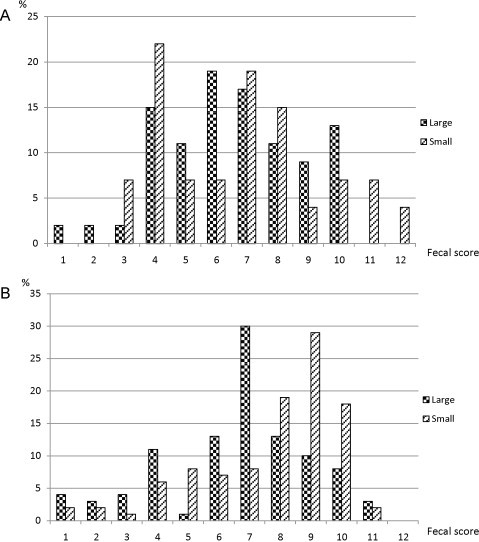
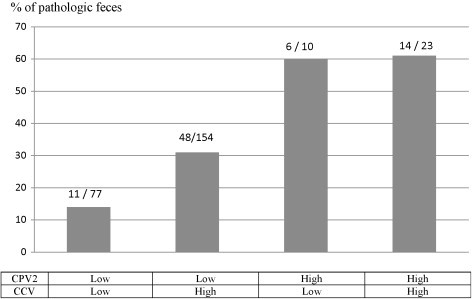
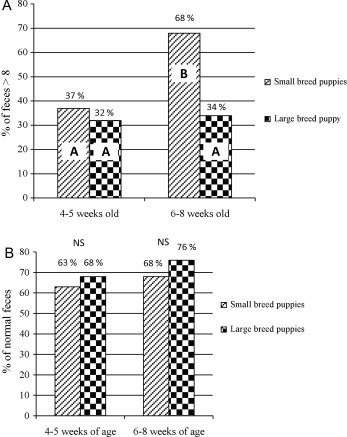
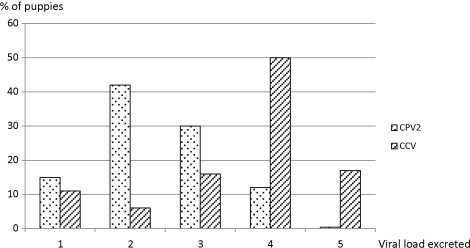
In puppies weaning is a high risk period. Fecal changes are frequent and can be signs of infection by digestive pathogens (bacteria, viruses, parasites) and indicators of nutritional and environmental stress. The aim of this study was to define a pathological fecal score for weaning puppies, and to study the impact on that score of two intestinal viruses (canine parvovirus type 2 and canine coronavirus). For this, the quality of stools was evaluated on 154 puppies between 4 and 8 weeks of age (100 from small breeds and 54 from large breeds). The scoring was performed immediately after a spontaneous defecation based on a 13-point scale (from 1; liquid to 13; dry and hard feces). Fecal samples were frozen for further viral analysis. Each puppy was weighed once a week during the study period. The fecal score regarded as pathological was the highest score associated with a significant reduction in average daily gain (ADG). Fecal samples were checked by semi-quantitative PCR or RT-PCR for canine parvovirus type 2 and canine coronavirus identification, respectively. The quality of feces was affected by both age and breed size. In small breeds, the ADG was significantly reduced under a fecal score of 6 and 7 for puppies at 4-5 and 6-8 weeks of age, respectively. In large breeds, the ADG was significantly reduced under a fecal score of 5 whatever the age of the puppy. Whereas a high viral load of canine parvovirus type 2 significantly impacted feces quality, no effect was recorded for canine coronavirus. This study provides an objective threshold for evaluation of fecal quality in weaning puppies. It also emphasizes the importance to be given to age and breed size in that evaluation.
在小狗断奶期间是一个高风险期。粪便变化频繁,可能是消化道病原体(细菌、病毒、寄生虫)感染的迹象,也是营养和环境压力的指标。本研究旨在为断奶幼犬定义一个病理性粪便评分,并研究两种肠道病毒(犬细小病毒 2 型和犬冠状病毒)对该评分的影响。为此,在 4 至 8 周龄的 154 只幼犬(100 只为小型犬,54 只为大型犬)中评估了粪便质量。评分是根据 13 分制(从 1;液体到 13;干硬粪便)在一次自发性排便后立即进行的。粪便样本在进一步的病毒分析前进行冷冻。在研究期间,每只幼犬每周称重一次。被认为是病理性的粪便评分是与平均日增重(ADG)显著降低相关的最高评分。通过半定量 PCR 或 RT-PCR 检查粪便样本,分别用于鉴定犬细小病毒 2 型和犬冠状病毒。粪便质量受到年龄和品种大小的影响。在小型犬中,4-5 周龄和 6-8 周龄的幼犬粪便评分分别为 6 和 7 时,ADG 显著降低。在大型犬中,无论幼犬的年龄如何,粪便评分 5 时 ADG 均显著降低。尽管犬细小病毒 2 型的高病毒载量显著影响粪便质量,但犬冠状病毒则没有影响。本研究为评估断奶幼犬的粪便质量提供了一个客观的阈值。它还强调了在评估中考虑年龄和品种大小的重要性。