Department of Conservation Biology, Estación Biológica de Doñana, CSIC, Isla de la Cartuja, Sevilla, Spain.
PLoS One. 2012;7(4):e34716. doi: 10.1371/journal.pone.0034716. Epub 2012 Apr 18.
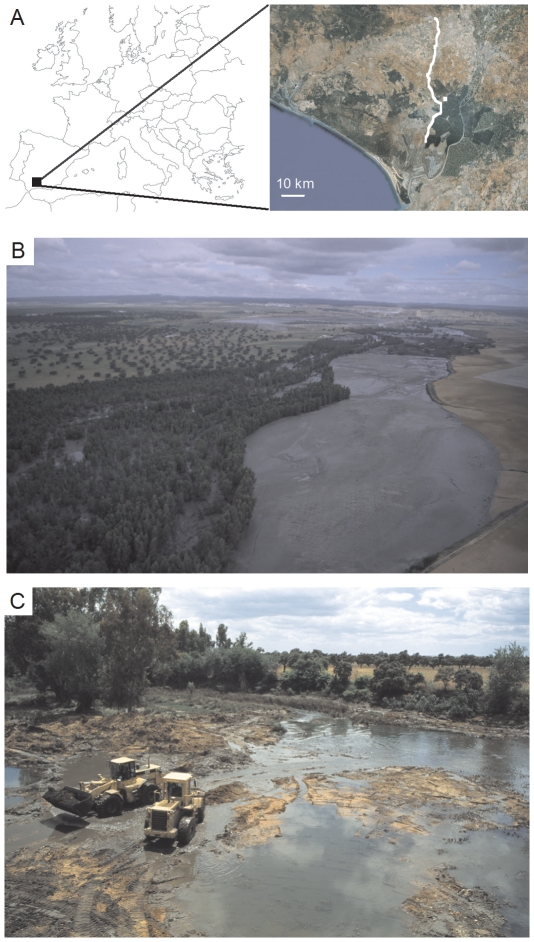
BACKGROUND/OBJECTIVE: Exposure to environmental contaminants may result in reduced reproductive success and long-lasting population declines in vertebrates. Emerging data from laboratory studies on model species suggest that certain life-stages, such as development, should be of special concern. However, detailed investigations of long-term consequences of developmental exposure to environmental chemicals on breeding performance are currently lacking in wild populations of long-lived vertebrates. Here, we studied how the developmental exposure to a mine spill (Aznalcóllar, SW Spain, April 1998) may affect fitness under natural conditions in a long-lived bird, the White Stork (Ciconia ciconia).
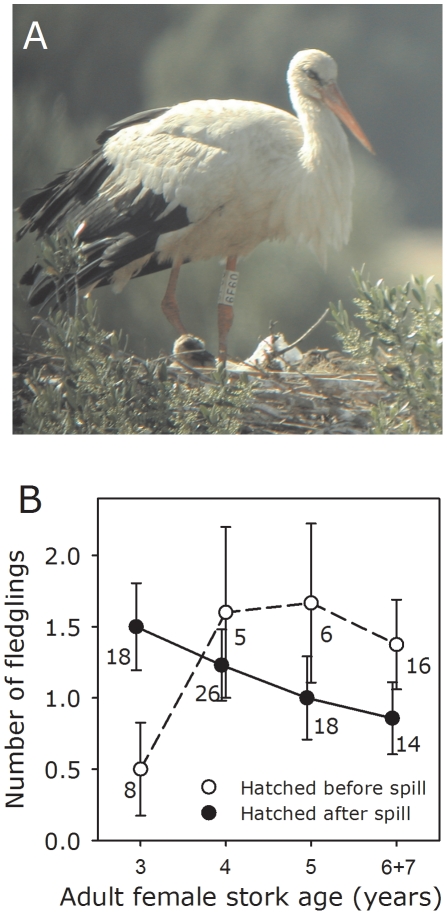
The reproductive performance of individually-banded storks that were or not developmentally exposed to the spill (i.e. hatched before or after the spill) was compared when these individuals were simultaneously breeding during the seven years after the spill occurred (1999-2005).
Female storks developmentally exposed to the spill experienced a premature breeding senescence compared with their non-developmentally exposed counterparts, doing so after departing from an unusually higher productivity in their early reproductive life (non-developmentally exposed females: 0.5 ± 0.33SE fledglings/year at 3-yr old vs. 1.38 ± 0.31SE at 6-7 yr old; developmentally exposed females: 1.5 ± 0.30SE fledglings/year at 3-yr old vs. 0.86 ± 0.25SE at 6-7 yr old).
CONCLUSIONS/SIGNIFICANCE: Following life-history theory, we propose that costly sub-lethal effects reported in stork nestlings after low-level exposure to the spill-derived contaminants might play an important role in shaping this pattern of reproduction, with a clear potential impact on population dynamics. Overall, our study provides evidence that environmental disasters can have long-term, multigenerational consequences on wildlife, particularly when affecting developing individuals, and warns about the risk of widespread low-level contamination in realistic scenarios.
背景/目的:暴露于环境污染物可能导致脊椎动物生殖成功率降低和种群长期衰退。来自模式物种的实验室研究的新数据表明,某些生命阶段,如发育,应特别关注。然而,目前在长寿命脊椎动物的野生种群中,缺乏对发育过程中暴露于环境化学物质对繁殖性能的长期后果的详细调查。在这里,我们研究了在一种长寿命鸟类,白头鹤(Ciconia ciconia)中,1998 年 4 月在西班牙西南部阿纳克里亚尔矿场泄漏事件中,发育暴露如何在自然条件下影响其繁殖表现。
对在泄漏事件前后(即泄漏前或泄漏后孵化)暴露于泄漏事件的个体进行单独标记,然后比较这些个体在泄漏发生后的七年(1999-2005 年)同时繁殖时的繁殖性能。
与未暴露于发育中的个体相比,暴露于发育中的个体的繁殖衰老提前,这是在其早期生殖生活中经历了异常高的生产力之后发生的(未暴露于发育中的个体:3 岁时每年有 0.5 ± 0.33SE 幼鸟,6-7 岁时为 1.38 ± 0.31SE;暴露于发育中的个体:3 岁时每年有 1.5 ± 0.30SE 幼鸟,6-7 岁时为 0.86 ± 0.25SE)。
结论/意义:根据生活史理论,我们提出,在低水平暴露于泄漏衍生的污染物后,白头鹤巢雏中报告的代价高昂的亚致死效应可能在塑造这种繁殖模式方面发挥重要作用,对种群动态有明显的潜在影响。总的来说,我们的研究提供了证据,表明环境灾难会对野生动物产生长期的、多代的影响,特别是当影响到发育中的个体时,并警告人们要注意在现实情况下广泛存在的低水平污染的风险。