Department of Cancer Immunology and AIDS, Dana Farber Cancer Institute, Boston, MA, USA.
Retrovirology. 2012 Jun 22;9:33. doi: 10.1186/1742-4690-9-33.
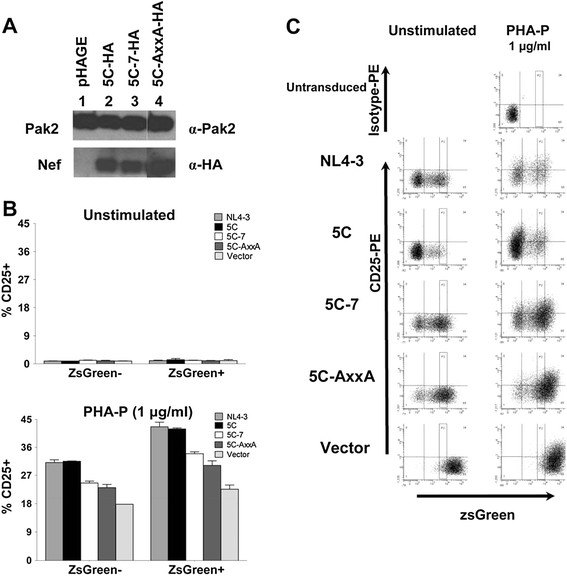
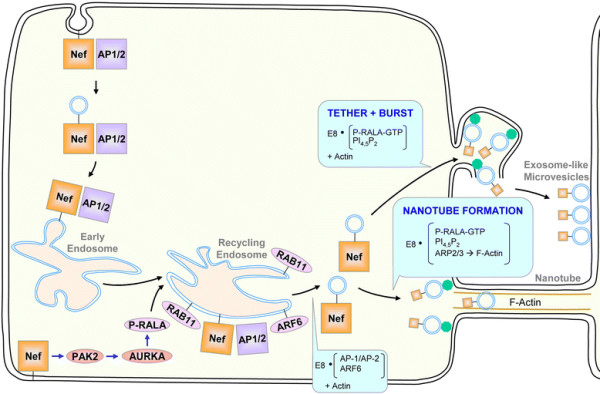
HIV-1 Nef protein contributes to pathogenesis via multiple functions that include enhancement of viral replication and infectivity, alteration of intracellular trafficking, and modulation of cellular signaling pathways. Nef stimulates formation of tunneling nanotubes and virological synapses, and is transferred to bystander cells via these intercellular contacts and secreted microvesicles. Nef associates with and activates Pak2, a kinase that regulates T-cell signaling and actin cytoskeleton dynamics, but how Nef promotes nanotube formation is unknown.
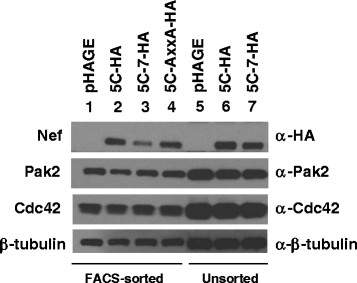
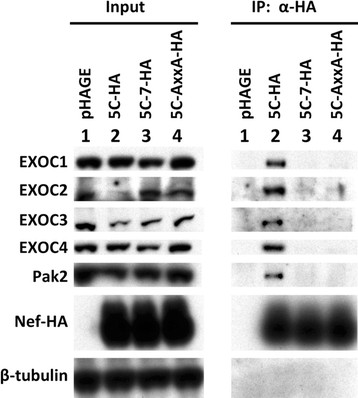
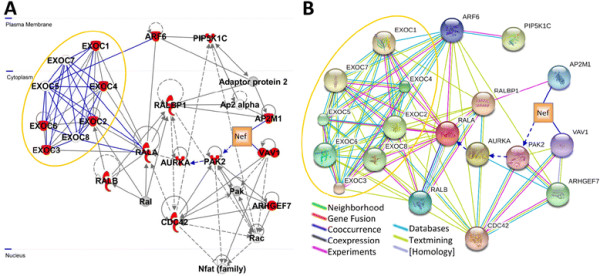
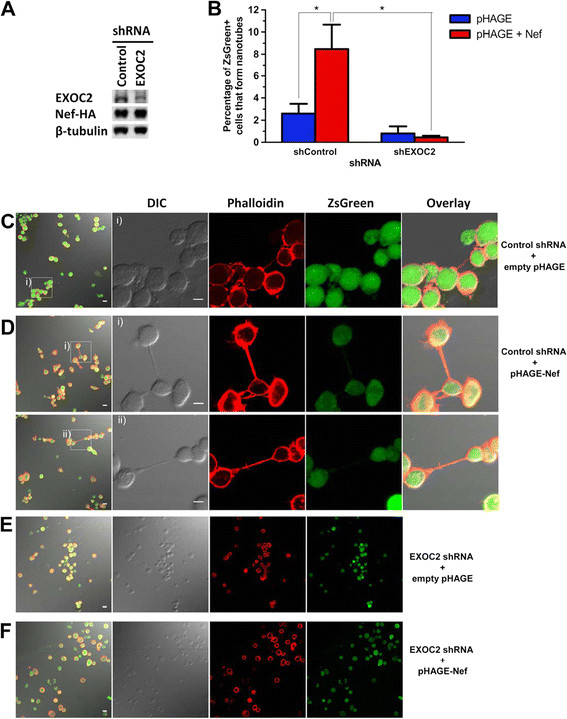
To identify Nef binding partners involved in Pak2-association dependent Nef functions, we employed tandem mass spectrometry analysis of Nef immunocomplexes from Jurkat cells expressing wild-type Nef or Nef mutants defective for the ability to associate with Pak2 (F85L, F89H, H191F and A72P, A75P in NL4-3). We report that wild-type, but not mutant Nef, was associated with 5 components of the exocyst complex (EXOC1, EXOC2, EXOC3, EXOC4, and EXOC6), an octameric complex that tethers vesicles at the plasma membrane, regulates polarized exocytosis, and recruits membranes and proteins required for nanotube formation. Additionally, Pak2 kinase was associated exclusively with wild-type Nef. Association of EXOC1, EXOC2, EXOC3, and EXOC4 with wild-type, but not mutant Nef, was verified by co-immunoprecipitation assays in Jurkat cells. Furthermore, shRNA-mediated depletion of EXOC2 in Jurkat cells abrogated Nef-mediated enhancement of nanotube formation. Using bioinformatic tools, we visualized protein interaction networks that reveal functional linkages between Nef, the exocyst complex, and the cellular endocytic and exocytic trafficking machinery.
Exocyst complex proteins are likely a key effector of Nef-mediated enhancement of nanotube formation, and possibly microvesicle secretion. Linkages revealed between Nef and the exocyst complex suggest a new paradigm of exocyst involvement in polarized targeting for intercellular transfer of viral proteins and viruses.
HIV-1 Nef 蛋白通过多种功能促进发病机制,包括增强病毒复制和感染力、改变细胞内运输以及调节细胞信号通路。Nef 刺激形成隧道纳米管和病毒突触,并通过这些细胞间接触和分泌的微泡转移到旁观者细胞。Nef 与 Pak2 结合并激活 Pak2,Pak2 是一种调节 T 细胞信号和肌动蛋白细胞骨架动态的激酶,但 Nef 如何促进纳米管形成尚不清楚。
为了鉴定与 Pak2 相关的 Nef 结合伙伴参与 Nef 功能,我们采用串联质谱分析从表达野生型 Nef 或 Nef 突变体(F85L、F89H、H191F 和 A72P、A75P 在 NL4-3 中无法与 Pak2 结合)的 Jurkat 细胞中 Nef 免疫复合物。我们报告说,野生型 Nef,但不是突变体,与外泌体复合物(EXOC1、EXOC2、EXOC3、EXOC4 和 EXOC6)的 5 个成分相关,外泌体复合物是一种八聚体复合物,将囊泡固定在质膜上,调节极化分泌,并募集形成纳米管所需的膜和蛋白质。此外,Pak2 激酶仅与野生型 Nef 相关联。通过 Jurkat 细胞中的共免疫沉淀测定验证了 EXOC1、EXOC2、EXOC3 和 EXOC4 与野生型但不是突变型 Nef 的关联。此外,Jurkat 细胞中 EXOC2 的 shRNA 介导耗竭消除了 Nef 介导的纳米管形成增强。使用生物信息学工具,我们可视化了蛋白质相互作用网络,揭示了 Nef、外泌体复合物和细胞内吞和外排运输机制之间的功能联系。
外泌体复合物蛋白可能是 Nef 介导的纳米管形成增强的关键效应物,并且可能是微泡分泌。Nef 和外泌体复合物之间揭示的联系表明,外泌体参与病毒蛋白和病毒的极化靶向用于细胞间转移的新范例。