Schmieder Roland E, Goebel Matthias, Bramlage Peter
Nephrology and Hypertension, University Hospital Erlangen, Germany.
Vasc Health Risk Manag. 2012;8:177-86. doi: 10.2147/VHRM.S29915. Epub 2012 Mar 15.
Despite the availability of risk engines to determine cardiovascular risk, risk factor control is suboptimal. Using EURIKA data we compared risk factor control in Germany with that of 11 other European countries (rest of Europe [ROE]) to identify differences and opportunities for improvement.
EURIKA was a multinational, cross-sectional study in 12 European countries including Germany from May 2009 to January 2010. Physicians' attitudes to risk factor control based on the 2007 European guidelines on cardiovascular disease (CVD) prevention in a representative cohort of 7641 primary care outpatients aged ≥ 50 years with no CV disease and at least one major CV risk factor were determined.
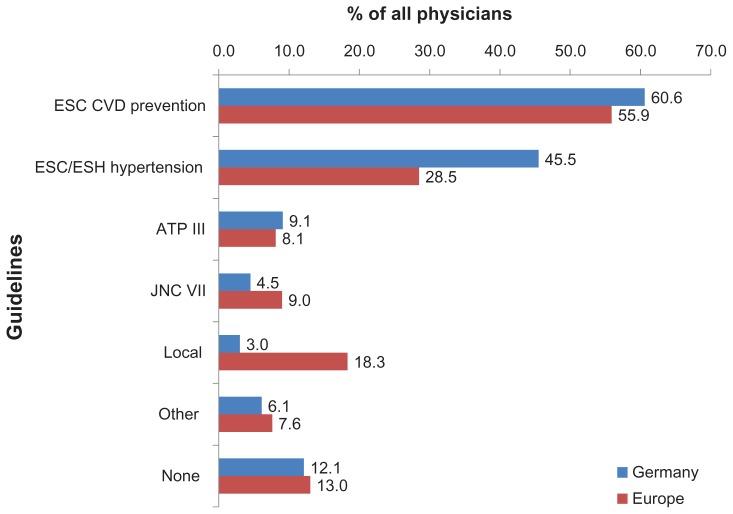
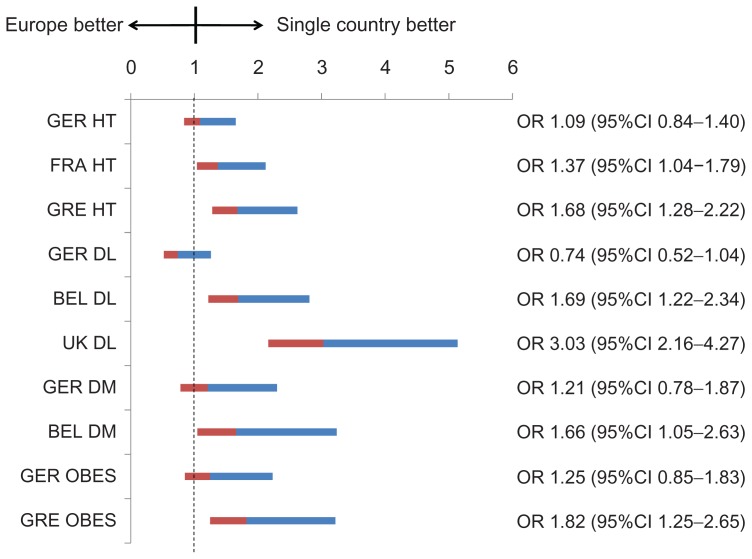
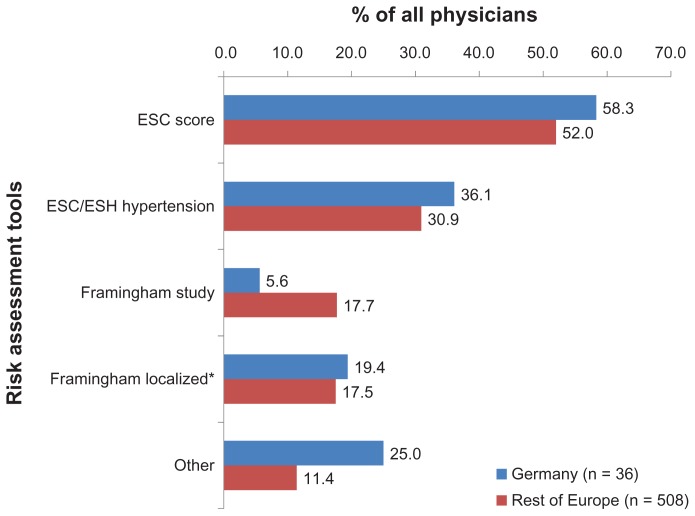
Compared to the ROE, German physicians were more frequently male (72.7% vs 62.6%), had a higher mean age (51.7 ± 8.4 vs 47.0 ± 9.7 years), faced higher patient loads (37.9% vs 16.5% had >199 patients/week), and involved other health sector professionals (dieticians, psychologists) less (31.8% vs 41.0% in the ROE). The European Society of Cardiology (ESC) guidelines on CVD prevention were more important for German physicians (60.6% vs 55.9%), while those who didn't use them gave reasons for nonuse as too many (62.5% vs 46.2%), too confusing, unrealistic, or not applicable to their patients. Risk engines were used less (54.5% vs 70.7%), with perceived lack of time (65.5% vs 60.2%) a frequent reason for nonuse. Risk factor control in German patients was inadequate (control rates: hypertension 36.3%, dyslipidemia 30.4%, type 2 diabetes 40.6%, obesity 28.8%) but largely comparable to other ROE countries; however, physicians tended to overestimate control rates.
EURIKA provides comprehensive data on the status of primary prevention of CVD in clinical practice in Germany and reveals considerable potential for improving the primary prevention of CVD.
尽管已有风险评估工具来确定心血管疾病风险,但风险因素控制仍未达到最佳状态。我们利用EURIKA研究数据,比较了德国与其他11个欧洲国家(欧洲其他地区[ROE])的风险因素控制情况,以找出差异和改进机会。
EURIKA是一项于2009年5月至2010年1月在包括德国在内的12个欧洲国家开展的跨国横断面研究。在一个具有代表性的队列中,对7641名年龄≥50岁、无心血管疾病且至少有一项主要心血管风险因素的初级保健门诊患者,根据2007年欧洲心血管疾病(CVD)预防指南,确定医生对风险因素控制的态度。
与欧洲其他地区相比,德国医生男性比例更高(72.7%对62.6%),平均年龄更大(51.7±8.4岁对47.0±9.7岁),患者负担更重(37.9%对16.5%的医生每周接诊患者>199例),且较少与其他卫生部门专业人员(营养师、心理学家)合作(欧洲其他地区为41.0%,德国为31.8%)。欧洲心脏病学会(ESC)的CVD预防指南对德国医生更为重要(60.6%对55.9%),而未使用该指南的医生给出的未使用原因是指南内容过多(62.5%对46.2%)、过于复杂、不切实际或不适用于他们的患者。风险评估工具的使用率较低(54.5%对70.7%),认为缺乏时间(65.5%对60.2%)是未使用的常见原因。德国患者的风险因素控制情况不佳(控制率:高血压36.3%,血脂异常30.4%,2型糖尿病4,0.6%,肥胖28.8%),但在很大程度上与欧洲其他地区国家相当;然而,医生往往高估了控制率。
EURIKA提供了德国临床实践中心血管疾病一级预防状况的全面数据,并揭示了改善心血管疾病一级预防的巨大潜力。