Taylor Cheminformatics Software, 54 Sherfield Avenue, Rickmansworth, Hertfordshire, WD3 1NL, UK.
J Comput Aided Mol Des. 2012 Apr;26(4):451-72. doi: 10.1007/s10822-012-9573-y. Epub 2012 Apr 27.
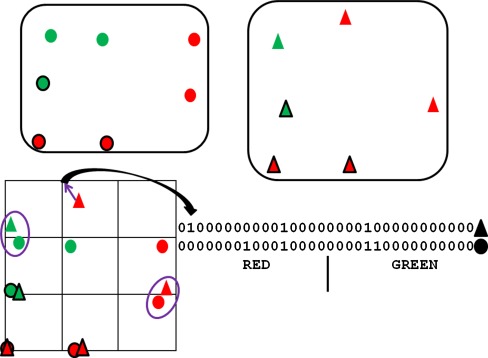
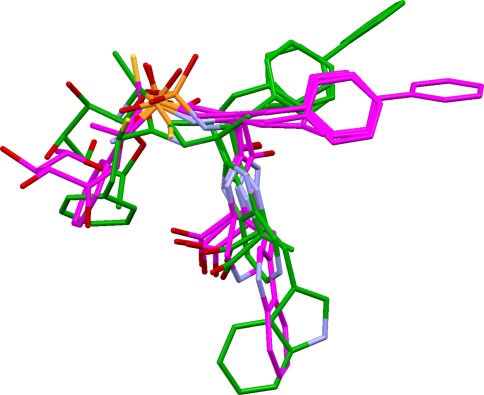
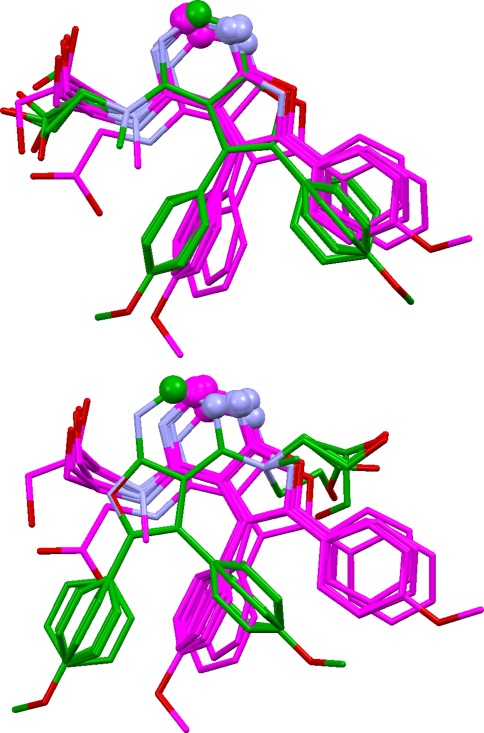
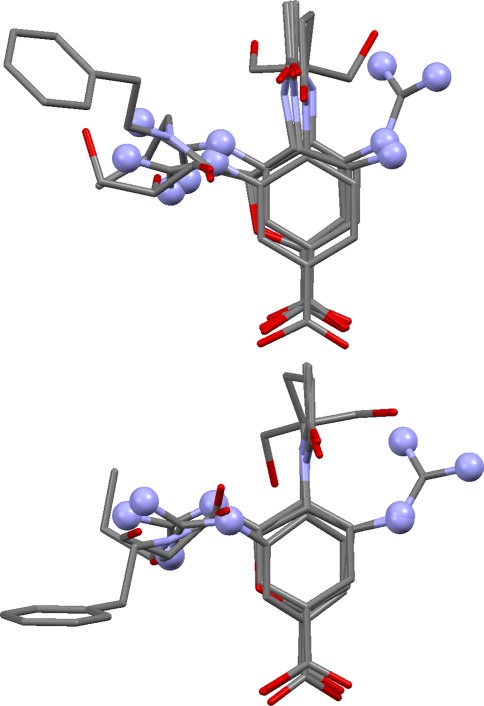
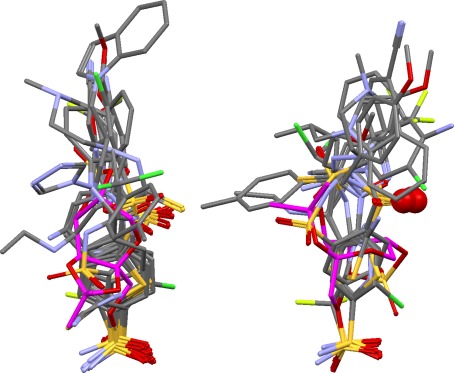
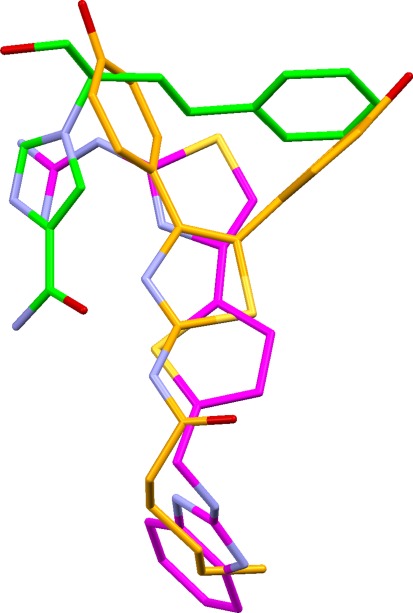
A program for overlaying multiple flexible molecules has been developed. Candidate overlays are generated by a novel fingerprint algorithm, scored on three objective functions (union volume, hydrogen-bond match, and hydrophobic match), and ranked by constrained Pareto ranking. A diverse subset of the best ranked solutions is chosen using an overlay-dissimilarity metric. If necessary, the solutions can be optimised. A multi-objective genetic algorithm can be used to find additional overlays with a given mapping of chemical features but different ligand conformations. The fingerprint algorithm may also be used to produce constrained overlays, in which user-specified chemical groups are forced to be superimposed. The program has been tested on several sets of ligands, for each of which the true overlay is known from protein-ligand crystal structures. Both objective and subjective success criteria indicate that good results are obtained on the majority of these sets.
已经开发出一种用于叠加多个柔性分子的程序。候选叠加物由一种新颖的指纹算法生成,根据三个客观函数(并集体积、氢键匹配和疏水性匹配)进行评分,并通过约束 Pareto 排名进行排序。使用叠加相似度度量选择最佳排名解决方案的多样化子集。如果需要,可以对解决方案进行优化。多目标遗传算法可用于找到具有给定化学特征映射但不同配体构象的其他叠加物。指纹算法还可用于生成受约束的叠加物,其中用户指定的化学基团被迫叠加。该程序已经在几组配体上进行了测试,对于每组配体,从蛋白质配体晶体结构中都可以知道真实的叠加物。客观和主观的成功标准都表明,在大多数情况下都可以得到良好的结果。