Department of Entomology and Plant Pathology, University of Tennessee, Knoxville, TN, 37996, USA.
Malar J. 2012 Apr 27;11:133. doi: 10.1186/1475-2875-11-133.
Anopheles gambiae sensu stricto (s.s.) is a primary vector of Plasmodium falciparum in sub-Saharan Africa. Although some physiological differences among molecular and chromosomal forms of this species have been demonstrated, the relative susceptibility to malaria parasite infection among them has not been unequivocally shown. The objective of this study was to investigate P. falciparum circumsporozoite protein infection (CSP) positivity among An. gambiae s.s. chromosomal and molecular forms.
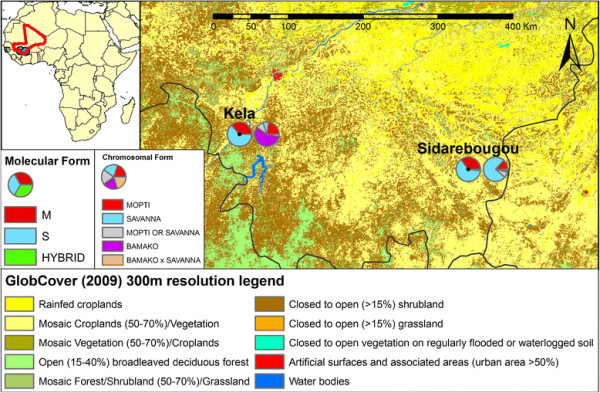
Wild An. gambiae from two sites Kela (n=464) and Sidarebougou (n=266) in Mali were screened for the presence of P. falciparum CSP using an enzyme-linked immunosorbent assay (ELISA). Samples were then identified to molecular form using multiple PCR diagnostics (n=713) and chromosomal form using chromosomal karyotyping (n=419).
Of 730 An. gambiae sensu lato (s.l.) mosquitoes, 89 (12.2%) were CSP ELISA positive. The percentage of positive mosquitoes varied by site: 52 (11.2%) in Kela and 37 (13.9%) in Sidarebougou. Eighty-seven of the positive mosquitoes were identified to molecular form and they consisted of nine Anopheles arabiensis (21.4%), 46 S (10.9%), 31 M (12.8%), and one MS hybrid (14.3%). Sixty of the positive mosquitoes were identified to chromosomal form and they consisted of five An. arabiensis (20.0%), 21 Savanna (15.1%), 21 Mopti (30.4%), 11 Bamako (9.2%), and two hybrids (20.0%).
In this collection, the prevalence of P. falciparum infection in the M form was equivalent to infection in the S form (no molecular form differential infection). There was a significant differential infection by chromosomal form such that, P. falciparum infection was more prevalent in the Mopti chromosomal forms than in the Bamako or Savanna forms; the Mopti form was also the most underrepresented in the collection. Continued research on the differential P. falciparum infection of An. gambiae s.s. chromosomal and molecular forms may suggest that Plasmodium - An. gambiae interactions play a role in malaria transmission.
冈比亚按蚊斯氏亚种(s.s.)是撒哈拉以南非洲地区间日疟原虫的主要传播媒介。尽管已经证明该物种的分子和染色体形式之间存在一些生理差异,但它们对疟原虫感染的相对易感性尚未得到明确证实。本研究的目的是调查冈比亚按蚊 s.s. 染色体和分子形式中疟原虫环子孢子蛋白感染(CSP)的阳性率。
采用酶联免疫吸附试验(ELISA)检测来自马里两个地点 Kela(n=464)和 Sidarebougou(n=266)的野生冈比亚按蚊体内是否存在疟原虫 CSP。然后使用多重 PCR 诊断(n=713)和染色体核型分析(n=419)对样本进行分子形式和染色体形式鉴定。
在 730 只冈比亚按蚊 s.l. 中,有 89 只(12.2%)CSP ELISA 检测为阳性。阳性蚊子的百分比因地点而异:Kela 为 52(11.2%),Sidarebougou 为 37(13.9%)。87 只阳性蚊子被鉴定为分子形式,其中包括 9 只阿拉伯按蚊(21.4%)、46 S(10.9%)、31 M(12.8%)和 1 只 MS 杂种(14.3%)。60 只阳性蚊子被鉴定为染色体形式,其中包括 5 只阿拉伯按蚊(20.0%)、21 只萨凡纳(15.1%)、21 只莫普提(30.4%)、11 只巴马科(9.2%)和 2 只杂种(20.0%)。
在本次采集的样本中,M 形式的疟原虫感染率与 S 形式相同(无分子形式差异感染)。染色体形式存在显著的差异感染,莫普提染色体形式的疟原虫感染更为普遍,而巴马科或萨凡纳形式的感染则较少;莫普提形式在采集样本中也最少。对冈比亚按蚊 s.s. 染色体和分子形式的疟原虫差异感染的进一步研究可能表明,疟原虫与冈比亚按蚊的相互作用在疟疾传播中起作用。