Istituto Pasteur-Fondazione Cenci-Bolognetti, Dipartimento di Sanità Pubblica e Malattie Infettive, Università SAPIENZA, Piazzale Aldo Moro 5, 00185, Rome, Italy.
Malar J. 2011 Aug 2;10:215. doi: 10.1186/1475-2875-10-215.
Anopheles gambiae M and S molecular forms, the major malaria vectors in the Afro-tropical region, are ongoing a process of ecological diversification and adaptive lineage splitting, which is affecting malaria transmission and vector control strategies in West Africa. These two incipient species are defined on the basis of single nucleotide differences in the IGS and ITS regions of multicopy rDNA located on the X-chromosome. A number of PCR and PCR-RFLP approaches based on form-specific SNPs in the IGS region are used for M and S identification. Moreover, a PCR-method to detect the M-specific insertion of a short interspersed transposable element (SINE200) has recently been introduced as an alternative identification approach. However, a large-scale comparative analysis of four widely used PCR or PCR-RFLP genotyping methods for M and S identification was never carried out to evaluate whether they could be used interchangeably, as commonly assumed.
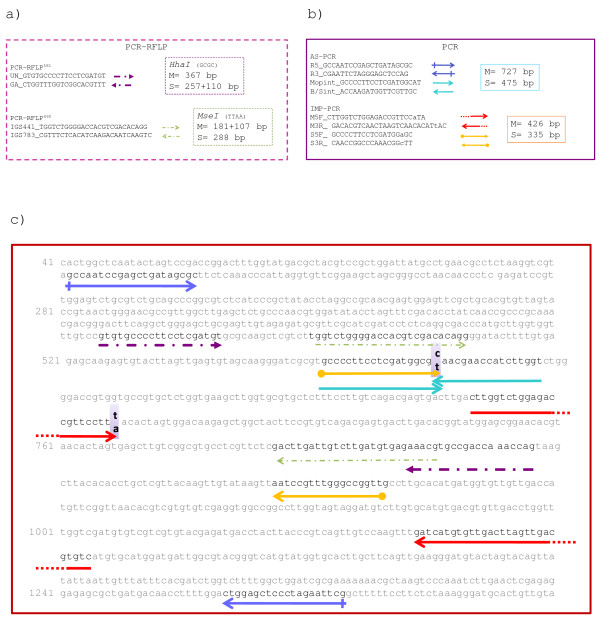
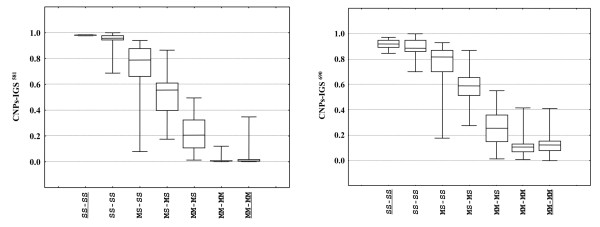
The genotyping of more than 400 A. gambiae specimens from nine African countries, and the sequencing of the IGS-amplicon of 115 of them, highlighted discrepancies among results obtained by the different approaches due to different kinds of biases, which may result in an overestimation of MS putative hybrids, as follows: i) incorrect match of M and S specific primers used in the allele specific-PCR approach; ii) presence of polymorphisms in the recognition sequence of restriction enzymes used in the PCR-RFLP approaches; iii) incomplete cleavage during the restriction reactions; iv) presence of different copy numbers of M and S-specific IGS-arrays in single individuals in areas of secondary contact between the two forms.
The results reveal that the PCR and PCR-RFLP approaches most commonly utilized to identify A. gambiae M and S forms are not fully interchangeable as usually assumed, and highlight limits of the actual definition of the two molecular forms, which might not fully correspond to the two A. gambiae incipient species in their entire geographical range. These limits are discussed and operational suggestions on the choice of the most convenient method for large-scale M- and S-form identification are provided, also taking into consideration technical aspects related to the epidemiological characteristics of different study areas.
冈比亚按蚊 M 和 S 分子型是在非洲热带地区主要的疟疾传播媒介,它们正在经历生态多样化和适应性谱系分裂的过程,这正在影响西非的疟疾传播和媒介控制策略。这两个初生种是基于位于 X 染色体上多拷贝 rDNA 的 IGS 和 ITS 区域中的单核苷酸差异来定义的。许多基于 IGS 区域中形式特异性 SNP 的 PCR 和 PCR-RFLP 方法被用于 M 和 S 的鉴定。此外,最近引入了一种检测 M 特异性插入短散在重复元件(SINE200)的 PCR 方法作为替代鉴定方法。然而,从未进行过广泛使用的用于 M 和 S 鉴定的四种 PCR 或 PCR-RFLP 基因分型方法的大规模比较分析,以评估它们是否可以像通常假设的那样可互换使用。
对来自 9 个非洲国家的 400 多个冈比亚按蚊标本进行基因分型,并对其中 115 个的 IGS 扩增子进行测序,突出了由于不同的偏差,不同方法获得的结果之间存在差异,这可能导致对 MS 假定杂种的高估,如下所示:i)等位基因特异性-PCR 方法中使用的 M 和 S 特异性引物的不正确匹配;ii)PCR-RFLP 方法中使用的限制酶识别序列中的多态性;iii)限制反应过程中的不完全切割;iv)在两个形式之间的二次接触区域中,个体中存在 M 和 S 特异性 IGS 阵列的不同拷贝数。
结果表明,最常用于鉴定冈比亚按蚊 M 和 S 形式的 PCR 和 PCR-RFLP 方法并不像通常假设的那样完全可互换,并突出了两种分子形式的实际定义的局限性,这可能与两种冈比亚按蚊初生种在其整个地理范围内不完全对应。讨论了这些限制,并就选择最方便的方法进行大规模 M 和 S 形式鉴定提供了操作建议,同时考虑了与不同研究区域流行病学特征相关的技术方面。