UCL Department of Applied Health Research, Department of Epidemiology and Public Health, UCL, 1-19 Torrington Place, London, WC1E 6BT, UK.
BMC Public Health. 2012 Apr 30;12:317. doi: 10.1186/1471-2458-12-317.
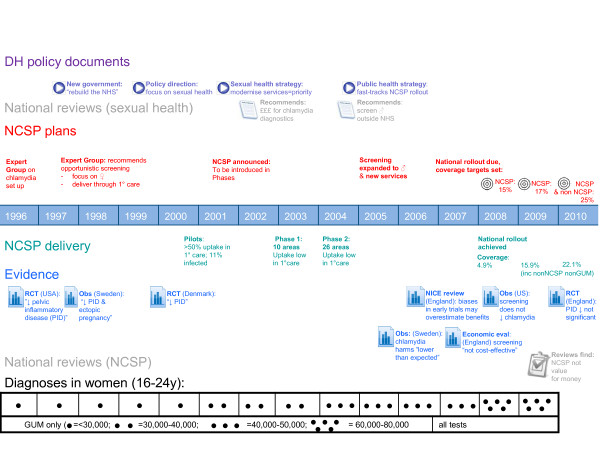
The rationale for the English National Chlamydia Screening Programme (NCSP) has been questioned. There has been little analysis, however, of what drove the NCSP's establishment and how it was implemented. Such analysis will help inform the future development of the NCSP. This study used a qualitative, theory-driven approach to evaluate the rationale for the NCSP's establishment and implementation.
Semi-structured interviews with 14 experts in chlamydia screening were undertaken. The interview data were analysed with policy documents and commentaries from peer-reviewed journals (published 1996-2010) using the Framework approach.
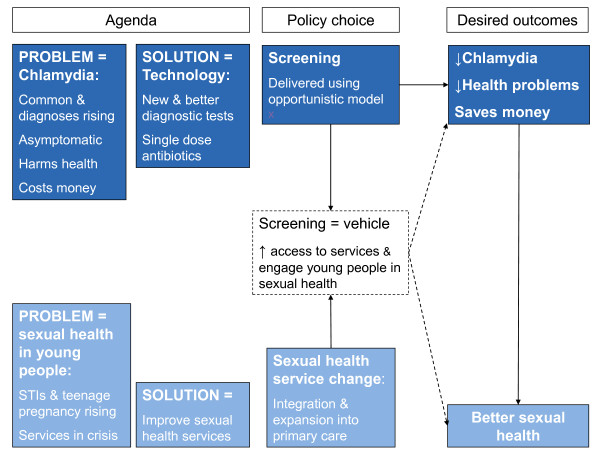
Two themes drove the NCSP's establishment and implementation. The first, chlamydia control, was prominently referenced in documents and interviews. The second theme concerned the potential for chlamydia screening to advance wider improvements in sexual health. In particular, screening was expected to promote sexual health services in primary care and encourage discussion of sexual health with young people. While this theme was only indirectly referenced in policy documents, it was cited by interviewees as a strong influence on implementation in the early years. However, by full rollout of the Programme, a focus on screening volume may have limited the NCSP's capacity to improve broader aspects of sexual health.
A combination of explicit and implicit drivers underpinned the Programme's establishment. This combination may explain why there was widespread support for its introduction and why implementation of the NCSP was inconsistent. The potential to improve young people's sexual health more comprehensively should be made explicit in future planning of the NCSP.
英国国家衣原体筛查计划(NCSP)的基本原理受到了质疑。然而,对于推动 NCSP 的建立及其实施方式的分析却很少。这种分析将有助于为 NCSP 的未来发展提供信息。本研究采用定性、理论驱动的方法来评估 NCSP 建立和实施的基本原理。
对 14 名衣原体筛查专家进行了半结构式访谈。使用框架方法,对访谈数据和同行评议期刊(1996-2010 年出版)的政策文件和评论进行了分析。
有两个主题推动了 NCSP 的建立和实施。第一个主题是衣原体控制,在文件和访谈中被多次提及。第二个主题是衣原体筛查有可能促进更广泛的性健康改善。特别是,筛查有望促进初级保健中的性健康服务,并鼓励年轻人讨论性健康问题。虽然这个主题在政策文件中只是间接提及,但被受访者认为是该计划早期实施的重要影响因素。然而,随着该计划的全面实施,对筛查数量的关注可能限制了 NCSP 改善更广泛性健康方面的能力。
明确和隐含的驱动因素共同构成了该计划的基础。这种组合可能解释了为什么它的引入得到了广泛的支持,以及为什么 NCSP 的实施不一致。在未来规划 NCSP 时,应该明确改善年轻人性健康的潜力。