Department of Mathematics and Statistics, Boston University, Boston, Massachusetts, United States of America.
PLoS One. 2012;7(5):e35693. doi: 10.1371/journal.pone.0035693. Epub 2012 May 1.
In recent years, intense research efforts have focused on developing methods for automated flow cytometric data analysis. However, while designing such applications, little or no attention has been paid to the human perspective that is absolutely central to the manual gating process of identifying and characterizing cell populations. In particular, the assumption of many common techniques that cell populations could be modeled reliably with pre-specified distributions may not hold true in real-life samples, which can have populations of arbitrary shapes and considerable inter-sample variation.
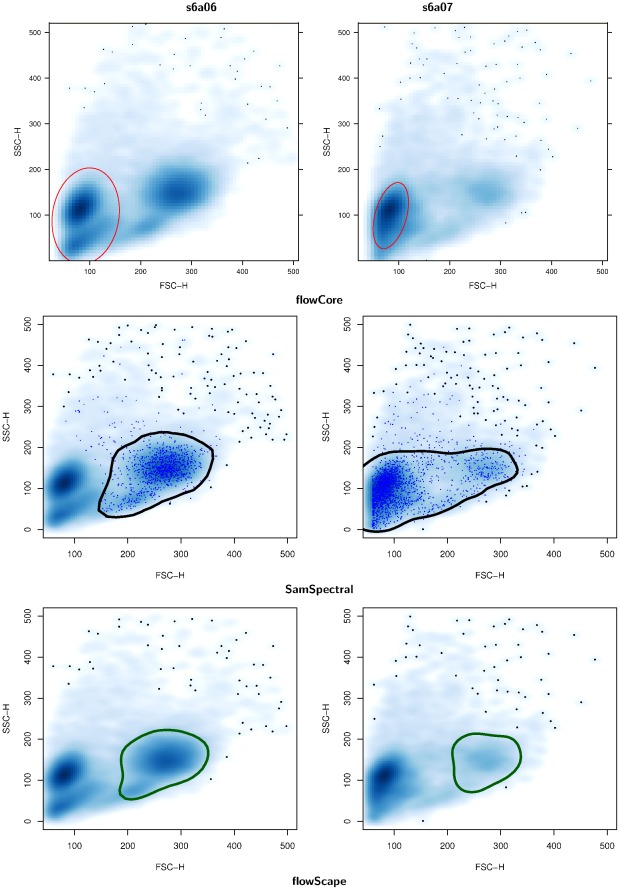
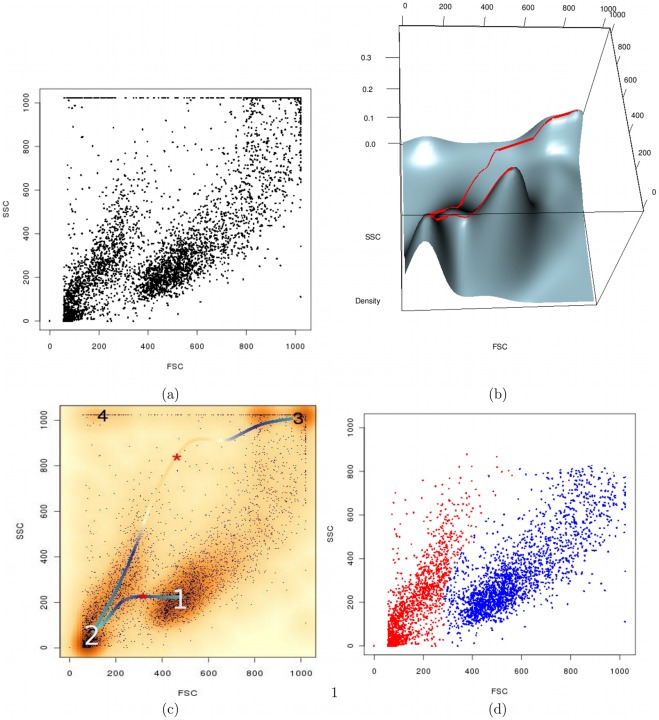
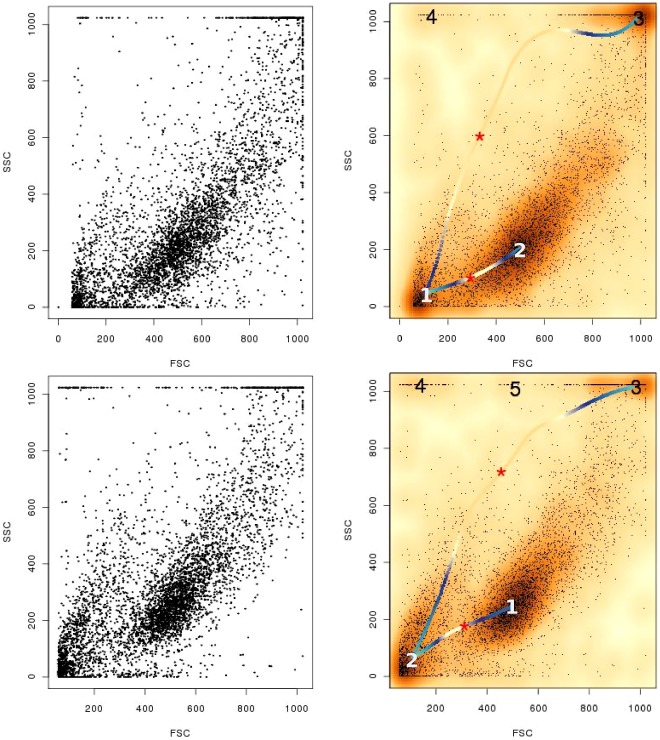
To address this, we developed a new framework flowScape for emulating certain key aspects of the human perspective in analyzing flow data, which we implemented in multiple steps. First, flowScape begins with creating a mathematically rigorous map of the high-dimensional flow data landscape based on dense and sparse regions defined by relative concentrations of events around modes. In the second step, these modal clusters are connected with a global hierarchical structure. This representation allows flowScape to perform ridgeline analysis for both traversing the landscape and isolating cell populations at different levels of resolution. Finally, we extended manual gating with a new capacity for constructing templates that can identify target populations in terms of their relative parameters, as opposed to the more commonly used absolute or physical parameters. This allows flowScape to apply such templates in batch mode for detecting the corresponding populations in a flexible, sample-specific manner. We also demonstrated different applications of our framework to flow data analysis and show its superiority over other analytical methods.
The human perspective, built on top of intuition and experience, is a very important component of flow cytometric data analysis. By emulating some of its approaches and extending these with automation and rigor, flowScape provides a flexible and robust framework for computational cytomics.
近年来,人们致力于开发自动化流式细胞术数据分析方法。然而,在设计此类应用程序时,几乎没有或根本没有关注到人类视角,而这对于识别和描述细胞群体的手动门控过程至关重要。特别是,许多常见技术都假设细胞群体可以通过预定义的分布进行可靠建模,但在实际样本中,细胞群体可能具有任意形状和相当大的样本间变异性,这一假设可能并不成立。
为了解决这个问题,我们开发了一个新的框架 flowScape,用于模拟分析流式数据时人类视角的某些关键方面,我们通过多个步骤来实现这一目标。首先,flowScape 从基于围绕模式的事件相对浓度定义的密集和稀疏区域创建高维流式数据景观的数学严格映射开始。在第二步中,这些模态聚类与全局层次结构连接。这种表示允许 flowScape 执行脊线分析,以便在不同的分辨率级别遍历景观和隔离细胞群体。最后,我们通过构建可以根据相对参数识别目标群体的模板,扩展了手动门控功能,而不是使用更常见的绝对或物理参数。这使得 flowScape 可以以灵活、特定于样本的方式在批量模式下应用这些模板来检测相应的群体。我们还展示了我们的框架在流式数据分析中的不同应用,并展示了它优于其他分析方法的优越性。
基于直觉和经验构建的人类视角是流式细胞术数据分析的一个非常重要的组成部分。通过模拟其一些方法并通过自动化和严谨性扩展这些方法,flowScape 为计算细胞术提供了一个灵活而强大的框架。