Knowledge Discovery and Bioinformatics Group (KDBIO), INESC-ID, Lisbon, Portugal.
PLoS One. 2012;7(5):e35977. doi: 10.1371/journal.pone.0035977. Epub 2012 May 1.
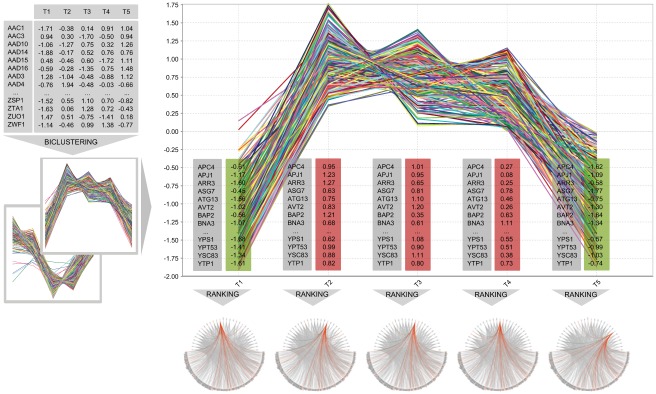
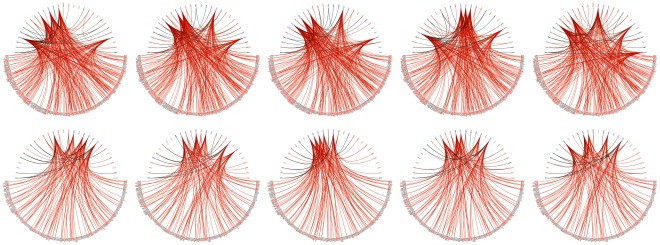
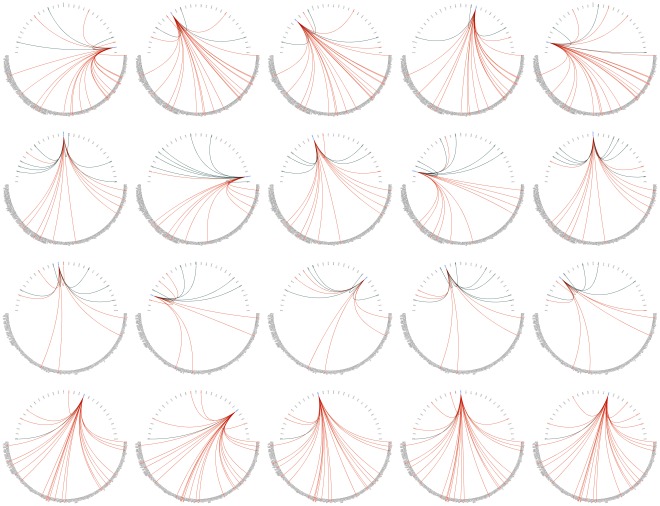
Explaining regulatory mechanisms is crucial to understand complex cellular responses leading to system perturbations. Some strategies reverse engineer regulatory interactions from experimental data, while others identify functional regulatory units (modules) under the assumption that biological systems yield a modular organization. Most modular studies focus on network structure and static properties, ignoring that gene regulation is largely driven by stimulus-response behavior. Expression time series are key to gain insight into dynamics, but have been insufficiently explored by current methods, which often (1) apply generic algorithms unsuited for expression analysis over time, due to inability to maintain the chronology of events or incorporate time dependency; (2) ignore local patterns, abundant in most interesting cases of transcriptional activity; (3) neglect physical binding or lack automatic association of regulators, focusing mainly on expression patterns; or (4) limit the discovery to a predefined number of modules. We propose Regulatory Snapshots, an integrative mining approach to identify regulatory modules over time by combining transcriptional control with response, while overcoming the above challenges. Temporal biclustering is first used to reveal transcriptional modules composed of genes showing coherent expression profiles over time. Personalized ranking is then applied to prioritize prominent regulators targeting the modules at each time point using a network of documented regulatory associations and the expression data. Custom graphics are finally depicted to expose the regulatory activity in a module at consecutive time points (snapshots). Regulatory Snapshots successfully unraveled modules underlying yeast response to heat shock and human epithelial-to-mesenchymal transition, based on regulations documented in the YEASTRACT and JASPAR databases, respectively, and available expression data. Regulatory players involved in functionally enriched processes related to these biological events were identified. Ranking scores further suggested ability to discern the primary role of a gene (target or regulator). Prototype is available at: http://kdbio.inesc-id.pt/software/regulatorysnapshots.
解释调控机制对于理解导致系统扰动的复杂细胞反应至关重要。一些策略从实验数据中反向工程调控相互作用,而另一些策略则假设生物系统具有模块化组织,从而识别功能调控单元(模块)。大多数模块化研究都集中在网络结构和静态特性上,而忽略了基因调控在很大程度上是由刺激-反应行为驱动的。表达时间序列是深入了解动态的关键,但目前的方法还没有充分探索,这些方法通常(1)应用不适合随时间进行表达分析的通用算法,因为它们无法保持事件的时间顺序或纳入时间依赖性;(2)忽略了在大多数转录活性的有趣情况下大量存在的局部模式;(3)忽视物理结合或缺乏对调节剂的自动关联,主要关注表达模式;或(4)将发现限制在预定义数量的模块内。我们提出了 Regulatory Snapshots,这是一种综合挖掘方法,可以通过将转录控制与反应相结合来随时间识别调控模块,同时克服上述挑战。首先使用时间性双聚类来揭示由随着时间呈现一致表达模式的基因组成的转录模块。然后使用有文档记录的调控关联网络和表达数据,为每个时间点的模块应用个性化排序,以优先考虑突出的调控因子。最后,通过绘制定制图形来暴露模块在连续时间点(快照)的调控活动。Regulatory Snapshots 成功地揭示了酵母对热休克和人类上皮-间充质转化响应的模块,分别基于 YEASTRACT 和 JASPAR 数据库中记录的调控以及可用的表达数据。确定了与这些生物学事件相关的功能丰富过程中涉及的调控参与者。排名分数进一步表明能够辨别基因的主要作用(靶标或调节剂)。原型可在:http://kdbio.inesc-id.pt/software/regulatorysnapshots 获得。