Department of Fibre and Polymer Technology, KTH Royal Institute of Technology, SE-100 44, Stockholm, Sweden.
ACS Appl Mater Interfaces. 2012 May;4(5):2788-93. doi: 10.1021/am300438k. Epub 2012 May 14.
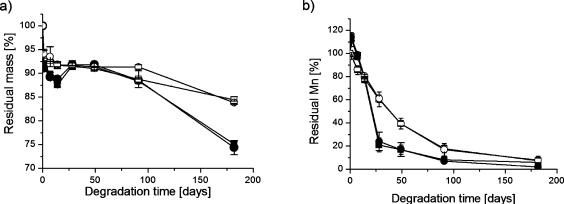
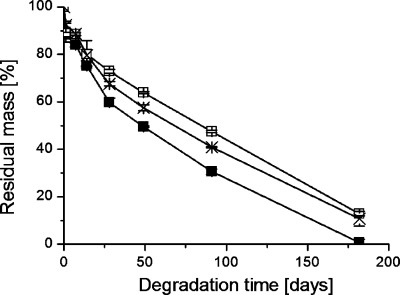
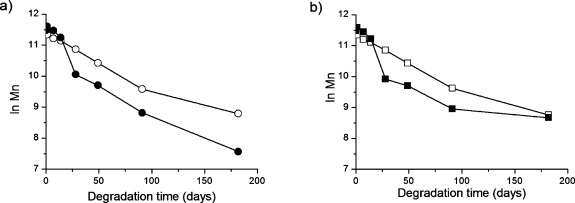
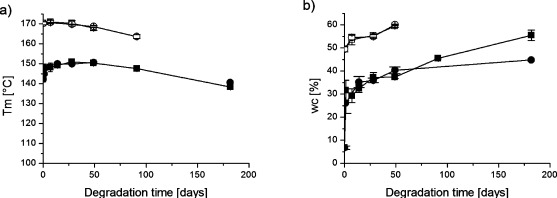
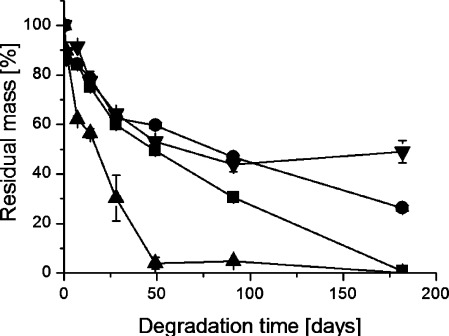
The rate of degradation of large-scale synthesized polylactide (PLA) of industrial origin was compared with that of laboratory-scale synthesized poly(L-lactide) (PLLA) of similar molar mass. The structural discrepancy between the two material types resulted in a significant difference in degradation rate. Although the hydrolysis of industrial PLA was substantially faster than that of PLLA, the PLA material became less brittle and fragmented to a lesser extent during degradation. In addition, a comprehensive picture of the degradation of industrial PLA was obtained by subjecting different PLA materials to hydrolytic degradation at various temperatures and pH's for up to 182 days. The surrounding environment had no effect on the degradation rate at physiological temperature, but the degradation was faster in water than in a phosphate buffer after prolonged degradation at temperatures above the T(g). The degree of crystallinity had a greater influence than the degradation environment on the rate of hydrolysis. For a future use of polylactide in applications where bulk plastics are generally used today, for example plastic packages, the appropriate PLA grade must be chosen based on the conditions prevailing in the degradation environment.
工业规模合成的聚乳酸(PLA)的降解速率与具有相似摩尔质量的实验室规模合成的聚 L-乳酸(PLLA)的降解速率进行了比较。两种材料类型的结构差异导致降解速率有显著差异。尽管工业 PLA 的水解速度明显快于 PLLA,但在降解过程中,PLA 材料的脆性和碎片程度降低的程度较小。此外,通过在不同温度和 pH 值下将不同的 PLA 材料进行水解降解长达 182 天,获得了工业 PLA 降解的全面情况。在生理温度下,周围环境对降解速率没有影响,但在 Tg 以上的温度下长时间降解后,在水中的降解速度比在磷酸盐缓冲液中快。结晶度对水解速率的影响大于降解环境。对于未来在今天广泛使用块状塑料的应用中使用聚乳酸,例如塑料包装,必须根据降解环境中的条件选择合适的 PLA 等级。